
Yellow scale
Aspidiotus transparens
Description
How to identify
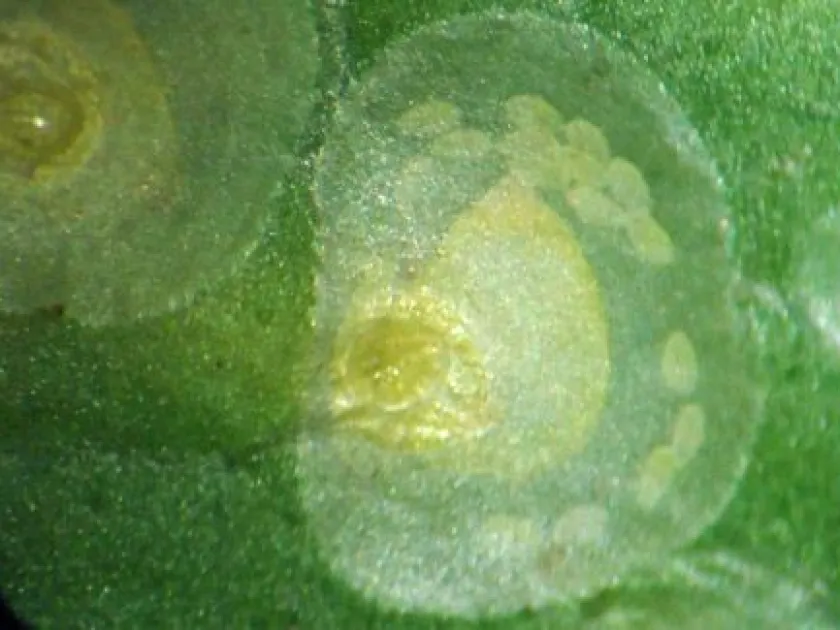
The yellow scale (Aspidiotus transparens) is a small insect belonging to the family Diaspididae, in the order Hemiptera. Adult females are characterized by a round, yellowish, or translucent scale cover that protects their soft body.
The females are sessile, meaning they lack eyes and legs, remaining attached to the host plant throughout their adult life. In contrast, males possess wings and functional legs, allowing them to travel in search of females for reproduction, although their lifespan is very brief.
The first instar larvae, often called "crawlers," are the only mobile stage. They have legs and are capable of migrating across the plant's surface, carried by wind or moving onto adjacent branches to establish new feeding sites.
The development cycle progresses through eggs, multiple larval instars, and adults. The protective scale is composed of wax secretions and shed larval exuviae, providing a strong barrier against harsh environmental conditions and many contact insecticides.
Species identification often requires microscopic examination of the female's pygidium. To the naked eye, the yellow scale is easily confused with other scale species, making professional identification important for large-scale agricultural management.
What it damages
This pest is a polyphagous insect that causes significant economic loss, particularly in citrus crops such as lemons, oranges, and mandarins. It also infests various subtropical plants, laurels, and many greenhouse ornamentals.
The insects insert their mouthparts into leaves, tender twigs, and fruit to extract plant sap. This feeding process drains the plant's vital nutrients, leading to physiological weakness and reduced resistance to environmental stress.
Heavy infestations typically result in chlorosis, leaf yellowing, and premature drop. Persistent damage to stems can cause dieback, while fruit infestation renders produce unmarketable and aesthetically damaged.
The accumulation of honeydew secreted by the scales facilitates the growth of sooty mold, a fungus that covers the plant in a black coating. This layer interferes with photosynthesis, further hindering the plant's recovery and overall health.
In greenhouses, the pest can quickly cover entire stems, leading to severe decline or death of the plant if left unchecked. Its high reproductive rate makes it a persistent challenge for plant health specialists.
When it appears
The yellow scale is a warm-climate pest, with its activity levels peaking during the spring and summer months. In tropical and subtropical climates, it can breed continuously throughout the year.
Optimal development occurs in temperatures ranging from 20°C to 28°C combined with high humidity. In greenhouse environments, generations often overlap, creating a constant presence of all life stages at any given time.
The crawler stage is most active during the warmest periods, making this the critical window for monitoring and management. Rapid dispersal can occur during these times if proper control measures are not initiated early.
During the winter, development slows down in temperate regions, but the scales continue to feed if the host plant is kept in a warm indoor environment. Consequently, the pest shows no significant dormant period in managed indoor collections.
The length of a single generation depends on the accumulated thermal units. In favorable conditions, multiple generations can occur annually, leading to exponential population growth and severe damage if the infestation is not intercepted.
Signs of infestation
Initial signs of infestation appear as small, yellowish or light-colored spots on leaves at the point of attachment. Over time, the affected foliage may show signs of deformation and loss of natural luster.
The presence of small, dense, convex scales on the underside of leaves or along leaf veins is a clear diagnostic sign. Removing a scale with a fingernail will reveal the soft insect underneath.
Sticky honeydew on the leaves and stems often attracts ants and supports the growth of sooty mold. This dark, velvety fungal growth is often the most visible indicator that the plant is suffering from a sucking pest attack.
Stunted growth of new shoots and premature leaf drop are common symptoms of severe infestation. As the plant loses vitality, it becomes more susceptible to secondary diseases and environmental pathogens.
Seeing scales on the fruit surface is an indication of a high-density population. At this stage, the fruit skin may appear uneven, and clusters of scales can merge to form continuous crusts, significantly reducing the crop's commercial value.
Control measures
Effective management requires a multi-faceted approach, as the scale cover protects the insect from most insecticides. Timing the applications to target the crawler stage is essential for successful eradication.
- Regular monitoring of plant surfaces and underside of leaves.
- Mechanical removal using a soft brush and soapy water for light infestations.
- Application of systemic insecticides that are absorbed into the plant sap.
- Use of horticultural oils to smother the insects by blocking their breathing pores.
- Strict quarantine procedures for new plants to prevent cross-infestation.
Chemical control must involve rotating different insecticide classes to prevent the development of resistance. Because the life stages are asynchronous, repeated treatments are necessary to ensure all generations are managed effectively.
Biological control involves the introduction of natural enemies, such as ladybird beetles or parasitic wasps. This method is highly effective in greenhouse environments where chemicals might be restricted or undesirable.
Agricultural practices such as proper irrigation and fertilization enhance the plant's natural defense systems. Pruning and disposing of heavily infested branches is a necessary step to reduce the overall pest load on the crop.
Discussion
No discussions yet — be the first.