
Reed Wainscot
Archanara
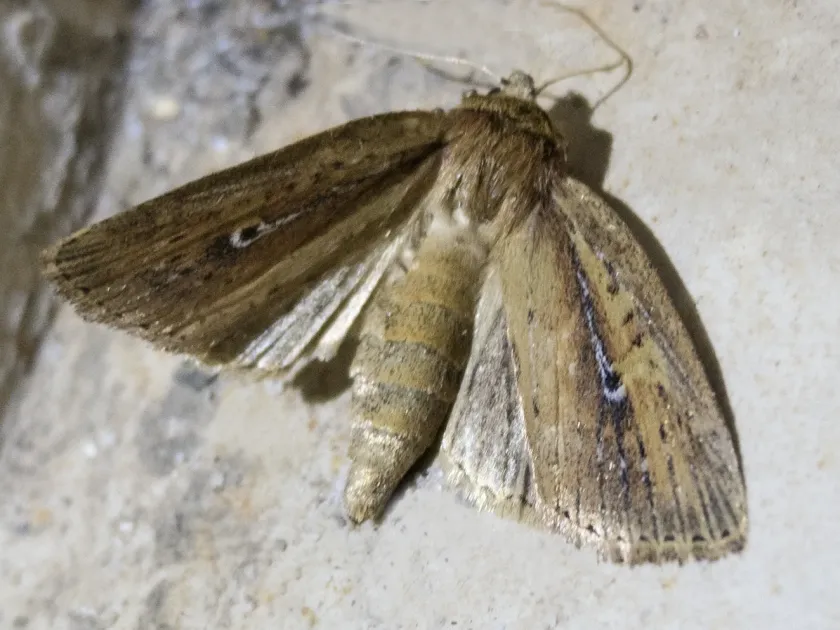
Description
How to identify
The Reed Wainscot (Archanara) belongs to the Noctuidae family within the order Lepidoptera. Adult moths are medium-sized, with a wingspan ranging between 30 and 40 mm.
The forewings exhibit an ocher, yellowish-brown, or dull brown coloration, often decorated with delicate cross-lines that resemble the appearance of dry grass stems.
The hindwings are typically lighter in color and lack the intricate patterns found on the forewings, providing a plain appearance when the insect is at rest.
Larvae are cylindrical and can grow up to 45 mm in length. Their coloration ranges from grayish to brownish with longitudinal dark stripes, helping them blend into host plants.
The larvae possess a hardened, brown head capsule, which is structurally adapted for boring into the tough, fibrous stems of aquatic and semi-aquatic plants.
What it damages
The primary hosts for this pest include various species of grasses (Poaceae), most notably common reed (Phragmites) and various types of sedges found in wetlands.
In agricultural settings, the Reed Wainscot can migrate to cultivated cereal crops such as maize, millet, and oats, especially if these fields are located near water sources.
The larvae act as internal stem borers, feeding on the soft core and vascular tissues inside the stem, which effectively disrupts the plant's ability to transport nutrients.
This internal damage causes the plant to weaken significantly, leading to stunted growth, reduced photosynthetic efficiency, and often the death of the main shoot.
In severe infestations, the yield loss can be substantial, as the crop fails to develop healthy reproductive organs, resulting in empty or undersized ears/panicles.
When it appears
The overwintering stage of the Reed Wainscot is primarily the egg, which is laid by females on the dry stems of host plants during late summer or early autumn.
Egg hatching typically occurs in the spring, coinciding with the beginning of the growing season when young succulent shoots become available for the emerging larvae.
Feeding activity is most intense from late spring through early summer, as the larvae grow rapidly while hidden safely inside the plant stems.
Pupation takes place within the stem gallery during the mid-summer months, providing the pupa with a protected environment until the adult moth emerges.
Adult flight occurs from late July to August, at which point the cycle restarts as females search for suitable vegetation to deposit their eggs for the next generation.
Signs of infestation
The most prominent sign of infestation is the yellowing and wilting of the central leaf (the "dead heart" symptom), which stands out against the green crop canopy.
Close inspection of the stem base often reveals small entry holes bored by the larvae, sometimes accompanied by frass (larval excrement) around the opening.
Stems damaged by the larvae become structurally unstable and may snap or lodge easily under moderate wind pressure due to the hollowed-out internal structure.
Affected plants frequently show significant growth retardation, and in the case of grain crops, the development of the ear is often incomplete or entirely aborted.
Splitting the stem vertically often reveals the presence of the larva or the evidence of its tunneling activity, characterized by dark, chewed-up plant debris.
Control measures
The primary management strategy involves eliminating wild grasses and reeds from field margins and drainage ditches, which serve as natural breeding grounds for the pest.
Deep autumn plowing is a recommended cultural practice, as it helps bury plant debris and destroys eggs, thereby reducing the overwintering population for the next season.
Chemical control with systemic insecticides may be applied if infestation thresholds are reached, targeting the early stages of larval development before they bore deep into the stems.
- Monitoring adult populations using light or pheromone traps to time interventions.
- Selecting resistant crop varieties or adjusting planting dates to avoid peak larval activity.
- Biological control through the use of entomopathogenic fungi or natural predatory insects.
Good field hygiene and regular monitoring during the early vegetative stages are crucial for preventing large-scale migration of larvae into the cultivated crop areas.
Taxonomy
- Latin name
- Archanara
- Order
- Lepidoptera (butterflies)
- Family
- Noctuidae
- EPPO code
- ARKASP
Discussion
No discussions yet — be the first.