
Aprostocetus hagenowii
Aprostocetus hagenowii
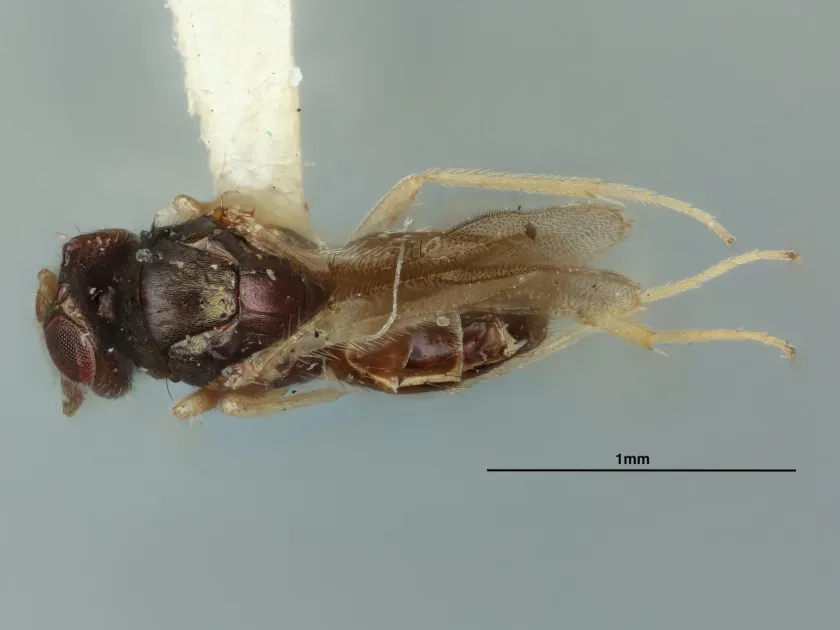
Description
How to identify
Aprostocetus hagenowii is a minute parasitic wasp belonging to the family Eulophidae, within the superfamily Chalcidoidea.
These wasps are typically 1 to 2 millimeters long, characterized by a slender body that often exhibits a dark, metallic luster.
The females are equipped with a specialized ovipositor designed to penetrate the tough, leathery walls of cockroach egg cases, known as oothecae.
Despite their small size, they are highly specialized hunters that play a specific ecological role in controlling pest populations of cockroaches.
Identification often requires a dissecting microscope because distinguishing them from other small chalcid wasps in the field is challenging for non-specialists.
What it damages
Aprostocetus hagenowii does not cause any direct damage to agricultural crops, ornamental plants, or stored agricultural produce.
They are strictly parasitoids of cockroach eggs, meaning their "damage" is exclusively restricted to the egg cases of cockroach pests.
In agricultural settings, their presence is usually interpreted as an indicator of a pre-existing cockroach infestation, which may be of concern for food safety.
Therefore, they are essentially biological control agents rather than pests, and they do not feed on plant tissues or damage crop yields.
No agricultural economic threshold has been established for this species, as it does not negatively impact the health or productivity of any cultivated flora.
When it appears
The seasonal activity of Aprostocetus hagenowii is entirely dependent on the presence of its hosts and the ambient temperature of the environment.
In greenhouses, warehouses, and domestic buildings, the wasp can reproduce continuously throughout the year if temperatures remain suitable.
Warm conditions, typically between 25 and 30 degrees Celsius, facilitate the rapid development of larvae and the emergence of adults.
Their activity levels are intrinsically linked to the reproductive cycles of cockroaches, increasing when fresh oothecae are available in the habitat.
In cooler climates or unheated structures, their development slows down significantly, and the wasps may enter a state of dormancy during winter months.
Signs of infestation
The most reliable sign of Aprostocetus hagenowii presence is the discovery of cockroach oothecae that contain tiny, circular exit holes.
When the adult wasp completes its development inside the cockroach egg case, it chews a hole through the shell to emerge, leaving a clear diagnostic mark.
These exit holes are generally much smaller and more uniform than the damage caused by other environmental factors or opportunistic insects.
Observing adult wasps actively crawling or flying in areas where cockroach populations are high is another common sign of their presence.
The absence of nymphs emerging from an ootheca, combined with these exit holes, confirms that the egg case has been successfully parasitized.
Control measures
As this species is a natural enemy of cockroaches, there is no need for dedicated chemical control measures to eliminate it from an agricultural area.
Standard pest control programs directed at managing cockroach infestations will naturally result in the reduction of Aprostocetus hagenowii populations.
Practicing good sanitation, such as removing organic waste and sealing potential hiding spots for cockroaches, remains the most effective management strategy.
Integrated Pest Management (IPM) practitioners often value the presence of these wasps as they provide a free, natural form of biological regulation.
If chemical interventions are necessary to control a cockroach outbreak, standard insecticides used in agriculture will be effective against the wasp as well.
Taxonomy
- Latin name
- Aprostocetus hagenowii
- Order
- Hymenoptera
- Family
- Eulophidae
- EPPO code
- APRSHA
Discussion
No discussions yet — be the first.