
Apatania
Apatania
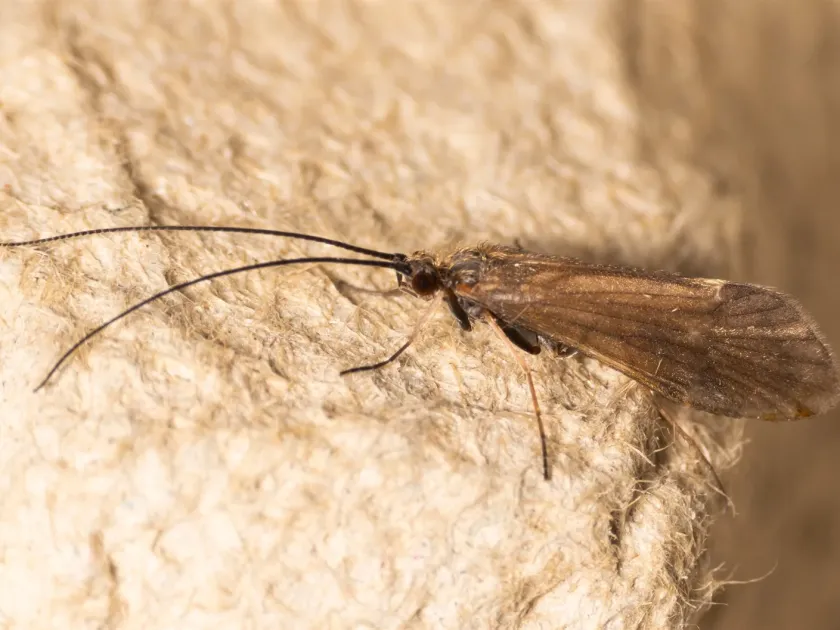
Description
How to identify
The genus Apatania belongs to the order Trichoptera (caddisflies) and the family Apataniidae. Adult specimens are small, moth-like insects with wings covered in dense hairs, which are held tent-like over the body at rest.
The larvae are predominantly aquatic, inhabiting clear-water streams, rivers, and lakes. They are characterized by their ability to construct portable protective cases made of fine sand grains or plant fragments, which they carry throughout their larval development.
Identifying the adults is difficult due to their secretive nature and morphological similarities to other caddisfly species. Precise identification usually requires microscopic analysis of the genitalia performed by an entomologist.
The body coloration of adults is typically dark, ranging from grey to brown, providing effective camouflage on tree bark or stones near water bodies where they spend much of their time.
The life cycle involves complete metamorphosis, consisting of four stages: egg, larva, pupa, and adult, with each stage adapted to specific environmental conditions.
What it damages
Direct damage to agricultural crops by Apatania is relatively uncommon unless fields are located in close proximity to irrigation canals or natural water bodies. In such cases, larvae can affect hydrophilic plants.
Damage manifests as feeding on the epidermis or tissues of stems and leaves submerged in water. This feeding activity weakens young seedlings and creates entry points for secondary fungal and bacterial infections.
In ornamental water plant nurseries, the presence of these larvae can cause significant aesthetic and growth damage, leading to stunted plants and reduced commercial value.
Hydroponic systems are particularly vulnerable if untreated water from open sources is used, as larvae can enter the system and attack the root structures of the plants being grown.
The economic impact is generally correlated with the proximity of production areas to natural habitats, where high population densities of these insects can occur.
When it appears
Adult activity is primarily concentrated in the spring and summer months, which is the period when swarming and mating occur, followed by egg-laying in aquatic habitats.
Larvae remain active throughout most of the year, but their most intensive feeding occurs during the warmer season, coinciding with the rapid growth of algae and other organic matter in water bodies.
The peak of damage to young crops near canals usually occurs in early spring, when water temperatures begin to rise and plants enter their most vulnerable vegetative growth stages.
Overwintering occurs in the form of larvae within bottom sediments or silt, where they are protected from low temperatures and do not pose a threat to agricultural fields.
The speed of each generation's development is strictly dependent on water temperature; higher temperatures significantly accelerate the metamorphosis process.
Signs of infestation
The most reliable sign of Apatania presence is the observation of their characteristic portable cases attached to submerged plant stems or stones in irrigation water.
- Evidence of tissue feeding on the lower stems of plants near water edges.
- Presence of empty pupal exuviae on shoreline vegetation after adult emergence.
- Stunted growth of seedlings in fields using open water for irrigation.
- High concentrations of adult insects near lights located close to water bodies at dusk.
Regular visual inspections of irrigation channels are essential for early detection, as larvae can be spotted by their distinctive movement and case construction.
Monitoring the condition of the root zone for water-grown plants is crucial, as this is where larvae tend to congregate to feed during the early stages of plant development.
Control measures
The primary control measure is the implementation of efficient mechanical filtration for water sourced from open bodies, which effectively removes larvae and eggs.
Regular maintenance of irrigation canals, including the removal of excessive aquatic vegetation and siltation, significantly reduces the habitat and food sources for Apatania larvae.
Biological control, utilizing natural predators of aquatic insects within closed systems, can be an effective way to manage population numbers without harmful chemicals.
The use of chemical insecticides should be approached with extreme caution, as the high toxicity to non-target aquatic organisms, including fish, usually prohibits their use in water supply systems.
Implementing effective field drainage and managing soil moisture levels can reduce the attractiveness of production areas to these moisture-dependent insects.
Taxonomy
- Latin name
- Apatania
- Family
- Apataniidae
- EPPO code
- AQTNSP
Discussion
No discussions yet — be the first.