
Double Lobed
Apamea ophiogramma
Description
How to identify
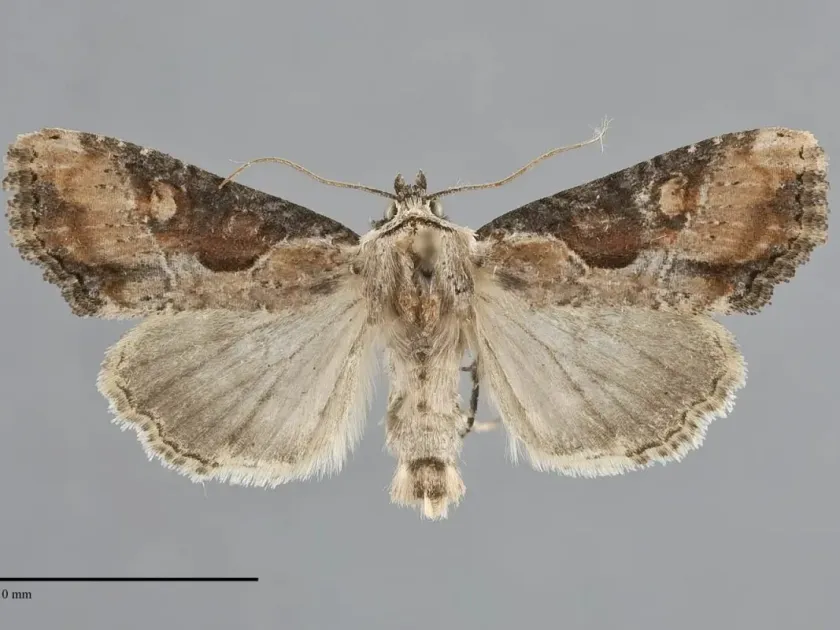
The Double Lobed (Apamea ophiogramma) is a moth species belonging to the Noctuidae family within the order Lepidoptera.
The moth has a wingspan of approximately 30–35 mm, with forewings marked by a distinct, dark, snake-like pattern, which gives the species its common and scientific names.
The larvae are typically greyish-green or brownish-yellow, featuring a lighter dorsal line and dark spots along the sides of the body.
The head is hard, shiny, and dark-brown, and the body is sparsely covered with short hairs that can be seen upon close inspection.
The pupae are reddish-brown and are typically found within the soil or near the roots of host plants, where they undergo diapause during the winter.
What it damages
The larvae primarily feed on various grass species, including wheat, barley, and oats, as well as wetland plants like reed canary grass.
Damage is caused by the caterpillars boring into the stems of the plants, which disrupts the vascular system and prevents nutrients from reaching the ear.
This results in stunted plant growth and often leads to the death of the main shoot, causing a yield reduction in infested agricultural fields.
In addition to direct feeding, the entry holes created by the larvae serve as infection points for bacteria and secondary fungal diseases.
Severe infestations can lead to significant economic losses, especially when agricultural fields are adjacent to ditch banks or moist, grassy areas.
When it appears
The adult moths are active during the summer, typically flying from June through August, when they mate and lay eggs.
Upon hatching, the young larvae immediately seek out suitable host plants and begin boring into the stem to feed and protect themselves.
The species completes one generation per year, with the larvae continuing their development through the summer and into the early autumn.
Wintering occurs in the larval stage, either in the soil or protected within the bases of old stems, providing a high survival rate through the cold months.
Activity resumes in the spring as temperatures rise, leading to further feeding before the larvae pupate in the late spring or early summer.
Signs of infestation
A key sign of an infestation is the yellowing and wilting of the central leaf of the plant, often referred to as the 'dead heart' symptom.
- Small entry holes located at the base of the plant stem.
- Frass (larval waste) accumulating at the base of the stem or in leaf sheaths.
- Premature drying of the grain ear, which appears hollow or poorly filled.
- The presence of larvae within the stem when cut open lengthwise.
The overall crop canopy may appear uneven, with patches of withered plants indicating the focal point of the pest infestation.
In the evenings, adult moths may be attracted to light sources, which can indicate the presence of the population in the vicinity.
Control measures
Effective management begins with strict weed control, especially the removal of perennial grasses that act as alternative hosts for the moth.
Deep plowing in the autumn is a crucial cultural practice that destroys the wintering sites and exposes larvae to predators and environmental stress.
Crop rotation helps minimize the risk by ensuring that the field is not continuously occupied by the same host grasses that the larvae depend on.
Chemical control with insecticides is recommended only when monitoring confirms that population levels exceed established economic thresholds.
Monitoring using pheromone traps or light traps provides essential data to time any necessary insecticide applications for maximum efficiency.
Taxonomy
- Latin name
- Apamea ophiogramma
- Order
- Lepidoptera (butterflies)
- Family
- Noctuidae
- EPPO code
- PARIOP
Discussion
No discussions yet — be the first.