
Scarce Brindle
Apamea lateritia
Description
How to identify
The Scarce Brindle (Apamea lateritia) is a moth species belonging to the Noctuidae family, known for its impact on various cereal crops.
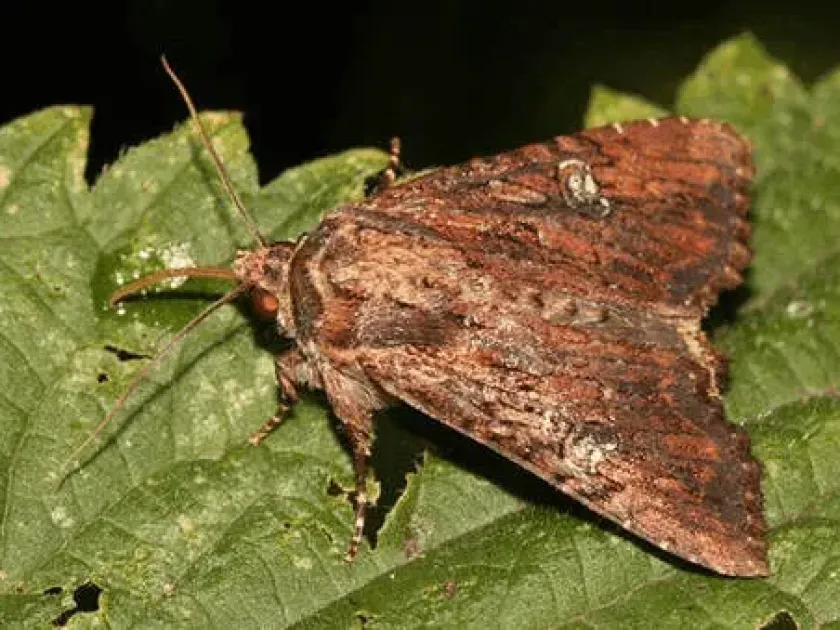
The adult moth has a wingspan of 40-50 mm, featuring distinctive brick-red or reddish-brown forewings adorned with dark, irregular markings.
The larvae are stout, measuring up to 5 cm in length, with a body color that ranges from greyish to yellowish-brown, marked with a dark dorsal stripe.
The head capsule of the larva is well-defined and sclerotized, adapted for chewing through the tough fibrous stems of grasses and cereal crops.
Pupation occurs within the soil, where the pupa resides in a specially constructed earthen cell, providing protection against environmental fluctuations.
What it damages
The Scarce Brindle is primarily a pest of cereal crops, including winter wheat, rye, and barley, which are highly susceptible to larval feeding.
The larvae are nocturnal feeders, inflicting significant damage by severing the stems of young plants at or just below the soil surface.
Beyond cultivated fields, the pest can utilize wild grasses as hosts, allowing the population to persist even in the absence of primary cereal crops.
Feeding results in the yellowing and wilting of affected plants, often leading to total loss of the stem and localized thinning of the crop stand.
High infestation levels can lead to significant economic losses, as the destruction of primary tillers reduces the overall density and yield potential.
When it appears
Adult moths are typically active from early summer through August, with peak emergence observed in mid-summer across many regions.
Females deposit their eggs in small batches on or near the soil surface, ensuring that emerging larvae have immediate access to their host plants.
The larvae undergo several developmental stages throughout the summer and autumn, actively feeding as they grow and mature before winter.
Overwintering occurs in the larval stage deep within the soil, with feeding resuming once soil temperatures rise in early spring.
The life cycle concludes with pupation during the spring months, leading to the emergence of the next generation of adults.
Signs of infestation
Early symptoms of infestation include the sudden wilting of central leaves in individual plants, which may initially be mistaken for drought stress.
Close examination of the base of damaged plants usually reveals severed stems with characteristic jagged edges caused by the larvae's mandibles.
The presence of fine, dark granular frass in the soil surrounding the base of the plant is a definitive indicator of larval feeding activity.
In spring, patchiness in the crop field, characterized by thinning or uneven growth, often suggests previous larval activity at the root level.
Nocturnal visual monitoring or the use of light traps can confirm the presence of adult moths and provide a baseline for pest management decisions.
Control measures
Effective management begins with proper crop rotation, which breaks the pest's life cycle by eliminating its preferred host plants on a regular basis.
Deep autumn tillage is a highly recommended practice, as it disrupts the overwintering pupae and larvae, exposing them to predators and desiccation.
- Maintain clean field borders by controlling wild grasses and weeds.
- Apply insecticides only when thresholds for damage are clearly exceeded.
- Utilize biological control agents, such as nematodes or fungal pathogens.
Field scouting should be prioritized during the seedling stage to detect larvae early before significant damage occurs across the field.
Monitoring adult populations with pheromone or light traps allows for precise timing of interventions, maximizing the efficacy of protective measures.
Taxonomy
- Latin name
- Apamea lateritia
- Order
- Lepidoptera (butterflies)
- Family
- Noctuidae
- EPPO code
- PARILA
Discussion
No discussions yet — be the first.