
Bordered Rustic
Apamea finitima
Description
How to identify
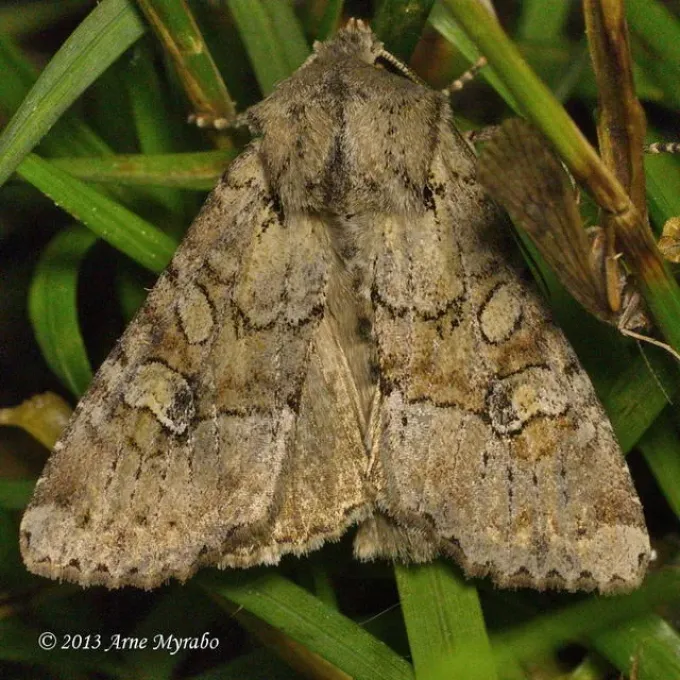
The Bordered Rustic (Apamea finitima) is a moth belonging to the Noctuidae family, order Lepidoptera. Adult moths typically have a wingspan ranging from 35 to 40 mm.
The forewings feature a distinctive ochre-brown pattern with darker markings and lighter edges, providing excellent camouflage against vegetation. The hindwings are usually a lighter, grayish-brown color.
The larvae, or caterpillars, are stout and reach lengths of up to 40 mm. Their coloration typically blends with the soil or the base of plants, making them difficult to spot during daytime.
The species follows a complete metamorphosis life cycle: egg, larva, pupa, and adult. Adults are nocturnal, active during the summer months when they lay eggs on host plants.
Hibernation usually occurs in the larval stage, with caterpillars remaining in the soil or under surface debris until the following spring.
What it damages
The larvae of this species primarily feed on various cereal crops, including wheat, barley, rye, and oats. They are often found in fields adjacent to grassy areas.
Caterpillars feed mainly at night, consuming leaf tissue and stems. They can cause significant foliage loss, which directly impacts the plant's ability to photosynthesize.
In the spring, larvae may feed on the base of young stalks, potentially severing them and causing the death of young seedlings in the early development phase.
High infestation levels lead to reduced stand density, poor crop development, and substantial yield loss, especially in years with favorable weather for the species.
The damage often creates entry points for secondary plant diseases, further weakening the crop and reducing grain quality.
Signs of infestation
The most visible signs are ragged edges on leaves and irregular holes in the leaf blades caused by night-time feeding activity.
Finding larval frass (excrement) on the soil surface at the base of the plants is a clear indicator of the presence of actively feeding caterpillars.
Wilting plants in the spring, which may be easily pulled from the ground due to damage at the root crown, are a classic sign of late-instar larval feeding.
Soil excavations around the base of the affected plants often reveal the hidden larvae during the day.
Patches of thinned or dead seedlings in a field during the early vegetative stage often point to an established population of this pest.
Control measures
Deep plowing in the autumn is the most effective agronomic practice to disturb overwintering sites and expose larvae to predation or freezing temperatures.
Maintaining crop rotation and keeping field margins free of weeds is crucial, as wild grasses often serve as a secondary food source for the larvae.
When the economic threshold is reached, the application of registered insecticides is recommended to prevent significant economic damage to the harvest.
Monitoring using light or pheromone traps helps to track moth populations and determine the precise timing for control efforts.
Biological control, using Bacillus thuringiensis or specific entomopathogenic fungi, can be a sustainable alternative to chemical interventions.
Taxonomy
- Latin name
- Apamea finitima
- Order
- Lepidoptera (butterflies)
- Family
- Noctuidae
- EPPO code
- TRAEFI
Discussion
No discussions yet — be the first.