
Glassy cutworm
Apamea devastator
Description
How to identify
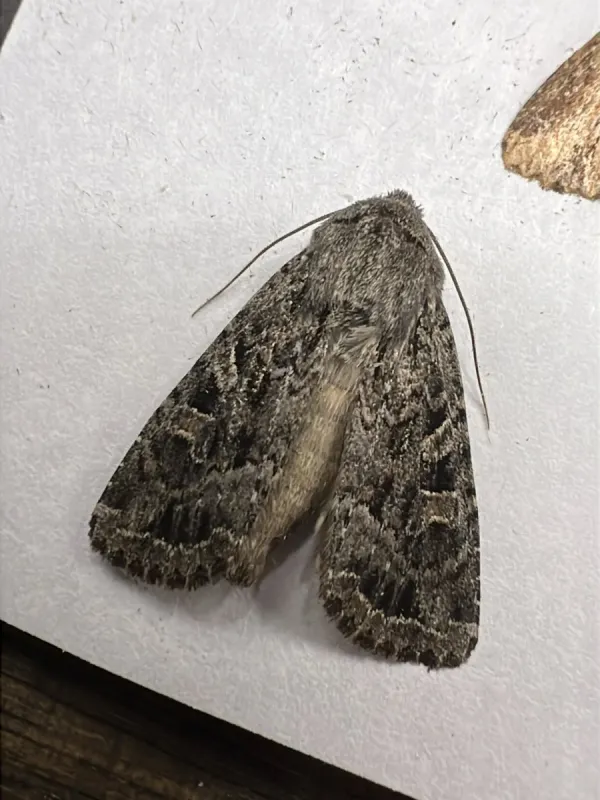
The glassy cutworm (Apamea devastator) is a member of the Noctuidae family within the order Lepidoptera. The adult moth has a wingspan of approximately 35 to 45 mm.
The forewings feature a cryptic coloration, ranging from grayish to dark brown, marked with intricate wavy lines and darker spots that provide excellent camouflage.
The larvae, known as cutworms, are the primary damaging stage. They appear translucent, with a dirty-white to grayish body, a dark-brown head, and a smooth texture.
Pupation occurs in the soil within a small earthen cell. The pupae are typically reddish-brown, marking the transition phase before the emergence of the adult moth.
This species is univoltine, meaning it completes one generation per year, with larvae overwintering in the soil to endure cold winter temperatures.
What it damages
This pest is a polyphagous insect that primarily targets cereals, including wheat, barley, and rye. It can also cause significant damage to young corn seedlings.
The larvae feed on the roots and the base of the stems, causing the plant to wilt and eventually die. This feeding behavior often occurs just below the soil surface.
Heavy infestations can lead to substantial stand loss, resulting in sparse or patchy fields that frequently require reseeding to maintain yields.
Although they prefer cereals, the larvae may feed on various grasses and sometimes vegetable crops if they are established in proximity to infested cereal fields.
Their ability to move through the soil profile allows them to progress from one plant to another, potentially clearing large sections of a field quite rapidly.
When it appears
Adult moths are active during the summer months, typically from June through August, when mating and egg-laying occur in fields.
Females deposit their eggs near the base of host plants or directly onto the soil surface, especially in areas with significant weed cover.
Larvae hatch in late summer and fall, feeding moderately before they enter the soil for hibernation as they reach their second or third larval instar.
In the spring, as soil temperatures rise, the overwintered larvae resume active feeding on emerging seedlings, which coincides with the most critical period for crops.
By late spring or early summer, the larvae finish their development and pupate in the soil, preparing for the next cycle of moth emergence.
Signs of infestation
A primary indicator of infestation is the sudden wilting of individual seedlings within a row, often occurring without any obvious signs of disease.
By carefully digging around the base of the damaged plant, one may discover eaten-out portions of the stem or entirely severed roots.
Finding the translucent, grayish larvae curled into a C-shape in the soil near damaged plants is a definitive sign of glassy cutworm activity.
Fields showing irregular, increasing patches of thin, dead, or stunted plants are typical markers of a larval population moving through the soil.
The presence of adult moths near outdoor light sources during the summer can serve as an early warning to monitor fields for potential larval populations.
Control measures
Effective management begins with deep tillage in the fall, which exposes overwintering larvae to predators and harsh weather conditions.
Maintaining clean fields by eliminating weeds before and after planting removes essential egg-laying sites and food sources for early-stage larvae.
Crop rotation with non-host plants is an effective strategy to break the life cycle of the insect and reduce population buildup over several seasons.
When economic thresholds are reached, contact or systemic insecticides can be applied to the soil or as a rescue treatment to minimize further stand loss.
Monitoring using pheromone traps allows growers to detect peak flight activity, helping to time scouting efforts and potential interventions more effectively.
Taxonomy
- Latin name
- Apamea devastator
- Order
- Lepidoptera (butterflies)
- Family
- Noctuidae
- EPPO code
- APAMDE
Discussion
No discussions yet — be the first.