
Rustic Shoulder-knot
Apamea anceps
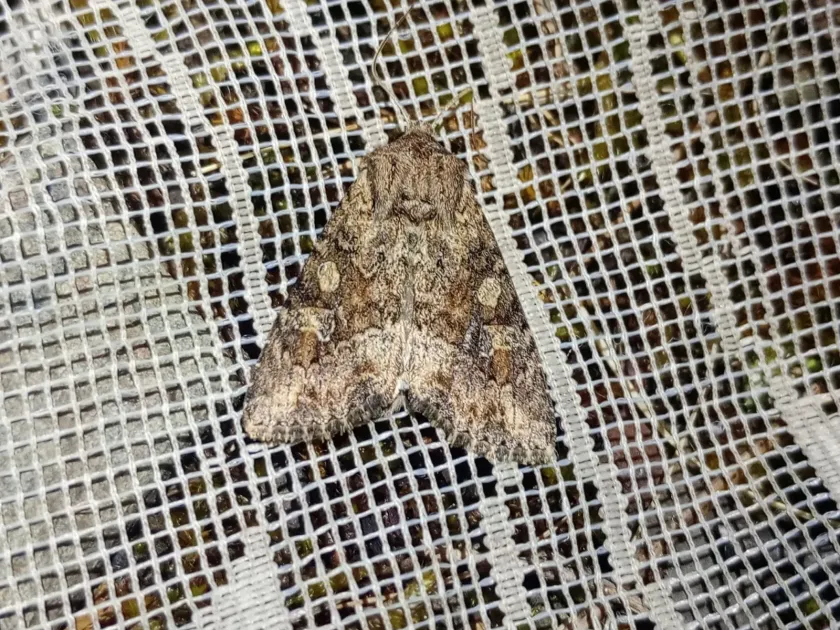
Description
How to identify
The Rustic Shoulder-knot (Apamea anceps) is a moth belonging to the family Noctuidae. The adult moth has a wingspan of approximately 35–40 mm, with greyish-brown forewings featuring characteristic markings that provide excellent camouflage on tree bark or soil.
The larvae, or caterpillars, reach a length of up to 35 mm. They typically exhibit a brown or greyish coloration with longitudinal stripes. The head capsule is dark brown, distinguishing them from other similar moth species found in agricultural fields.
The eggs are small and hemispherical, usually deposited on the underside of leaves. They are laid in small groups, and their color darkens as the embryo develops prior to hatching.
Pupation occurs in the soil, usually at a depth of 5 to 10 cm. The pupae are reddish-brown, smooth, and remain in the soil until the emergence of the adult moths in late spring.
The biological development is heavily dependent on environmental conditions, with optimal moisture and moderate temperatures significantly boosting the survival rate of the population.
What it damages
This pest primarily attacks cereal crops, including wheat, rye, and barley. It can also infest various wild grasses, which often serve as an alternative food source for the larvae.
The larvae cause direct damage by feeding on the internal tissues of the stems. In early spring, they attack the growing point of young plants, leading to the yellowing and death of the central leaf.
Infested crops exhibit reduced growth, irregular stand density, and often total plant loss if the infestation is severe. The destruction of the tillering process is a common outcome.
During the heading phase, larvae may feed on the developing grains within the ear, which directly impacts yield quantity and significantly degrades the quality of the harvested grain.
The damage is typically patch-like, as the female moths often lay their eggs in clusters, leading to localized areas of high larval density within the field.
When it appears
Adult moths are typically active from late May through June. They are nocturnal and are strongly attracted to artificial lights, which is a key factor in their monitoring.
After mating, the females lay eggs. The resulting larvae feed throughout the summer and transition into the later larval stages, which are the most destructive phase of their life cycle.
Overwintering takes place in the larval stage. Caterpillars hide inside the stems of host plants or within the upper layer of the soil to survive the cold winter months.
When temperatures rise above 8–10 degrees Celsius in the spring, the overwintered larvae become active and start feeding on the tillering stage of winter crops.
Pupation occurs in the spring, marking the transition to the next generation of adults and completing the annual developmental cycle of the insect.
Signs of infestation
A classic sign of infestation is the appearance of wilted or dead central leaves in young wheat or barley plants, often referred to as "dead hearts."
Closer examination reveals entry holes in the stem bases, often surrounded by small piles of frass, which are visible indicators of larval activity inside the plant.
Patches of sparse or stunted growth within a field are indicative of the pest's presence, especially in early spring when the larvae are moving between host plants.
The presence of adult moths during the evening hours can be confirmed using light traps, helping agronomists assess the potential pressure for the next season.
Physically splitting the stems of suspicious-looking plants usually confirms the presence of the larva, distinguishing this pest from fungal diseases or nutrient deficiencies.
Control measures
Effective control starts with crop rotation, which minimizes the buildup of pest populations in fields where susceptible cereal crops are grown consecutively.
Deep autumn plowing is a highly recommended practice, as it disrupts the larval overwintering sites in the soil and increases their exposure to natural enemies and harsh weather.
Effective weed management is essential, particularly targeting grassy weeds that host the larvae during the fallow periods between crop seasons.
Chemical control using insecticides is justified when the population density exceeds established economic thresholds, typically applied at the onset of mass larval hatching.
- Utilizing pheromone or light traps for accurate population monitoring.
- Ensuring optimal seedbed preparation to promote rapid early-stage crop development.
- Applying biological pesticides as a sustainable alternative during the early larval growth stages.
Taxonomy
- Latin name
- Apamea anceps
- Order
- Lepidoptera (butterflies)
- Family
- Noctuidae
- EPPO code
- PARISO
Discussion
No discussions yet — be the first.