
Yellow-headed cutworm
Apamea amputatrix
Description
How to identify
The Yellow-headed cutworm (Apamea amputatrix) is a moth belonging to the family Noctuidae, known for its destructive larvae in agricultural settings.
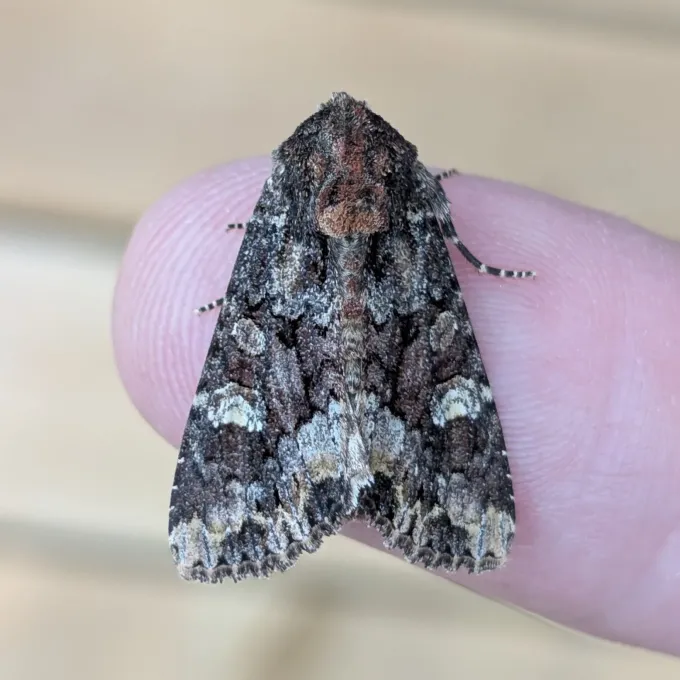
The adult moth has a wingspan of approximately 35–45 mm, with forewings featuring a dark brown pattern and a distinct yellow or ochre-colored apical spot.
The larvae, or cutworms, are typically plump and cylindrical, with a smooth skin that ranges in color from dull grey to brownish-grey.
A key diagnostic feature of the larvae is their shiny, dark brown or black head capsule, which remains visible as they feed on plant bases.
These insects are primarily nocturnal, which often leads to the underestimation of their population density during daytime scouting.
What it damages
This pest is a generalist feeder, capable of causing significant economic losses across a wide range of monocot and dicot crops.
Field crops such as corn, wheat, barley, and oats are highly susceptible, as are various vegetable crops like potatoes and brassicas.
The larvae cause damage by feeding on seeds, roots, and the lower stems of seedlings, often severing the plant at or just below the soil surface.
Weed infestation in fields, particularly grass weeds like quackgrass, acts as a primary host and refuge for the larvae before they move to crops.
Severe infestations can result in stand thinning, leading to reduced plant density and necessitating costly reseeding efforts.
When it appears
The Yellow-headed cutworm typically completes one generation per year, with life cycle timing adapted to temperate climatic zones.
Winter is passed as a partially grown larva in the soil, protected from deep frost within the soil profile or under heavy crop residues.
In the spring, larvae emerge to feed on developing root systems and seedling stems as temperatures begin to rise and soil moisture increases.
Adult moths are typically active in mid-summer, during which they mate and lay eggs on suitable host plants or directly onto the soil surface.
The resulting larvae grow throughout the summer and fall, reaching a stage of development suitable for overwintering by late autumn.
Signs of infestation
A primary indicator of presence is the sudden wilting or lodging of plants that appear otherwise healthy during the early vegetative stage.
When inspecting the base of the plant, farmers will often find the stem chewed through or missing, accompanied by small holes in the root system.
The presence of frass (larval excrement) near the base of the plant or in the soil around the seedling is a tell-tale sign of active feeding.
In high-density areas, entire patches of the crop may die off, creating distinct gaps in the field that are easy to spot during scouting.
During the night, using a flashlight in infested fields often reveals larvae on the soil surface, confirming their active feeding behavior.
Control measures
Cultural control via tillage, such as fall plowing, can significantly reduce overwintering larval populations by exposing them to predators and freezing.
Effective weed management, specifically targeting grasses, removes the alternative food sources that keep the pest population alive in the field.
Seed treatments with systemic insecticides provide essential early-season protection, preventing larvae from feeding on vulnerable germinating seeds.
Biological control agents, including specialized nematodes or microbial products, can be applied to infested soil to suppress larval numbers.
Regular scouting and monitoring using pheromone traps help determine the timing of adult emergence, allowing for precise and timely intervention.
Taxonomy
- Latin name
- Apamea amputatrix
- Order
- Lepidoptera (butterflies)
- Family
- Noctuidae
- EPPO code
- APAMAM
Discussion
No discussions yet — be the first.