
Japanese citrus longhorned beetle
Anoplophora malasiaca
Description
How to identify
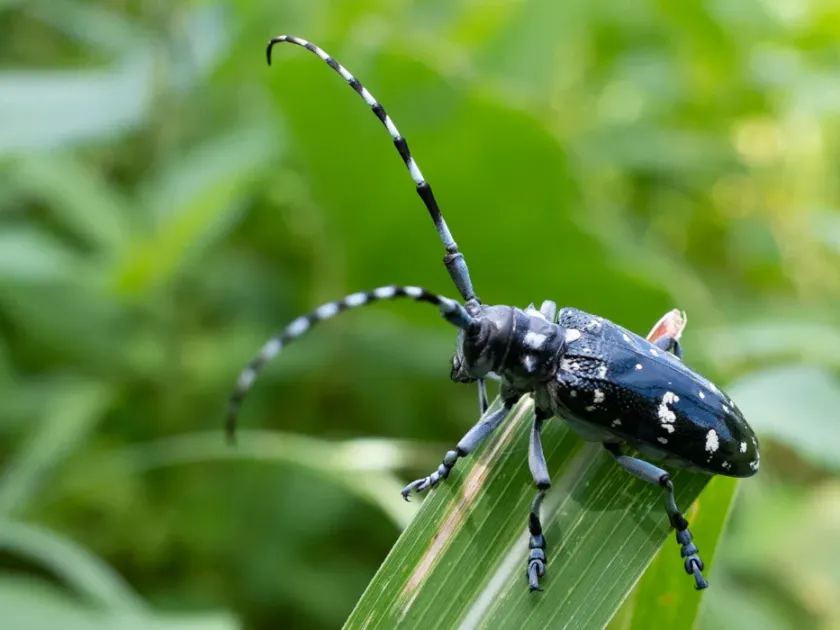
The Japanese citrus longhorned beetle is a species of long-horned beetle (Cerambycidae) that poses a significant threat to various tree species. Adults typically range from 20 to 35 mm in length and feature a shiny black body with distinct white spots on the elytra.
A defining characteristic of this species is its extraordinarily long antennae, which can be several times the length of the beetle's body in males. Unlike some other related species, the surface of the pronotum is usually smooth and lacks prominent tubercles.
The larvae are white, legless, and possess a heavily sclerotized head, specifically adapted for boring into solid wood. Pupation occurs within the galleries formed inside the host plant's wood.
Because they spend most of their life cycle inside the wood, these beetles are extremely difficult to detect in the early stages of infestation. Their activity is heavily influenced by ambient temperature, with higher activity in sunny and warm environments.
As a quarantine pest, accurate identification by professional entomologists is critical, as it is morphologically very similar to the Asian longhorned beetle.
What it damages
The Japanese citrus longhorned beetle is a highly polyphagous pest capable of infesting a wide range of broad-leaved trees and shrubs. Its host range includes fruit orchards, urban park trees, and forest ecosystems.
Commonly attacked species include members of the Rosaceae and Aceraceae families, such as apple, pear, citrus trees, and various species of maples, poplars, and willows.
Larvae cause the most significant damage by boring deep tunnels into the sapwood and heartwood. This activity disrupts the transport of water and nutrients, severely weakening the tree.
The galleries created by the larvae provide entry points for secondary fungal and bacterial infections, which accelerate the decay and eventual death of the host plant.
Widespread infestations lead to the decline of entire plantations, causing severe economic damage to the agricultural sector and nursery trade.
When it appears
Adult emergence typically begins in late spring and continues throughout the summer, peaking during June and July. Adults are diurnal, meaning they are primarily active during the day.
After mating, females chew small pits into the bark to deposit eggs. A single female is capable of laying between 50 and 100 eggs throughout her lifespan.
Embryonic development lasts approximately two weeks, after which the young larvae begin to feed on the inner bark before boring into the xylem.
The life cycle can take between one to two years to complete, depending on environmental conditions and the specific host tree species. Colder climates may slow down the larval development period.
Once mature, the adults emerge by chewing circular exit holes through the bark, signaling a new generation of beetles ready to mate and disperse.
Signs of infestation
The most visible sign of infestation is the presence of perfectly round exit holes, approximately 10 mm in diameter, found on the trunks and major branches of trees.
Oviposition sites appear as small depressions or notches on the bark surface. In stone fruit trees, these sites often show signs of sap flow or gumming.
Accumulation of sawdust-like frass at the base of the tree or caught in bark crevices is a strong indicator of active larval feeding and boring occurring inside the trunk.
Premature leaf yellowing, canopy dieback, and the wilting of individual branches are late-stage symptoms indicating that the vascular system of the tree has been heavily compromised.
Inspecting trees for localized bark cracking or peeling is recommended, as these can reveal early larval galleries located just beneath the outer bark layer.
Control measures
The primary control strategy is strict quarantine and phytosanitary measures designed to prevent the introduction and spread of the beetle via infested wood products.
If an infestation is confirmed, affected trees must be removed and destroyed immediately, usually by burning or chipping, to eliminate the pest before adults emerge.
Chemical control using systemic insecticides applied during the adult flight season can be effective at reducing beetle populations and protecting healthy trees.
Pheromone traps are valuable tools for the early detection and monitoring of beetle populations, helping to determine the precise timing for pest management actions.
- Regular inspections of vulnerable host trees in landscapes.
- Removal and destruction of dead or dying trees that could serve as breeding grounds.
- Utilization of biological control agents, including entomopathogenic nematodes.
Discussion
No discussions yet — be the first.