
Anastatus disparis
Anastatus disparis
Description
How to identify
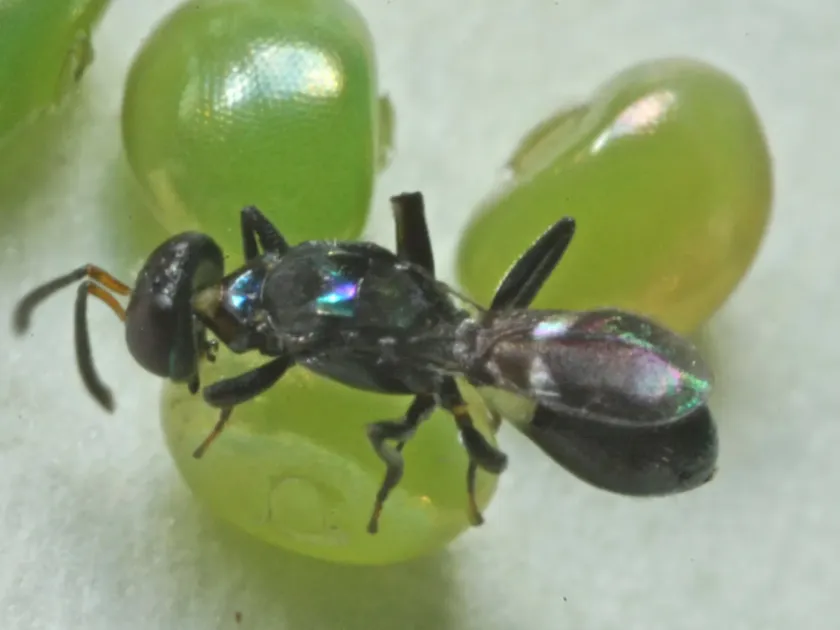
Anastatus disparis is a small parasitic wasp belonging to the family Eupelmidae, order Hymenoptera. It is a highly specialized insect known for its role as an egg parasitoid of various forest and orchard pests.
The adult wasp is minute, typically measuring between 3 and 5 millimeters in length. Females often exhibit a metallic coloration, which is a common characteristic within this family, and possess well-developed wings for flight.
Males are generally smaller, darker, and less frequently observed than females. They are specialized to detect the pheromones and chemical cues left by female moths during oviposition.
The life cycle of this wasp is strictly synchronized with the egg-laying period of its primary host, the gypsy moth. The development occurs entirely within the host egg, providing the larva with a stable and protected environment.
This species is highly valued in forestry and entomology as a biological control agent that naturally suppresses outbreaks of major defoliating pests.
What it damages
Anastatus disparis does not cause any damage to plants, trees, or crops. As a parasitoid, its entire life cycle is focused on insects, not vegetation.
The presence of this insect is highly beneficial for agricultural ecosystems. By parasitizing the eggs of pests, it effectively reduces the number of larvae that would otherwise emerge to feed on plant foliage.
Its role is equivalent to that of a natural biological pesticide. It helps maintain a balance in the ecosystem, preventing large-scale defoliation of trees in orchards and forests.
There is no economic harm associated with this insect. On the contrary, its absence often leads to an increase in pest populations, resulting in significant damage to the host plants.
Therefore, Anastatus disparis is considered a beneficial species that should be conserved and encouraged through proper habitat management.
When it appears
The flight activity of adult Anastatus disparis typically occurs during the mid-to-late summer months, following the peak of the gypsy moth's egg-laying season.
During this time, the female wasps actively search for egg masses on the bark of trees. Once a host mass is found, the female drills into the egg to deposit her own progeny.
The development of the wasp larva is slow, often extending through the autumn and winter months, effectively utilizing the host's egg as an overwintering site.
The larval stage remains in a state of diapause during the cold season, protected by the hard shell of the host egg and the surrounding egg mass matrix.
The emergence of the next generation of adults happens in the following spring, coinciding with the warming of the weather and the budding of trees, ready to continue the cycle.
Signs of infestation
Identifying the presence of Anastatus disparis involves close inspection of moth egg masses located on tree trunks or branches.
Evidence of parasitism can be seen as tiny pinprick holes in the protective surface of the egg mass, which are the exit or entry points created by the wasps.
Examining the internal contents of individual host eggs often reveals the presence of a developing wasp larva or pupa instead of the moth embryo.
A notable reduction in the number of emerging larvae in the spring compared to the size of the egg mass from the previous season is a key indicator of parasitoid activity.
Field monitoring during the summer, particularly in areas with known gypsy moth infestations, can reveal adult wasps resting or actively searching on tree bark.
Control measures
There is no need to control Anastatus disparis, as it is a beneficial insect. Efforts should instead be directed toward its conservation and population enhancement.
Integrated Pest Management (IPM) practices should be employed to ensure the survival of this parasitoid in the orchard environment.
- Avoid the use of broad-spectrum insecticides during the summer months when adult wasps are active.
- Maintain patches of floral resources nearby to provide nectar, which adult wasps use as an energy source.
- Protect natural habitats and hedgerows that serve as reservoirs for beneficial insects.
- Minimize bark treatments or scraping that could inadvertently destroy overwintering egg masses hosting the parasitoids.
By fostering a favorable environment, growers can harness the natural regulating power of Anastatus disparis to manage pest populations sustainably.
Discussion
No discussions yet — be the first.