
Bilberry moth
Anarta myrtilli
Description
How to identify
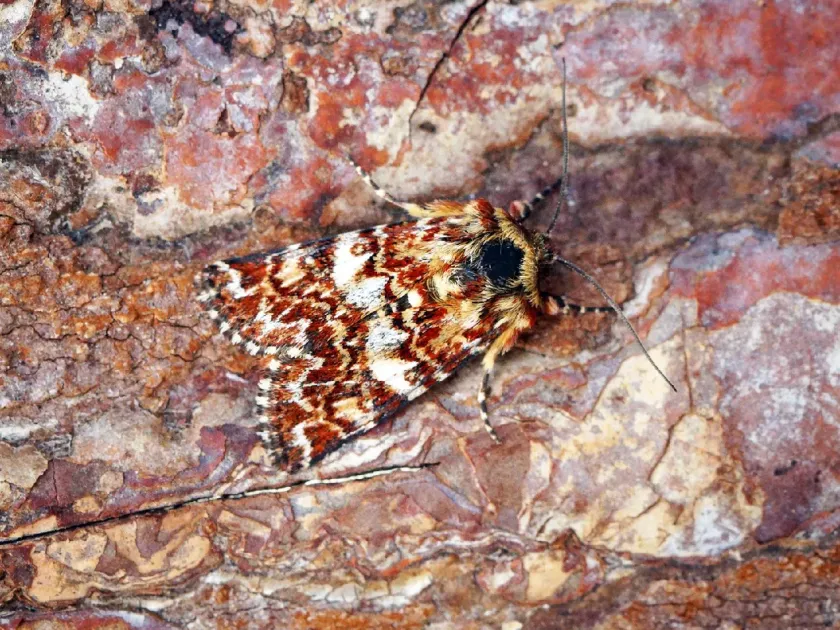
The Bilberry moth (Anarta myrtilli) is a small nocturnal moth belonging to the Noctuidae family. Adults typically have a wingspan ranging from 20 to 25 millimeters.
The forewings feature a distinctive pattern of reddish-brown and dark brown shades, interspersed with white markings that provide excellent camouflage against peat and plant stems.
The hindwings are paler, often yellowish-brown with a darker marginal band. The thorax and head are densely covered with hair-like scales, giving the moth a robust, compact appearance.
Larvae, or caterpillars, vary in color from bright green to brownish-green, often featuring diagonal pale stripes along the sides to blend in with their host plants.
Pupae are dark brown and are housed within firm, well-constructed cocoons, usually located in the soil or under leaf litter, which protects them during overwintering.
What it damages
The primary hosts for the Bilberry moth larvae are plants in the Ericaceae family, most notably Bilberry (Vaccinium myrtillus) and Lingonberry (Vaccinium vitis-idaea).
Larvae feed voraciously on the foliage of these shrubs. In cases of significant infestation, they can cause extensive defoliation, severely reducing the photosynthetic capacity of the plants.
The damage often begins at the leaf margins and progresses until only the midribs remain. Young larvae may also graze on the epidermis of stems and buds.
Reduced vigor in the host plants leads to stunted growth and reduced fruit production, which is a major concern for commercial berry growers and wild harvesters.
Furthermore, the physical damage to the leaves and stems makes the plants more susceptible to secondary fungal infections, further damaging the overall health of the crop.
When it appears
Adult moths are generally active in two generations throughout the warmer months, typically from May through August, depending on the latitude and local temperature.
Mating occurs at night, and females lay their eggs singly on the undersides of leaves, ensuring that the emerging larvae have immediate access to food.
The larval stage is characterized by intense feeding, which can last for several weeks. As the larvae grow, they become more destructive and noticeable on the host plants.
Pupation occurs in the soil, where the insect remains dormant through the winter. This strategy allows the species to survive low temperatures effectively.
Seasonal patterns can shift slightly due to climate conditions, with warmer springs leading to an earlier emergence of the first generation of adults.
Signs of infestation
The most visible sign of infestation is the presence of irregular holes in the leaves or entire leaf edges missing, often accompanied by dark fecal pellets on the foliage.
A closer inspection during the twilight hours may reveal the caterpillars actively feeding on the shoots, as they prefer to hide near the base of the plant during the day.
General wilting or yellowing of foliage in localized patches of the plantation may suggest high larval activity causing significant stress to the host plants.
For those monitoring populations, the presence of adult moths during dusk or dawn, often detected near light sources or pheromone traps, serves as an early warning system.
Severe defoliation is a clear sign that the population density has exceeded sustainable thresholds, requiring immediate intervention to protect the next year's yield.
Control measures
Cultural control measures, such as soil cultivation in the autumn, can help destroy the overwintering pupae by exposing them to predators or harsh weather conditions.
Manual removal of caterpillars is feasible on smaller patches or home gardens, especially when done during the evening when they are most active on the plants.
Biological control using Bacillus thuringiensis (Bt) based products is highly effective against larvae and minimizes the impact on non-target beneficial insects in the area.
Chemical control should only be used as a last resort, utilizing selective insecticides that have minimal impact on pollinators and adhering strictly to pre-harvest intervals.
- Monitor adult moth populations using light traps.
- Maintain weed-free environments to reduce alternative host plants for the larvae.
- Encourage natural predators such as birds and ground beetles to maintain balance.
Taxonomy
- Latin name
- Anarta myrtilli
- Order
- Lepidoptera (butterflies)
- Family
- Noctuidae
- EPPO code
- ANRTMY
Discussion
No discussions yet — be the first.