
Great Brocade
Anaplectoides prasina
Description
How to identify
The Great Brocade (Anaplectoides prasina) is a moth belonging to the family Noctuidae. It is a medium-sized insect with a wingspan of approximately 40–50 mm.
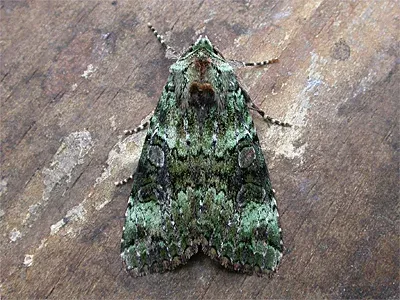
The forewings feature a distinctive olive-green color with dark markings and bands, which provides excellent camouflage against tree bark and foliage.
Larvae, or caterpillars, reach lengths of up to 50 mm and are typically brownish with dark diamond-shaped patches along their dorsal surface.
These moths are primarily nocturnal, remaining hidden during the day under debris or soil, which makes them difficult to spot during routine field inspections.
The species survives winter primarily in the larval stage, buried in the soil or leaf litter, ready to resume feeding as soon as spring temperatures rise.
What it damages
This pest is highly polyphagous, meaning it feeds on a wide variety of plants, including cereals, vegetables, fruit trees, and various garden plants.
In cereal crops, larvae consume foliage, which reduces the plant's ability to photosynthesize and can lead to significant losses in grain yield.
Vegetable crops can suffer from leaf tissue loss, which weakens the plant and decreases the quality and market value of the harvested produce.
Orchards are also at risk, as larvae feed on the leaves of fruit trees, potentially impacting the development of buds and the overall health of the tree.
Severe infestations can lead to extensive defoliation, leaving plants vulnerable to diseases and environmental stress, ultimately threatening total crop survival.
When it appears
The adult moth flight period typically occurs between June and August, during which time mating and egg-laying take place across the field.
After hatching, the caterpillars feed throughout the summer and autumn months before transitioning into their overwintering phase in the soil.
Spring activity begins as temperatures increase, with larvae emerging to feed on new green growth before they eventually undergo pupation.
Pupation takes place in the soil within protective chambers, where the moth develops until it emerges as an adult the following summer.
The lifecycle is generally univoltine, meaning there is typically one generation per year, though this can shift depending on regional climate conditions.
Signs of infestation
Early symptoms of an infestation include irregular holes and notches on leaf margins, indicating that larvae have been grazing on the foliage.
Searching at night with a flashlight may reveal caterpillars actively feeding on the stems or leaves of the affected host plants.
Frass (larval excrement) appearing as small dark pellets on the leaves or at the base of the plant is a clear sign of a resident caterpillar population.
In cases of heavy defoliation, the veins of the leaves may be all that remains, which causes the plants to yellow or wither prematurely.
Dying or stunted plants in patches within a field may indicate larval feeding damage concentrated at the root zone or near the soil surface.
Control measures
Deep autumn plowing is a recommended cultural practice to disrupt the pupation site and expose overwintering larvae to predators and frost.
Managing weed populations is crucial, as many weeds act as secondary host plants that sustain the larvae during the growing season.
Chemical control using registered insecticides is most effective when applied during the early larval stages when the caterpillars are smaller and more vulnerable.
Monitoring the adult population using pheromone or light traps allows for precise timing of interventions before significant crop damage occurs.
- Maintain diverse crop rotation.
- Clean cultivation methods.
- Use of biological control agents like beneficial nematodes or bacteria.
Taxonomy
- Latin name
- Anaplectoides prasina
- Order
- Lepidoptera (butterflies)
- Family
- Noctuidae
- EPPO code
- EURMPR
Discussion
No discussions yet — be the first.