
Cucumber looper
Anadevidia peponis
Description
How to identify
The cucumber looper (Anadevidia peponis) belongs to the Noctuidae family, which includes some of the most destructive agricultural insect species worldwide.
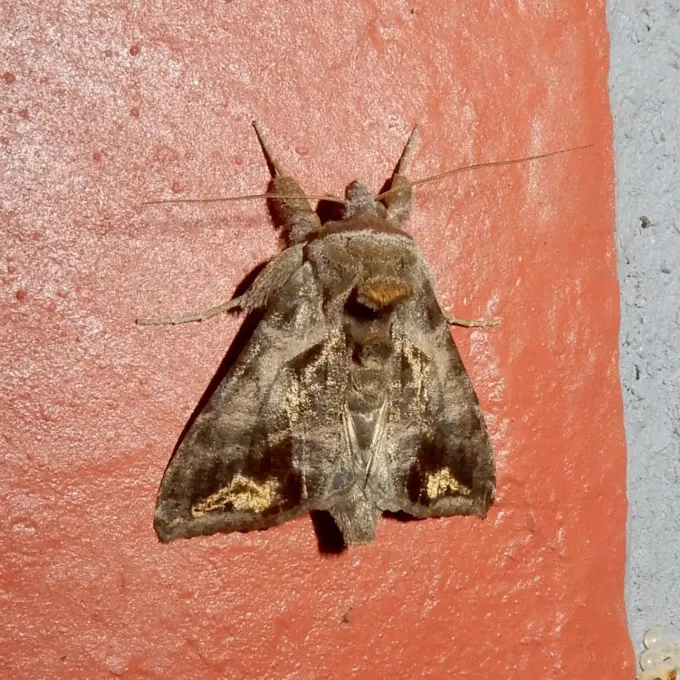
Adult moths are medium-sized with a wingspan of approximately 30 to 35 mm. Their forewings are distinctively mottled with gray-brown tones and often feature a metallic sheen.
The larval stage is characterized by a bright green, elongated body that blends seamlessly with the foliage of host plants, providing excellent camouflage against predators.
Pupation occurs within a loose silk cocoon attached to the underside of leaves or within debris, which serves as a protective chamber during the transformation process.
Understanding the life cycle is crucial, as environmental temperature fluctuations directly influence the rate of development and the number of generations per season.
What it damages
This pest primarily affects plants within the Cucurbitaceae family, including cucumbers, melons, watermelons, and squash, causing significant losses to both yield and plant health.
Larvae consume large amounts of leaf tissue, often leaving only the main veins. This defoliation drastically reduces the plant's capacity for photosynthesis, impacting growth.
Beyond foliage, the caterpillars may also feed on young fruits and buds, resulting in physical scarring and deformities that make the produce unmarketable.
Feeding sites often provide entry points for secondary infections, such as bacterial soft rot and various fungal pathogens, which can destroy the entire fruit crop.
The damage is particularly severe during the fruit-set stage, where even minor feeding can stunt the development of marketable yields in greenhouses and open fields.
When it appears
Adult moths typically emerge in late spring or early summer, synchronized with the onset of favorable nocturnal temperatures required for mating and oviposition.
The population tends to peak during mid-summer, coinciding with the rapid vegetative growth phase of host plants, which provides an abundant food source.
Multiple overlapping generations can occur within a single growing season, necessitating ongoing vigilance and consistent monitoring efforts throughout the summer.
The pest enters its overwintering phase as a pupa, hiding in the soil or protected organic debris to survive the winter and re-emerge the following spring.
Local climatic conditions dictate the precise timing of emergence and the severity of the infestation, making regional monitoring essential for effective management.
Signs of infestation
A primary indication of an infestation is the presence of irregular, ragged holes in the leaves, often accompanied by the accumulation of dark, granular frass.
Observing the underside of leaves frequently reveals the larvae or the delicate silk threads they use to tie leaf edges together for protection against heat and predators.
Wilting of young terminal shoots or sudden yellowing of individual leaves may suggest active feeding that warrants a closer inspection of the plant canopy.
Light traps are a standard professional tool to detect the early arrival of adult moths, allowing growers to initiate control measures before egg-laying becomes widespread.
Regular scouting during the cool hours of the morning or evening is recommended to accurately assess the larval density per plant and determine if intervention is needed.
Control measures
Cultural practices, such as deep plowing after harvest, are highly effective at disturbing the soil-dwelling pupae and breaking the pest's reproductive cycle.
Maintaining a clean field environment by removing host weeds and crop residues significantly reduces the available habitat for the pest to flourish.
Physical barriers, including the use of fine-mesh screening in greenhouses, are excellent strategies to prevent adult moths from entering and laying eggs.
- Biological control through the release of natural enemies like Trichogramma wasps.
- Application of Bacillus thuringiensis (Bt) based sprays which specifically target lepidopteran larvae.
- Use of synthetic insecticides (such as pyrethroids) as a last resort, observing pre-harvest intervals for food safety.
Integrated Pest Management (IPM) is the most sustainable approach, combining biological, cultural, and mechanical controls to minimize dependence on chemical sprays.
Taxonomy
- Latin name
- Anadevidia peponis
- Order
- Lepidoptera (butterflies)
- Family
- Noctuidae
- EPPO code
- PLUSPE
Discussion
No discussions yet — be the first.