
Green leafhopper
Amrasca punctata
Description
How to identify
The Green leafhopper (Amrasca punctata) is a small insect belonging to the order Hemiptera and the family Cicadellidae. These pests are highly mobile and are known for their rapid population growth.
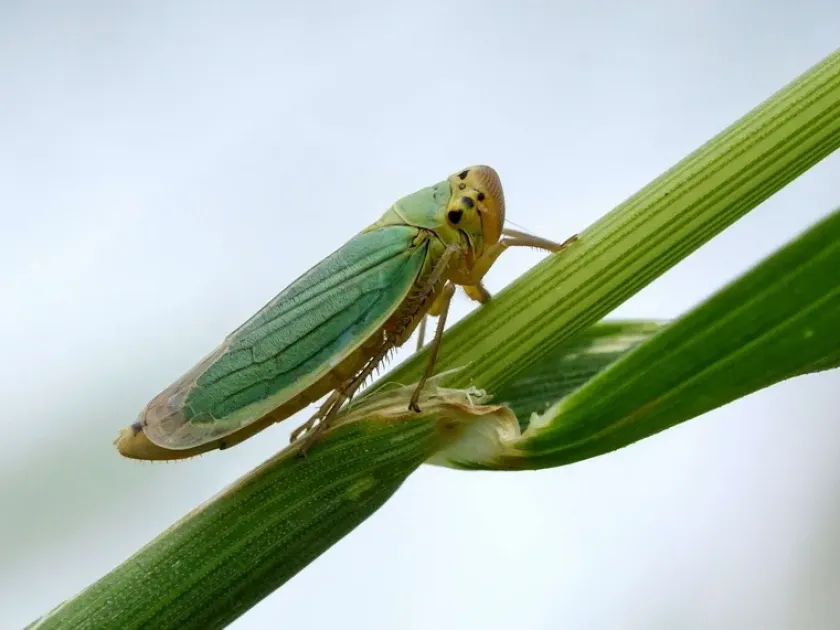
The adult insect is slender, measuring approximately 3 to 4 mm in length. Its body is light green, providing excellent camouflage against the foliage of the host plants they infest.
Nymphs resemble the adults but are smaller and lack wings. They possess a distinct habit of moving sideways across the leaf surface, which is a key diagnostic feature for identification in the field.
Their life cycle includes egg, nymph, and adult stages. Females lay eggs inside the leaf veins or petioles, providing protection for the developing offspring from environmental hazards and many contact pesticides.
They prefer warm and humid conditions, which makes them particularly problematic in greenhouses and during summer months in open fields where climate conditions are optimal for breeding.
What it damages
This pest attacks a wide range of crops, including vegetables such as tomatoes, eggplants, potatoes, and various berry bushes. Both adults and nymphs feed by sucking sap from the plant's tissues.
As they feed, they pierce the leaf surface, causing chlorosis, which manifests as white or yellowish stippling. These spots eventually merge, leading to tissue necrosis and significant loss of photosynthetic area.
Severe infestations cause leaves to curl, yellow, and eventually die. The weakened plant struggles to develop fruits, which leads to a significant decrease in total harvest yield and quality.
Beyond direct damage, the Green leafhopper is a vector for various plant pathogens, including phytoplasmas and viruses. These diseases can devastate entire crops even if the insect population is relatively small.
Under heavy pressure, plant growth is severely stunted, and the overall plant vigor declines, making the crop more susceptible to secondary infections and environmental stress.
When it appears
Activity begins in the spring when temperatures consistently stay above 15°C. The peak of infestation usually occurs during the warmest months of the growing season.
Depending on climatic conditions, the pest can complete several generations within a single season. High heat and drought conditions typically accelerate the reproductive cycle.
Overwintering occurs primarily in the adult stage within plant debris, leaf litter, or weeds. Protected environments like greenhouses can also serve as year-round reservoirs for the population.
Early in the season, adults migrate from their overwintering sites to colonize young seedlings, initiating the first generation that will affect the crop throughout the summer.
As autumn approaches and temperatures drop, the activity of the leafhoppers declines, and the surviving individuals seek suitable shelter to survive the winter, completing the annual life cycle.
Signs of infestation
The most common sign is the appearance of chlorotic, white, or yellow spots on the leaves. These often begin at the leaf margins and are followed by curling and drying of the foliage.
Upon inspecting the underside of the leaves, one can often see the insects themselves or the white, shed skins (exuviae) left behind by nymphs after molting.
If you brush against or shake the infected plants, the leafhoppers will jump or fly off in large numbers, providing an immediate visual confirmation of an infestation.
Overall stunted growth, misshapen leaves, and a general lack of vigor in the crop are clear indicators that sap-sucking pests are stressing the plant.
In cases of severe infestation, a premature leaf drop and the presence of honeydew-like secretions (though less common than in aphids) can also be observed.
Control measures
Integrated Pest Management (IPM) is essential. A core strategy is the removal of weeds that act as alternate hosts, which prevents the buildup of populations before the crops are infested.
- Deploying yellow sticky traps to monitor population spikes and catch adult leafhoppers.
- Applying systemic insecticides that are absorbed into the plant, ensuring control even after the insects start feeding.
- Utilizing crop rotation and physical barriers to interrupt the life cycle and movement of the pest between fields.
- Implementing biological controls, such as introducing predatory insects or applying entomopathogenic fungi to reduce the pest population naturally.
It is crucial to rotate insecticide classes to manage resistance, as these insects can quickly adapt to chemical treatments if the same active ingredients are used repeatedly.
Post-harvest sanitation, including the destruction of plant remains, is vital to eliminate the overwintering sites and ensure a cleaner start for the next growing cycle.
Discussion
No discussions yet — be the first.