
Cotton leafhopper
Amrasca devastans
Description
How to identify
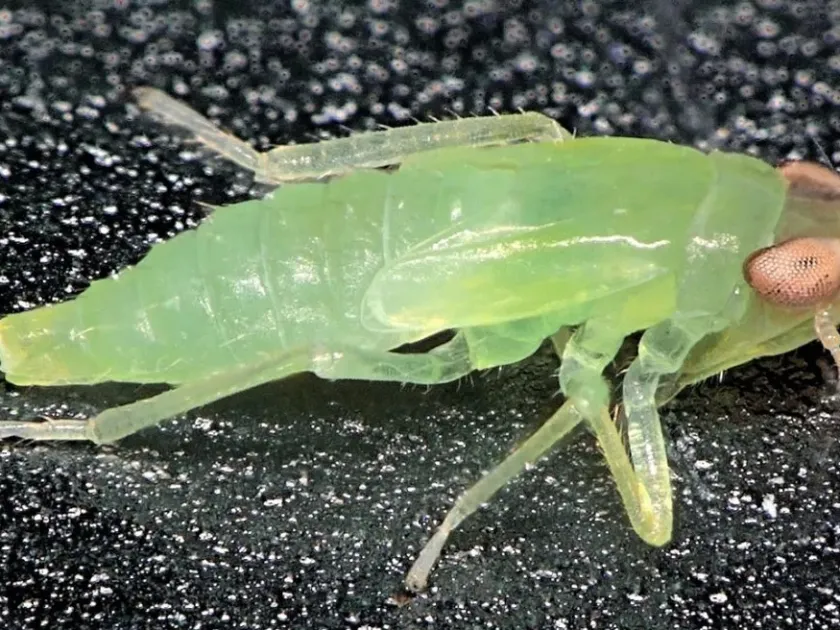
The cotton leafhopper (Amrasca devastans) belongs to the order Hemiptera and the family Cicadellidae. Adult insects are wedge-shaped, typically measuring 2–3 mm in length, and exhibit a distinct pale green or yellowish-green color.
Nymphs resemble the adults in appearance but lack wings. They are highly mobile and are typically found on the undersides of leaves, often exhibiting a characteristic sideways walking motion when disturbed.
The life cycle consists of the egg, five nymphal stages, and the adult stage. In favorable temperatures, the life cycle completes rapidly, allowing for multiple generations per season.
These insects are highly sensitive to environmental conditions, thriving in warm and moderately humid weather, which accelerates their developmental rate.
They overwinter as adults on alternative host plants, particularly weeds or perennial vegetation located near cultivated fields.
What it damages
While primarily a major pest of cotton, the leafhopper is highly polyphagous and infests various crops, including okra, eggplant, sunflower, and several legumes.
Feeding occurs by piercing the plant epidermis and sucking sap from the leaf tissues. This process directly depletes the plant of essential nutrients and moisture.
Saliva injected during feeding contains toxic substances that interfere with chlorophyll production and overall plant metabolism, leading to reduced photosynthetic capacity.
Severe infestations cause stunted growth, leaf curling, and eventual shedding of damaged foliage, which drastically impacts the plant's ability to produce fruit.
In uncontrolled populations, the damage can lead to significant yield losses, often exceeding 40% in sensitive varieties and favorable pest conditions.
When it appears
The activity of the cotton leafhopper begins as temperatures rise in the spring, signaling the transition from overwintering sites to growing crops.
Peak infestation levels usually occur during mid-season when temperatures reach their optimal range for nymphal growth and rapid reproduction.
Migration from wild hosts or earlier-planted fields is a common phenomenon that farmers must monitor closely during the early growth stages of the cotton crop.
The number of generations per season is determined by the local climate, with tropical and subtropical regions seeing continuous breeding cycles.
Monitoring for the presence of the pest is most critical during the vegetative growth phase before the onset of boll development.
Signs of infestation
The most distinctive symptom is the downward curling of leaf margins, often referred to as "hopper burn," which signifies significant localized tissue damage.
The damaged leaf edges initially turn yellow and then transition to a necrotic, bronze, or reddish-brown color as the tissue dies.
Early warning signs include the presence of white, discarded exoskeletons (exuviae) left behind on the underside of leaves after molting.
Plants affected by the pest appear chlorotic and exhibit reduced vigor, with shortened internodes and generally poor canopy development.
- Downward curling of leaf margins.
- Marginal yellowing (chlorosis).
- Bronzing and necrosis of leaf tissues.
- Premature defoliation.
- Stunted plant growth.
Control measures
Effective management begins with strict field hygiene, including the removal of weeds that act as alternative hosts for the leafhopper throughout the season.
The use of resistant or tolerant crop varieties with higher levels of leaf pubescence can significantly reduce the attractiveness of the plant to the pest.
Chemical control is implemented using systemic or contact insecticides when the pest population exceeds the economic threshold established for the region.
Biological control strategies focus on conserving indigenous natural enemies, such as lacewings, ladybird beetles, and parasitic wasps that predate on nymphs.
Integrated Pest Management (IPM) practices, including the use of sticky yellow traps for population monitoring, are essential for making informed treatment decisions.
Discussion
No discussions yet — be the first.