
Amphipoea velata
Amphipoea velata
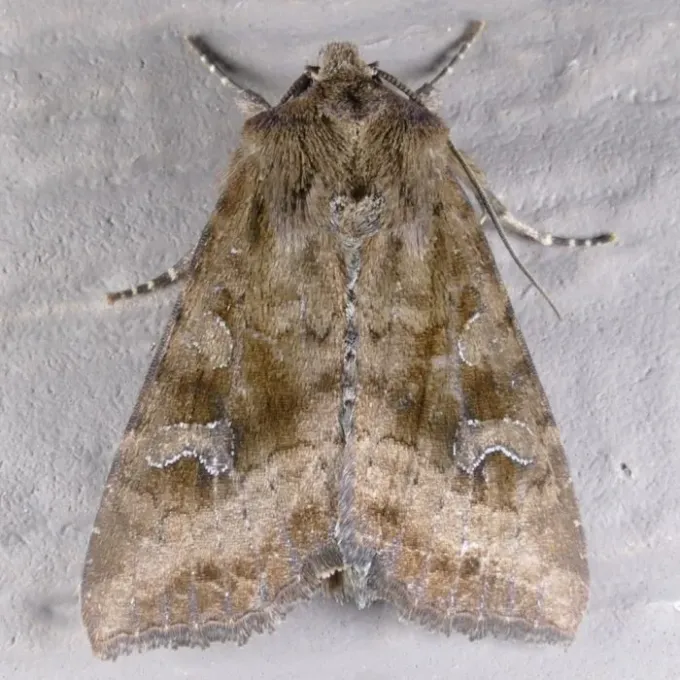
Description
How to identify
Amphipoea velata belongs to the Noctuidae family, order Lepidoptera. It is a moth species recognized by its nocturnal habits and specific morphological traits.
The adult moth has a wingspan of approximately 30–35 mm, with brownish forewings featuring intricate patterns that mimic natural textures for daytime camouflage.
The larvae, known as caterpillars, grow up to 40 mm in length and display a dull greyish or greenish color with lighter longitudinal stripes running along the body.
The head capsule of the larva is dark and robust, designed to facilitate boring into the stems of host plants where they spend most of their feeding stage.
As a member of the Amphipoeinae subfamily, this insect is adapted to various open field environments, often thriving in areas with tall grasses.
What it damages
This species is primarily known as a pest of various grasses, including commercial cereal crops and meadow forage grasses which are crucial for agriculture.
The larvae feed internally on the stems of host plants, consuming the pith and structural tissues, which disrupts the flow of nutrients to the upper parts of the plant.
High levels of infestation can lead to significant yield losses due to decreased plant density and poor development of the grain-bearing organs.
The tunnels created by the larvae within the stems weaken the plant physically and provide entry points for secondary fungal and bacterial pathogens.
Economic damage is typically localized but can be severe in fields where weed management and crop rotation practices are neglected.
When it appears
Amphipoea velata typically completes one generation per year, with eggs serving as the overwintering stage on plant debris or in the soil surface.
Larval emergence occurs in mid-spring, coinciding with the beginning of the vegetative growth of cereal crops, providing immediate access to food.
Feeding activity is at its peak during late spring and early summer, when the larvae are growing and preparing for the pupation phase.
Pupation takes place either in the soil or within the protected environment of the host plant stem, followed by the emergence of adults in mid-to-late summer.
The adult flight period extends throughout the summer months, during which mating and egg-laying ensure the continuity of the next generation.
Signs of infestation
The most noticeable sign is the wilting of the central shoot or the entire plant, as the larvae sever the vascular system during their stem-boring activity.
External indicators include small, circular entry holes found near the base of the stems, often accompanied by frass (larval excrement) accumulation.
Affected plants often display chlorotic symptoms or premature drying, appearing yellowish and stunted compared to healthy surrounding crops.
Upon dissecting a damaged stem, one can easily identify the larvae or the hollowed-out central area where the caterpillar has been feeding.
Localized patches of dying plants within a field often signal the presence of this pest, requiring immediate field inspection and assessment.
Control measures
Cultural control via deep autumn plowing is a highly effective method to disrupt the life cycle by burying eggs and larvae, preventing successful emergence.
Stringent weed control is essential, as many non-crop grasses act as primary hosts and reservoirs for the pest population between cropping seasons.
Chemical intervention with systemic insecticides may be necessary if monitoring reveals that the larval population exceeds the economic threshold.
Implementing a diverse crop rotation strategy, moving away from continuous cereal monocropping, significantly reduces the survival rate of the larvae.
Field scouting using pheromone traps to monitor adult moth activity can provide an early warning system, allowing for precise and timely pest management actions.
Taxonomy
- Latin name
- Amphipoea velata
- Order
- Lepidoptera (butterflies)
- Family
- Noctuidae
- EPPO code
- AMPOVE
Discussion
No discussions yet — be the first.