
Rustic Shoulder-knot
Amphipoea fucosa
Description
How to identify
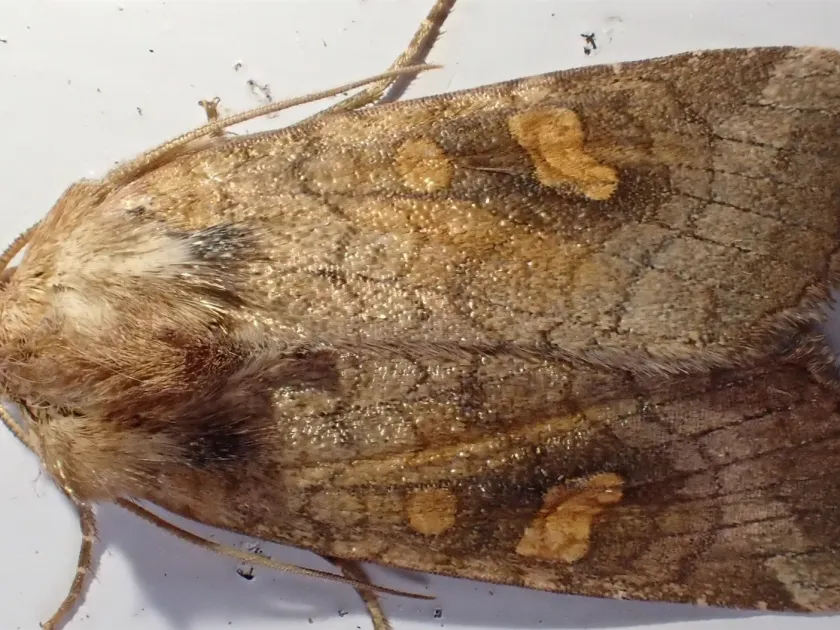
The Rustic Shoulder-knot (Amphipoea fucosa) is a moth belonging to the family Noctuidae. The adult moth features a wingspan of approximately 30 to 35 mm, with a coloration ranging from reddish-brown to dark brown, often marked with light spots on the forewings.
The larvae, or caterpillars, reach up to 40 mm in length. They have a cylindrical body that is typically grayish-brown or greenish, often featuring a darker dorsal stripe, and a brown head capsule.
The eggs are small and yellowish-white. Females deposit them on the stems or base of host plants, which serve as the initial food source for the hatching larvae.
Pupation occurs in the soil within a cocoon made of silk and soil particles. The species typically overwinters in the egg stage, which is resistant to harsh weather conditions.
Adult moths are nocturnal and are highly attracted to light sources, making light traps an essential tool for monitoring population density during the summer season.
What it damages
This species is considered a polyphagous pest, though it primarily infests cereal crops such as wheat, barley, and oats. Other hosts include potatoes, corn, and various garden vegetables.
The larvae are internal feeders that bore into the stems of host plants. By consuming the inner tissues, they disrupt the plant's vascular system, leading to wilting and reduced plant vigor.
Damage to the stem base often leaves the plant susceptible to secondary infections, such as root rot or other fungal diseases, which can further decrease yield quality and quantity.
Young plants are particularly vulnerable. When the main stem is attacked during the tillering phase of cereals, the plant may fail to produce a productive head entirely.
Because the larvae can migrate from surrounding grassy weeds, fields adjacent to unmanaged vegetation are at a higher risk of infestation, necessitating perimeter monitoring.
When it appears
The Rustic Shoulder-knot completes one generation per year. The winter is spent as eggs, which are found on plant debris or in the upper layers of the soil.
Larvae hatch in the spring, typically from April to May, coinciding with the early growth stages of cereal crops, which provides them with immediate access to food.
The larval feeding period lasts until early summer. Pupation follows in the soil, usually taking place in June or July, depending on local temperatures and rainfall.
Adult moths emerge in mid-to-late summer, primarily in July and August. During this time, they engage in mating and feeding on floral nectar.
Egg-laying takes place in late summer and early autumn. Once the females lay their eggs, the cycle resets for the following season, ensuring the population's survival through winter.
Signs of infestation
One of the earliest signs of infestation is the premature wilting of central leaves or shoots, which often appears despite adequate soil moisture levels.
Careful inspection of the stem base may reveal entry holes created by the larvae. These holes are frequently accompanied by frass (larval waste), which is a diagnostic indicator.
Plants infested with larvae can often be pulled easily from the soil, as the internal damage to the stem base compromises the plant's anchorage and nutrient intake.
The presence of adult moths in evening light traps near the field serves as a warning of potential future larval outbreaks, signaling that fields should be checked for damage.
Dissecting a wilted plant stem will typically reveal the caterpillar inside, confirming the presence of Amphipoea fucosa rather than other stem-boring pests.
Control measures
Cultural practices are the first line of defense. Proper crop rotation helps break the life cycle of the pest, making the field less hospitable for subsequent generations.
Deep plowing in the autumn is an effective mechanical method to bury eggs and destroy potential overwintering sites, significantly reducing the pest population for the next spring.
Effective weed management, particularly of wild grasses around field borders, is critical as these plants often serve as early-season host reservoirs for the larvae.
If population thresholds are exceeded, targeted application of approved systemic insecticides can be used to control the larvae before they cause widespread crop loss.
- Monitor adult flight patterns using pheromone or light traps.
- Maintain balanced soil fertility to help plants recover from stress.
- Consider biological control agents if chemical options are restricted.
Taxonomy
- Latin name
- Amphipoea fucosa
- Order
- Lepidoptera (butterflies)
- Family
- Noctuidae
- EPPO code
- AMPOFU
Discussion
No discussions yet — be the first.