
Green-brindled Crescent
Allophyes oxyacanthae
Description
How to identify
The adult moth has a wingspan of approximately 40-45 mm. Its forewings exhibit a complex, mottled pattern of greys, browns, and dark greens, which provides exceptional camouflage against tree bark.
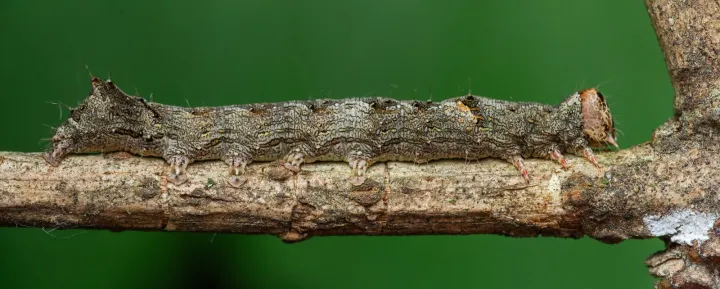
The larvae are typically pale green or brownish with a series of dark markings along the dorsal side. They grow up to 40 mm and possess a cylindrical, smooth body that blends perfectly with the foliage of their host plants.
As a member of the Noctuidae family, this moth is strictly nocturnal. During the daylight hours, they remain motionless in protected crevices, making them extremely difficult to spot without targeted searching.
The species undergoes a complete metamorphosis. The larval stage is the primary cause of concern for growers, as these caterpillars possess voracious appetites during their development.
This species is well-known for its cryptic coloration, which helps both the adults to hide and the larvae to avoid avian predators throughout their feeding period.
What it damages
The main host plants include members of the Rosaceae family. Hawthorn is the primary host, but the larvae frequently attack commercial fruit trees like apples, pears, and plums.
Caterpillars cause the most severe damage in early spring by feeding on swelling buds. A single larva can destroy several buds, significantly reducing the potential yield of the tree.
As the leaves unfurl, the larvae transition to feeding on the leaf tissue. They often skeletonize the leaves, leading to reduced photosynthetic capacity and overall tree stress.
In cases of high population density, defoliation of branches can occur, which weakens the tree's health and makes it more susceptible to environmental stressors and diseases.
The feeding wounds left by the caterpillars can serve as entry points for bacterial and fungal pathogens, potentially causing branch dieback or long-term structural damage.
When it appears
The adult flight period typically occurs in the autumn, specifically from September through October. During this time, mating occurs and eggs are deposited on the host trees.
The species overwinters in the egg stage. These eggs are firmly attached to the bark of young twigs, where they remain dormant throughout the winter months.
The larvae hatch in early spring, precisely as the buds of the host trees begin to break and swell. This timing makes them immediate pests to the developing fruit crop.
Feeding activity is at its peak during April and May. The caterpillars pass through several instars, feeding primarily at night and hiding during the day.
By late spring, the larvae descend or find pupation sites under loose bark or within the soil, where they remain in a pupal stage throughout the summer.
Signs of infestation
The earliest sign of infestation is the presence of hollowed-out buds in early spring. These buds may look shriveled or fail to open, indicating larval feeding.
Small, dark granular frass (excrement) on the leaves or beneath the canopy is a clear indicator that larvae are feeding in the vicinity.
Leaves that appear rolled, tied together with silk, or partially skeletonized suggest the presence of Green-brindled Crescent caterpillars.
Using a flashlight during the night allows for the direct observation of larvae feeding on the outer branches of host trees.
Gradual thinning of the canopy and poor growth of current-season shoots are common symptoms observed as the spring progresses in heavily infested orchards.
Control measures
Chemical control is most effective when applied at the 'green bud' stage, targeting young larvae before they penetrate deep into the developing buds.
Biological control using Bacillus thuringiensis (Bt) sprays can be highly effective against early instar larvae while remaining safe for beneficial insects and pollinators.
- Winter pruning of infested branches to remove egg-laden wood.
- Encouraging wild birds, which are natural predators of these caterpillars.
- Manual inspection and removal of larvae from young or ornamental trees.
- Soil cultivation around the base of trees to disrupt pupation sites.
- Monitoring with light or pheromone traps during the autumn flight period.
Systemic insecticides should be applied sparingly and only when threshold levels are exceeded to prevent ecological imbalance in the orchard ecosystem.
Integrated Pest Management (IPM) strategies focusing on monitoring and early intervention are the best practices for managing this moth effectively.
Taxonomy
- Latin name
- Allophyes oxyacanthae
- Order
- Lepidoptera (butterflies)
- Family
- Noctuidae
- EPPO code
- MEGNOX
Discussion
No discussions yet — be the first.