
Allophyes
Allophyes
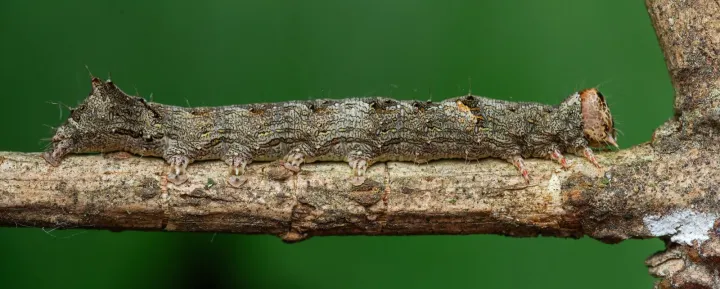
Description
How to identify
Allophyes is a genus of nocturnal moths belonging to the family Noctuidae. The adult moth has a wingspan of approximately 40–50 mm, with coloration ranging from grey to brown, featuring a complex pattern that provides excellent camouflage against tree bark.
The larvae of this genus have a cylindrical body covered in fine hairs, typically green or brownish in color with longitudinal stripes, which makes them nearly invisible among foliage. Larval development proceeds through several instars, each characterized by active feeding.
Systematically, this genus belongs to the subfamily Psaphidinae. It is primarily found in forest and forest-steppe zones, where environmental conditions favor the development of populations on woody and shrubby plants.
The insect's life cycle includes complete metamorphosis: egg, larva (caterpillar), pupa, and imago. Overwintering usually occurs at the pupal stage in the soil or in sheltered areas under bark, which ensures high species survival.
For accurate identification in agronomic settings, it is important to pay attention to the egg-laying patterns and specific leaf damage, which differs from damage caused by other noctuid species.
What it damages
The primary damage is caused by the caterpillars, which are polyphagous. They primarily affect deciduous woody species, including fruit trees from the Rosaceae family such as apple, pear, hawthorn, and cherry.
In intensive orchard management, caterpillars can feed on young shoots and buds, hollowing them out, which leads to reduced yields and weakened overall tree health.
In addition to fruit trees, the pest can damage ornamental shrubs, compromising the aesthetic value of landscapes and promoting secondary infections in the damaged areas.
The severity of damage is directly related to population density. During mass outbreaks, caterpillars are capable of skeletonizing leaves, leaving only coarse veins, which impairs photosynthesis.
In agricultural practice, Allophyes is often considered a minor pest, but in favorable years, it can cause significant damage to young orchards.
When it appears
The flight of the moths occurs primarily during the autumn period. It is in the fall that mating and egg-laying take place, with eggs remaining over the winter on branches or near host plants.
In the spring, during bud break, caterpillars emerge from the overwintered eggs. This is a critical moment as the pests begin feeding on young, tender plant tissues.
The peak activity of the caterpillars occurs in May and June. During this period, the insects grow rapidly and progress through all larval stages of development.
Pupation usually takes place in early summer. The pupae reside in the soil in a special chamber, where they remain in a state of diapause until the autumn flight of the next generation.
Thus, the pest has a univoltine life cycle (one generation per year), which simplifies monitoring and the planning of protective measures in orchards.
Signs of infestation
The first sign of infestation is damaged buds that fail to open or show evidence of hollowing. At early stages, this may resemble damage caused by bud weevils.
On the leaves, there are irregular holes and chewed leaf margins. In cases of severe damage, leaf skeletonization becomes evident.
The presence of the pest can be detected by the presence of frass (excrement) on the leaves and under the tree canopy. The accumulation of frass pellets is a direct indicator of active larval feeding.
Sometimes, beneath the bark or in leaf axils, one can find leaves curled into capsules or webbed together, where caterpillars hide during the daytime.
When inspecting tree canopies in the evening using a flashlight, one can spot the caterpillars themselves as they begin feeding after dusk.
Control measures
To control Allophyes, it is primarily recommended to implement agrotechnical measures, including autumn cultivation of the soil around tree trunks, which destroys pupae in the soil.
Manual collection of caterpillars and shaking them off trees is effective for small gardens with low pest density.
The use of pheromone traps allows for the monitoring of moth flight onset and timely tracking of population levels in commercial orchards.
- Biological products based on Bacillus thuringiensis.
- Systemic insecticides when the economic threshold is exceeded.
- Maintaining high-level agrotechnical practices to improve tree resistance.
Chemical applications should be carried out strictly according to the instructions, considering the activity periods of the pest, ideally during the early larval stages when they are most vulnerable to treatments.
Discussion
No discussions yet — be the first.