
Aleocharinus
Aleocharinus
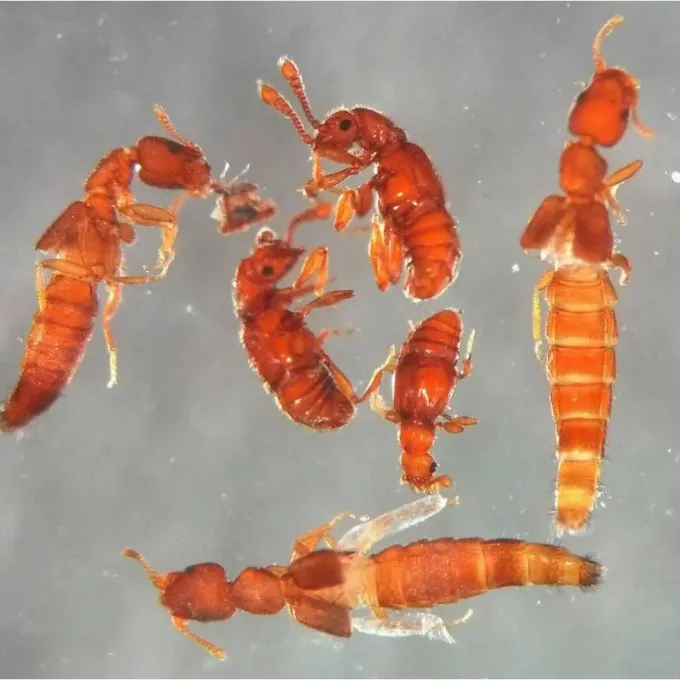
Description
How to identify
Aleocharinus belongs to the family Staphylinidae, part of the order Coleoptera. These insects are characterized by a specific body structure with shortened elytra, leaving a significant portion of the abdomen exposed.
Adult beetles generally have an elongated body and a flexible abdomen, which they often curl upwards when disturbed. The size of the imago varies, but on average, it ranges from 3 to 7 millimeters.
The coloration of the beetles is typically dark brown to coal-black. The head is distinct, with well-developed chewing mouthparts adapted for active feeding.
The larvae are campodeiform, equipped with well-developed thoracic legs, and are highly active in searching for food in topsoil or decaying organic matter.
Identification of specific Aleocharinus species requires microscopic analysis of genitalia and cuticle microsculpture, as external morphological features often resemble other members of the Aleocharinae subfamily.
What it damages
While many staphylinids are entomophagous, some members of the Aleocharinae complex can exhibit phytophagy or associate with soil-borne pathogens that attack plant roots.
The pest most often damages the root systems of vegetable crops, especially in greenhouse conditions where high soil moisture favors the accumulation of the pest population.
Root damage creates entry points for fungal and bacterial infections, such as root rots, which significantly reduces the overall vitality of the plant.
The greatest damage is recorded during mass outbreaks in waterlogged, organic-rich substrates where larvae can feed on young seedlings and tender root hairs.
Crops most at risk include cruciferous plants, solanaceous crops, and various ornamental species grown in protected environments under intensive cultivation.
When it appears
The life cycle of the pest is closely linked to soil temperature regimes and the availability of sufficient moisture required for larval development.
The active breeding period begins in early spring as soil warms to 12–15 degrees Celsius, which often coincides with the transplanting of seedlings into the ground.
During summer months, under favorable humidity conditions, these insects can produce several generations, significantly increasing the population density in the fields.
In autumn, adults migrate into deeper soil layers or shelter in plant debris to successfully overwinter until the next growing season.
Peak pest pressure typically occurs during periods of prolonged rainfall, when high air and soil humidity stimulates the activity and fecundity of the pests.
Signs of infestation
The first sign of infestation is sudden wilting of plants during daylight hours, which does not recover after irrigation due to damage to the root vascular system.
Visual inspection of the root zone often reveals characteristic necrotic spots and nibbled marks on thin roots, caused by larval feeding.
Small tunnels may be visible on the soil surface around the stem, and the presence of highly mobile adult beetles can be observed when the soil surface is disturbed.
Gradual stunting of growth and yellowing of lower leaves indicate systemic damage to the root zone caused by the activity of the pest complex.
In greenhouses, an indirect sign is the deterioration of substrate health and the development of secondary infections in damaged root tissues.
Control measures
The primary control measure is the implementation of crop rotation, which limits the build-up of the pest in the soil and disrupts its development cycle.
- Deep autumn plowing to destroy overwintering sites.
- Managing irrigation to prevent soil waterlogging.
- Using biological preparations based on entomopathogenic fungi.
- Applying authorized soil-applied insecticides when high infestation levels occur.
- Eliminating weeds that act as reservoirs for the pest.
Controlling the level of organic matter in the substrate is also important, as an excess of decomposing material attracts insects for egg-laying.
Regular monitoring using yellow sticky traps allows for the assessment of adult population dynamics during the early stages of infestation.
Discussion
No discussions yet — be the first.