
Shuttle-shaped Dart
Agrotis puta
Description
How to identify
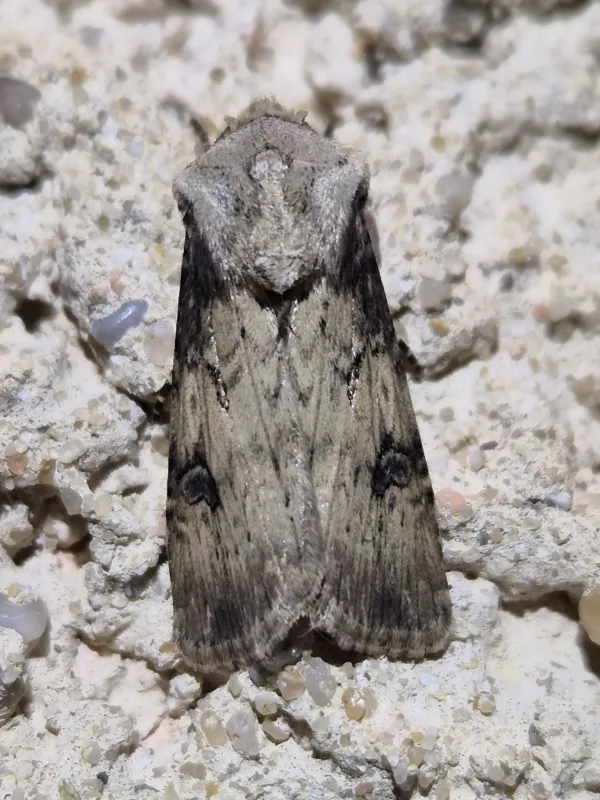
The Shuttle-shaped Dart (Agrotis puta) is a moth species belonging to the Noctuidae family, widely distributed in agricultural landscapes.
Adult moths typically have a wingspan ranging from 30 to 35 mm, displaying a dull brown or greyish appearance with dark markings.
The larvae are earth-colored caterpillars that live mostly in the upper soil layers, making them elusive during the daytime.
Like all species of the Noctuidae family, they undergo a complete metamorphosis including the egg, larva, pupa, and adult stages.
The name reflects the subtle, shuttle-like markings on their forewings, which serve as camouflage against soil and plant debris.
What it damages
The larvae are polyphagous pests, meaning they feed on a wide variety of herbaceous plants, including vegetables and field crops.
They frequently attack root crops and seedling stages of leafy greens, causing significant economic losses in horticultural operations.
By chewing through the stems at the soil level, the larvae cause plants to collapse, leading to rapid death and reduced yield.
Young caterpillars often skeletonize leaves, while older larvae are capable of consuming entire stems or roots of young seedlings.
In high densities, the damage can lead to patchy crop stands, requiring extensive re-sowing or emergency pest control measures.
When it appears
Adults are active during the night, typically seen flying from late spring through the summer months, depending on the climatic zone.
Females lay eggs either on the underside of leaves or directly onto the soil surface near preferred host plants.
The larval stage is the most destructive period, with peak activity often occurring in early summer for the first generation.
The species overwinters as a pupa, buried deep within the soil profile, providing protection against harsh winter weather conditions.
Multiple generations can occur in warmer regions, resulting in overlapping larval populations throughout the growing season.
Signs of infestation
One of the earliest indicators is the sudden wilting of young plants, often caused by larvae severing the stem at the base.
Look for jagged, irregular holes in leaves, indicating that caterpillars have been feeding on the foliage during the night.
Soil disturbance or small mounds of frass (larval droppings) near the base of damaged plants are strong indicators of infestation.
Finding curled-up, greyish caterpillars in the soil near a wilted plant is a definitive sign of Agrotis puta presence.
In areas with high population density, patchy bare spots in fields may appear as young seedlings are completely destroyed before establishment.
Control measures
Deep autumn ploughing is highly effective at exposing overwintering pupae to predators and adverse weather, reducing future populations.
Maintaining clean fields by removing weeds eliminates alternative food sources and shelter for the larvae during their development.
Strategic use of insecticides should be timed to coincide with the presence of early-instar larvae to ensure maximum efficacy.
Biological controls, such as beneficial nematodes or parasitic wasps, can be integrated into a broader pest management program.
Crop rotation remains a fundamental practice to break the life cycle of soil-dwelling pests like the Shuttle-shaped Dart.
Taxonomy
- Latin name
- Agrotis puta
- Order
- Lepidoptera (butterflies)
- Family
- Noctuidae
- EPPO code
- AGROPU
Discussion
No discussions yet — be the first.