
Turnip moth
Agrotis lutescens
Description
How to identify
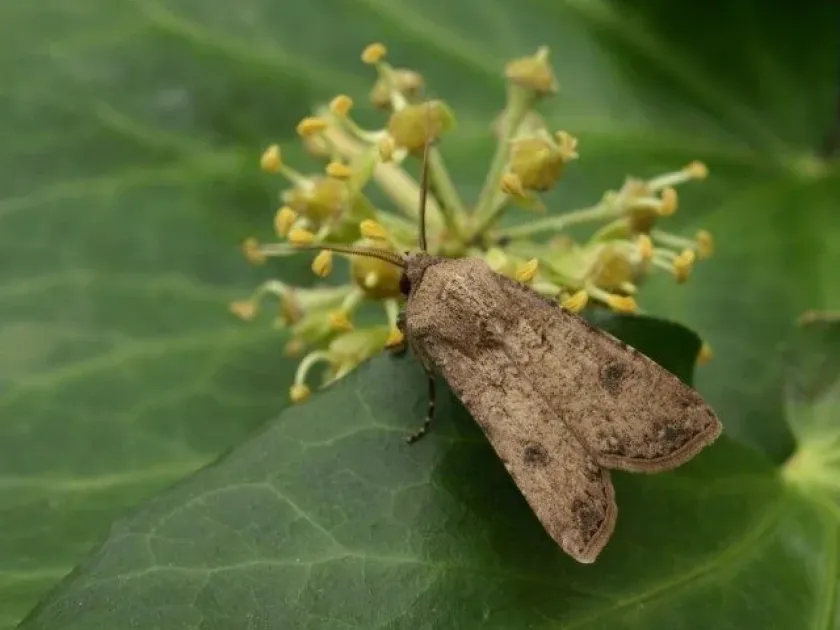
The Turnip moth (Agrotis lutescens) belongs to the order Lepidoptera and the Noctuidae family. The adult moth has a wingspan of approximately 45 mm, characterized by grayish-brown forewings with distinct patterns and spots.
The larvae, known as cutworms, grow up to 50 mm in length. Their bodies exhibit an earthy gray or brownish hue with a granular skin surface. These larvae are nocturnal and prefer to hide in the soil during the day.
The pupa is shiny, reddish-brown, and measures about 20 mm. It resides in an earthen cell within the soil, where metamorphosis takes place before the adult moth emerges.
The life cycle consists of four distinct stages: egg, larva, pupa, and adult. The number of generations per year is heavily influenced by regional climatic conditions and seasonal temperatures.
Adult moths are nocturnal and feed on nectar from flowers. During the day, they remain concealed in dense vegetation or burrow slightly into the topsoil to avoid predators and desiccation.
What it damages
As a significant polyphagous pest, the Turnip moth causes severe damage to numerous crops, including cereals, sugar beets, potatoes, maize, and sunflowers. Older instar larvae are the most destructive.
The primary mode of damage is severing the plant stems at the soil surface or slightly below it. This results in the collapse and rapid death of young seedlings, leading to reduced plant stands.
In sugar beet crops, larvae may burrow into the roots, creating deep cavities that promote secondary infections like soft rot, which significantly reduces the crop's market value.
In cereal fields, massive infestations can lead to complete loss of patches, necessitating re-sowing. The hidden nature of the damage often means it is discovered only after significant losses occur.
High infestations can drastically reduce overall yield potential, making the Turnip moth a primary concern for integrated pest management programs in many agricultural regions.
When it appears
The flight of the first generation adults typically begins in late spring or early summer, depending on soil temperatures. Peak egg-laying occurs during periods of favorable weather for larval development.
Larvae hatch within a few weeks and begin feeding. They progress through several instars, with older larvae eventually burrowing deeper into the soil as the season advances towards autumn.
The species typically overwinters as a fully grown larva in the soil, often at depths of up to 25 cm, which provides protection from extreme winter weather and predators.
In the spring, as the soil warms, the larvae migrate to the upper layers to pupate. After a successful pupation period, the first generation of adults emerges to start the cycle anew.
If a second generation occurs, it poses a major threat to newly planted winter cereals, as the timing of egg-laying often coincides with the germination and early growth stages of the crops.
Signs of infestation
A primary indicator of infestation is the sudden wilting or lodging of plants. A close inspection of the base of these plants will often reveal signs of stem gnawing or complete severance.
Frass (larval excrement) is frequently found on the soil surface near affected plants. Carefully excavating the top 3-5 cm of soil around the damaged area usually reveals the hiding cutworm.
The presence of bare patches in the field, where seedlings have been destroyed, is a late-stage warning sign indicating that the pest population has exceeded the economic threshold.
Using light traps or pheromone traps can effectively detect adult activity, providing early warnings that allow farmers to time their scouting and control interventions accurately.
Small, irregular holes in the leaves, caused by young larvae feeding before they move to the roots and stems, are an early warning sign of a developing infestation.
Control measures
- Deep autumn plowing to disturb the soil and expose overwintering larvae to predators.
- Effective weed management, as many weeds serve as host plants for young larvae.
- Application of insecticides during the evening when larvae emerge to feed on the surface.
- Utilizing pheromone traps for population monitoring and precise timing of control measures.
- Strategic crop rotation to reduce the build-up of larval populations in the soil over time.
Evening applications are critical because the larvae are strictly nocturnal, and topical insecticide coverage is significantly more effective when they are active above ground.
Discussion
No discussions yet — be the first.