
Long-toothed cutworm
Agrotis longidentifera
Description
How to identify
The long-toothed cutworm (Agrotis longidentifera) belongs to the family Noctuidae, order Lepidoptera. The adult is a nocturnal moth displaying morphological traits characteristic of the Agrotis genus.
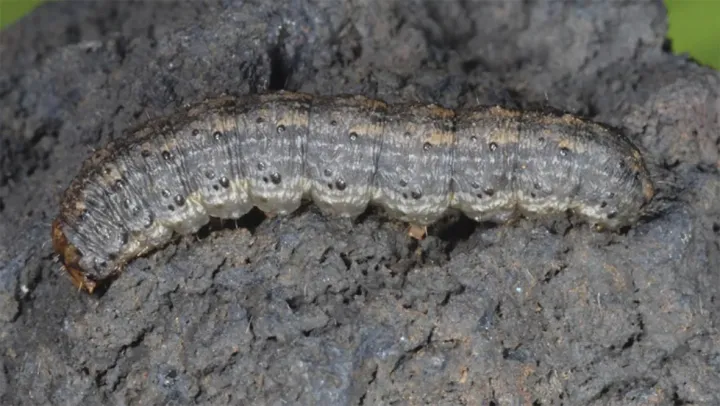
The insect's body is covered in dense hairs, with coloration ranging from grey to brownish, providing excellent camouflage against the soil surface. Larvae are earth-toned, enabling them to remain hidden within the topsoil during daylight hours.
Taxonomically, the species is distinguished by its specific genital structure and forewing patterns, which are essential for precise identification by entomologists in field conditions.
The development cycle follows a complete metamorphosis: egg, larva, pupa, and imago. Depending on the geographical zone, the species can complete one or two generations per year.
Modern field monitoring often utilizes pheromone traps to detect moth flight patterns, which helps agronomists predict peak egg-laying periods and optimize timing for control measures.
What it damages
This pest is highly polyphagous, causing significant economic losses to various crops. Cereals, including winter wheat, rye, and barley, are among the most frequently attacked.
The larvae also feed on row crops such as maize, sunflowers, and sugar beets. Damage occurs from the seedling stage through to the active growth phases of the plants.
Younger larvae are the most destructive, feeding at night and often cutting through the plant stems or root necks, causing plants to wilt and collapse rapidly.
High population densities can lead to severe thinning of stands, often necessitating the reseeding of affected areas, which increases production costs for the farm.
Additionally, the wounds created by the feeding larvae serve as entry points for various soil-borne pathogens, leading to secondary infections that further reduce harvest quality.
When it appears
Adult moth flight typically begins during the spring and early summer when soil temperatures are sufficient for activity. Peak activity is often observed in June and July.
Females deposit eggs primarily on the undersides of weeds or directly onto moist soil, ensuring the emerging larvae have immediate access to food and hydration.
Larval development is often staggered, requiring farmers to monitor their fields consistently throughout the vegetation season until the pest enters the pupal stage.
The species typically overwinters as a larva at various developmental stages deep within the soil profile, often between 10 to 20 centimeters below the surface.
In spring, larvae resume feeding as soon as crops emerge, making early growth stages the period of highest risk for significant damage.
Signs of infestation
The most prominent sign of an infestation is the appearance of uneven patches of wilting plants with irregular holes or skeletonized areas on the leaves.
Plants may show damage to the base of the stem or root collar, which is a classic indicator of cutworm activity causing the plant to fall over or wither.
Field scouting during the night can reveal larvae on the surface, while daytime checks of the soil around affected plants often uncover resting larvae curled in a C-shape.
Accumulations of larval excrement (frass) on the soil surface near the base of the plant are reliable signs of active feeding and should trigger immediate field assessment.
Rapid emergence of bare spots in a field, especially in the early spring, is a critical warning sign that requires professional intervention to prevent total crop loss.
Control measures
Deep autumn tillage is a highly effective cultural practice, as it exposes overwintering larvae to predators, desiccation, and freezing temperatures.
Maintaining clean fields by controlling weeds is essential, as vegetation serves as both a food source for young larvae and a site for adult moths to lay eggs.
Biological control options, such as the application of Bacillus thuringiensis or the release of egg parasitoids like Trichogramma, can reduce population numbers with minimal environmental impact.
Chemical control involving systemic insecticides is recommended when pest population density exceeds the economic injury threshold, targeting the larvae before they cause irreparable damage.
- Implement a diverse crop rotation system.
- Perform thorough seed treatment with systemic insecticides.
- Use pheromone traps for regular pest monitoring.
- Conduct timely inter-row cultivation to disturb soil-dwelling larvae.
Taxonomy
- Latin name
- Agrotis longidentifera
- Order
- Lepidoptera (butterflies)
- Family
- Noctuidae
- EPPO code
- EUXOLO
Discussion
No discussions yet — be the first.