
Greasy cutworm
Agrotis ipsilon
Description
How to identify
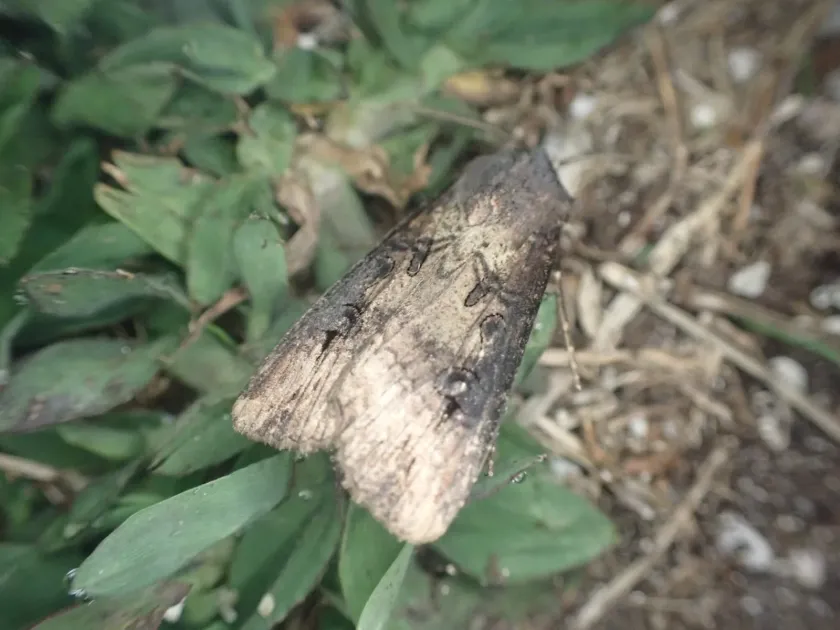
The greasy cutworm (Agrotis ipsilon) is a moth of the family Noctuidae. The adult moth has a wingspan of 40-50 mm, with greyish-brown forewings bearing a distinct dark, Y-shaped marking.
The larvae, known as cutworms, grow up to 50 mm long. They have a greasy, dark-grey to brownish appearance with a light dorsal stripe and a granular skin texture.
Eggs are small, hemispherical, and whitish, usually laid individually or in small clusters on the soil surface or low-growing vegetation.
Pupae are reddish-brown, smooth, and typically found in the soil at a depth of 5-15 cm, where they undergo development.
This species is a long-distance migrant, which allows it to rapidly colonize new areas and contribute to unpredictable seasonal outbreaks.
What it damages
Agrotis ipsilon is a polyphagous pest, causing severe damage to a wide range of crops including corn, cotton, potatoes, tobacco, and various vegetables.
Young larvae feed on the foliage, creating small holes, which is generally not economically damaging in itself.
Third-instar larvae and older become subterranean, cutting off stems of seedlings at or just below the soil surface, leading to plant death.
A single larva can destroy several seedlings in a row, leading to significant stand reduction and potential total yield loss in severely affected fields.
Large outbreaks often necessitate costly replanting operations and complicate standard field maintenance routines.
When it appears
Adult moths emerge in early spring when soil temperatures allow for activity. They are nocturnal and are attracted to light traps.
The number of generations depends on the climate, typically ranging from two to three per year in temperate regions, with more in warmer climates.
The larvae are most active during moist, cool periods. High soil moisture is generally conducive to the survival and development of young caterpillars.
Larval activity usually peaks during the early seedling growth stage, which is the most vulnerable time for agricultural crops.
The entire life cycle from egg to adult takes approximately 30 to 60 days, influenced heavily by ambient temperature and available food sources.
Signs of infestation
The most prominent sign is the sudden wilting of seedlings in a field, where affected plants can be easily pulled from the soil.
Visual inspection of the base of the plant reveals a clean cut or irregular gouging of the stem, often right at the soil level.
Larvae can be found by digging in the loose soil around the base of the damaged plant, usually coiled into a tight C-shape.
Sparse or missing patches in the crop row pattern are a common indicator of significant cutworm activity.
- Presence of cut-off stems at the soil level.
- Wilting plants that appear healthy otherwise.
- Larvae found coiled in the soil near damaged seedlings.
- Leaf damage (shot-holes) on young leaves.
Control measures
Cultural control practices include deep plowing and cultivation, which exposes pupae and larvae to predators and harsh environmental conditions.
Weed control is essential, as many common weeds serve as primary hosts for early-stage larvae before they transition to crop plants.
Chemical control involving insecticidal sprays is most effective when applied in the evening, coinciding with the peak nocturnal activity of the larvae.
Seed treatment with systemic insecticides is a highly effective preventative measure to protect seedlings during the crucial emergence phase.
Biological control agents, such as parasitoid wasps or nematodes (Steinernema spp.), can be utilized to manage larval populations sustainably.
Taxonomy
- Latin name
- Agrotis ipsilon
- Order
- Lepidoptera (butterflies)
- Family
- Noctuidae
- EPPO code
- AGROYP
Discussion
No discussions yet — be the first.