
Bogong moth
Agrotis infusa
Description
How to identify
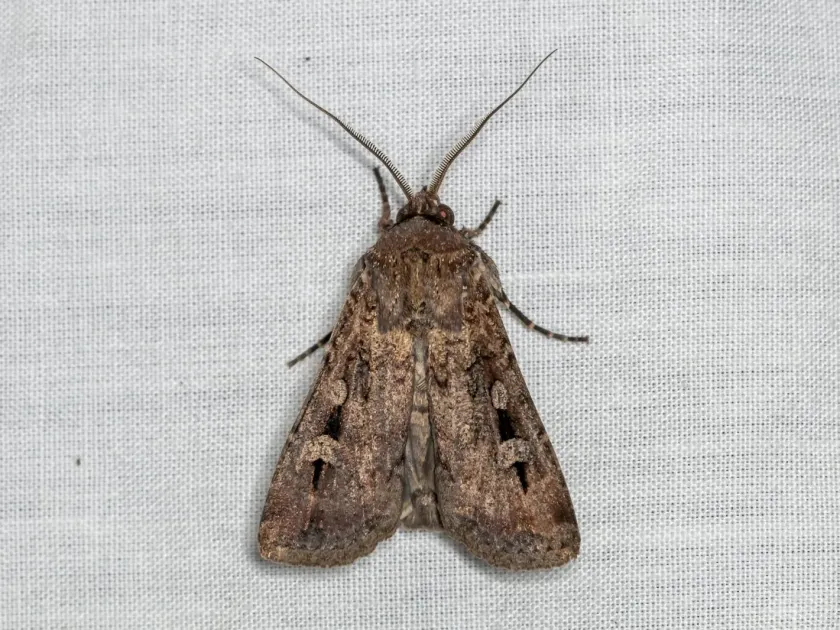
The Bogong moth (Agrotis infusa) is a migratory moth species belonging to the Noctuidae family, order Lepidoptera. Adult moths typically have a wingspan of 40-50 mm, featuring dark brown or black forewings with distinct pale markings that assist in identification.
The larvae, known as cutworms, grow up to 45-50 mm in length. Their bodies are dark, ranging from earthy brown to grey, which provides effective camouflage within the soil environment. They have a smooth appearance, lacking prominent body hair.
This species is famous for its unique biological behavior: adults undergo long-distance migrations to high-altitude mountain caves, where they enter a state of aestivation (summer dormancy) in massive aggregations to survive the heat.
Taxonomically, they are part of the genus Agrotis, which is widely recognized in agriculture for including major soil-dwelling pests. This lifestyle makes them notoriously difficult to detect during the early stages of crop development.
Field identification is often based on the specific behavior of the larvae as cutworms and the presence of the adult moths during their seasonal migration cycles, which coincide with specific agricultural windows.
What it damages
The Bogong moth larvae act as cutworms, posing a serious threat to a wide variety of crops, including cereals (wheat, barley), oilseeds (canola), and legumes (chickpeas). The most severe damage occurs when larvae sever the stems of young plants at ground level.
During outbreaks, these pests can decimate large areas of farmland, leaving behind patches of dead or missing seedlings. The damage is often localized initially, reflecting the distribution of egg-laying sites, but can rapidly spread.
Plants attacked by cutworms typically wilt and die shortly after the stem is cut. Since the vascular system is destroyed at the base, the plant cannot recover, leading to a direct reduction in plant density and final yield.
Economic losses arise not only from the destruction of seedlings but also from the high cost of remedial insecticide applications. In many cases, entire areas may require reseeding if the damage threshold is exceeded early in the season.
The intensity of the damage depends heavily on the larval age and the timing of the infestation relative to the crop's growth stage. Early detection is critical, as young plants have little capacity to withstand subterranean feeding.
When it appears
The life cycle of the Bogong moth is highly seasonal. Larval development generally takes place during the cooler months, which aligns with the germination and early vegetative growth stages of winter crops.
Adult moths migrate to their aestivation sites in late spring to escape the summer heat. This migration means that fields are relatively free of the pest during the height of the summer, as the population is aggregated in distant mountain regions.
The return migration and subsequent egg-laying in autumn trigger the start of the next generation. The survival and hatching success of these eggs are heavily influenced by autumn rainfall and ambient temperature conditions.
Monitoring for the pest should begin in the autumn when moths return to lay eggs. Agronomists use light traps and pheromone traps to detect adult activity, providing early warnings before the larvae become problematic.
Weather patterns, particularly mild and wet autumns, provide optimal conditions for the larvae to establish themselves in cropping areas. Monitoring soil conditions and seedling emergence is essential during these periods.
Signs of infestation
The first signs of a Bogong moth infestation are usually thinning crop stands. Seedlings may appear yellow or withered and are easily pulled from the soil, revealing that the roots or stems have been neatly severed.
By excavating the soil near the base of damaged plants during the day, one can usually find the larvae. They reside in the top 2-5 cm of the soil, remaining hidden to avoid predators and extreme surface temperatures.
Small "windows" or irregular edges on the leaves of young seedlings can indicate the presence of younger larvae before they become large enough to cut through the stems. This early sign is often a precursor to more severe damage.
Frass (larval excrement) found on the soil surface near the base of the plant is another reliable indicator of recent feeding activity by cutworms.
- Localized patchiness or thinning of crop stands.
- Wilting and yellowing of young seedlings.
- Evidence of stem severance at ground level.
- Presence of cutworm larvae in the soil near damaged plants.
Control measures
Integrated pest management (IPM) is the most effective approach to controlling Bogong moth populations. Deep tillage (ploughing) of fields after harvest can destroy larvae and pupae residing in the soil, significantly reducing the next generation.
Chemical control involving synthetic pyrethroids or organophosphates is often necessary when threshold levels are exceeded. These treatments should ideally be applied in the evening, coinciding with the peak surface activity of the larvae.
Crop rotation is a key strategy; avoiding the planting of susceptible crops in fields known to have high pest history helps break the life cycle of the cutworms.
Biological controls, such as the use of entomopathogenic fungi or bacterial agents, are becoming more popular. These products can be effective if applied under the right environmental conditions and at the correct larval stage.
Consistent monitoring and the use of threshold-based decision-making ensure that chemical interventions are timed for maximum efficacy, minimizing the environmental impact and reducing the cost of crop production.
Taxonomy
- Latin name
- Agrotis infusa
- Order
- Lepidoptera (butterflies)
- Family
- Noctuidae
- EPPO code
- EUXOIN
Discussion
No discussions yet — be the first.