
Desert cutworm
Agrotis desertorum
Description
How to identify
The desert cutworm (Agrotis desertorum) belongs to the order Lepidoptera and the family Noctuidae. It is a nocturnal moth species adapted to semi-arid and arid environments.
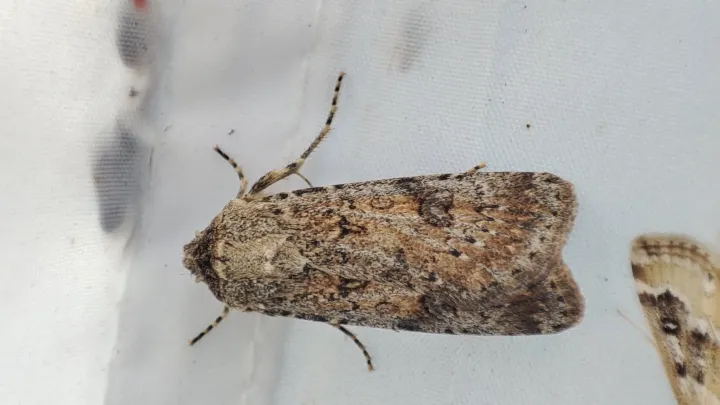
Adult moths have a wingspan of approximately 30–35 mm. Their forewings feature cryptic, brownish-grey patterns that provide excellent camouflage against dry soil and plant debris.
The larvae, known as cutworms, are cylindrical with a dusty-grey to brownish color, often marked with longitudinal stripes along the back and sides.
They possess a heavily sclerotized, dark head capsule equipped with robust mandibles, specialized for feeding on and severing the stems of young plants.
Pupation occurs within the soil, where the insect constructs a small earthen cell at a depth of 5–10 cm to protect itself during the metamorphosis stage.
What it damages
This pest is highly polyphagous, meaning it feeds on a wide array of agricultural crops, including cereals, sunflowers, sugar beets, and various vegetable species.
The primary damage is caused by the larvae, which feed on young seedlings, often severing the stem at or just below the soil surface, leading to rapid wilting and death.
In cases of high infestation, cutworms can destroy significant portions of a crop, resulting in thin, patchy stands and forcing farmers to consider replanting.
Damage is particularly severe during dry springs, as moisture-stressed plants are unable to compensate for the destruction of their root-shoot junctions.
The economic impact is high because the larvae are difficult to detect, often causing significant losses before the presence of the pest is even confirmed.
When it appears
The flight of the first generation of moths typically begins in late spring, continuing into early summer depending on local temperature and moisture conditions.
Females deposit eggs in small clusters, primarily on weeds, crop residues, or directly on the soil surface near suitable host plants.
The developmental cycle from egg to adult is highly responsive to ambient temperature, generally spanning between 30 to 50 days under favorable conditions.
In warm, southern latitudes, the desert cutworm can complete two or more generations per year, significantly increasing its potential for population outbreaks.
The pupal stage often includes a period of diapause, which allows the species to survive prolonged periods of extreme heat or winter cold in the soil profile.
Signs of infestation
The most evident sign of a desert cutworm infestation is the appearance of wilted or collapsed seedlings in parts of the field, creating scattered dead patches.
Close inspection of affected plants reveals the characteristic severed stem, often with the upper part of the plant resting on the soil near the intact root system.
Searching for the larvae requires digging into the top 2–5 cm of soil around the base of damaged plants during the day, as they hide from the sun and predators.
Pheromone traps are highly effective tools for monitoring adult moth populations, providing an early warning of potential larval infestations in the upcoming weeks.
High weed density in fields serves as an attractant for egg-laying females and provides early sustenance for young larvae before they transition to crop plants.
Control measures
Cultural control is a cornerstone of management: deep fall tillage disrupts pupal cells, exposing the insects to desiccation, frost, and avian predators.
Aggressive weed management is essential both before and during the early growing season to deprive larvae of alternative food sources and egg-laying sites.
Chemical control involving insecticide application is effective if timed correctly; evening applications are preferred as larvae are most active on the surface at night.
Integrated Pest Management (IPM) strategies, including the use of bait formulations, can help suppress populations without broad-spectrum insecticide sprays.
Monitoring fields closely during the susceptible seedling stage allows for targeted interventions, minimizing the cost and environmental impact of chemical applications.
Taxonomy
- Latin name
- Agrotis desertorum
- Order
- Lepidoptera (butterflies)
- Family
- Noctuidae
- EPPO code
- AGRODE
Discussion
No discussions yet — be the first.