
Grey rustic
Agrotis cinerea
Description
How to identify
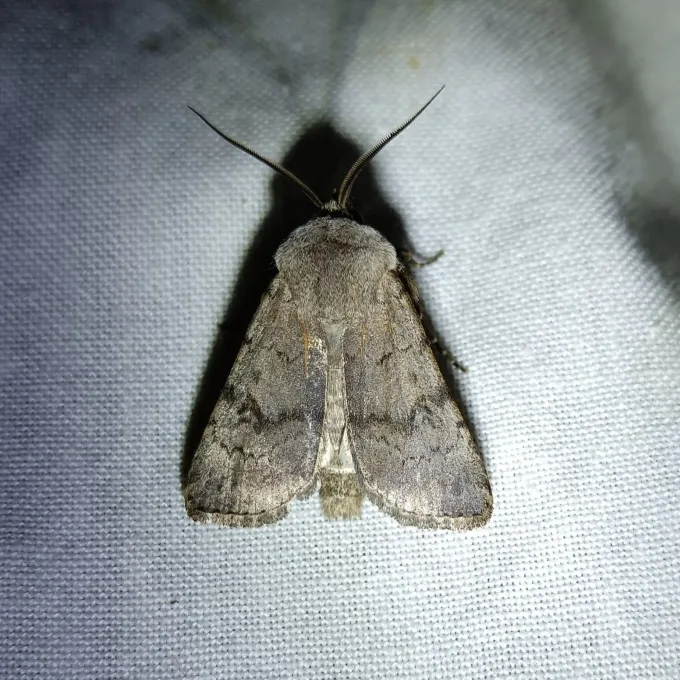
The Grey rustic (Agrotis cinerea) is a moth belonging to the Noctuidae family. The adult moth has a wingspan of approximately 35–40 mm, with forewings that are typically ash-grey or brownish-grey, providing excellent camouflage against soil or bark.
The larvae, or caterpillars, of this species grow up to 45 mm in length. Their body color is earthy, blending in with the soil, and they often feature darker longitudinal lines along the dorsal side of the body.
The pupa is smooth, shiny, and dark brown, typically found in a small chamber within the upper layers of the soil. This position allows the insect to survive unfavorable environmental conditions throughout its pupal stage.
The eggs are hemispherical and are laid by the female moth either directly on the soil surface or on the undersides of weeds, which provide the initial food source for the hatching larvae.
The life cycle comprises egg, larval (six instars), pupal, and adult stages. In most temperate regions, the species completes one generation per year, with the larvae serving as the primary overwintering stage.
What it damages
This pest is a polyphagous insect capable of damaging a wide array of crops, including cereals, sugar beet, maize, and sunflower. Its ability to feed on many plant species makes it a significant threat in diverse agricultural systems.
The most severe damage occurs when larvae feed on the roots and underground stems of young plants. By severing the stem at the base, the caterpillar causes the plant to wilt and die suddenly.
Younger larvae feed on the leaf tissue, which can weaken the seedlings significantly. While this damage is rarely lethal on its own, it leaves the plant vulnerable to pathogens and environmental stress.
Damage is usually more pronounced in fields with high weed pressure, as weeds serve as the primary host for the initial larval instars before they migrate to the more palatable crop plants.
Large outbreaks can lead to significant thinning of crop stands, which may necessitate reseeding operations or result in substantial yield losses at the end of the season.
When it appears
The flight period of adult moths typically begins in late spring and lasts until mid-summer. As nocturnal insects, they remain inactive during the day, hidden in soil cracks or dense vegetation.
Larval activity is primarily nocturnal; during the day, the caterpillars retreat into the soil to avoid predators and heat. This behavior makes early detection of the pest quite challenging for farmers.
Overwintering occurs in the soil, where larvae remain at a sufficient depth to avoid freezing. As temperatures rise in the spring, they migrate to the surface to resume feeding.
The pupation period occurs in the summer months, usually within the soil. Adult moths emerge later, completing the cycle, although some larvae may enter diapause to survive until the next year.
Weather conditions, particularly soil moisture, play a crucial role in the survival rate of the larvae. Excessive drought or heavy rains at specific stages can significantly impact the population density.
Signs of infestation
The most visible sign of infestation is the presence of wilting or dying plants in an otherwise healthy field. These plants can easily be pulled out of the ground due to severed roots.
Careful inspection of the soil around affected plants usually reveals the presence of holes or tunnels. Digging a few centimeters into the soil often uncovers the larvae resting near the base of the plant.
Small, irregular holes in the foliage of young plants, caused by the feeding of younger larval instars, are an early indicator that a moth population is present and active.
Accumulation of frass (larval excrement) in the soil near the plant base is another telltale sign of an active infestation that warrants further investigation and possible control measures.
Fields with high weed populations should be monitored closely, as they often serve as the focal point from which the caterpillars spread to the main crop.
Control measures
- Deep autumn plowing to disturb and kill overwintering larvae in the soil.
- Rigorous weed control in and around fields to remove alternative hosts and egg-laying sites.
- Use of insecticidal seed treatments to provide early-stage protection for vulnerable seedlings.
- Biological control through the release of beneficial organisms like egg parasitoids.
- Application of chemical insecticides during evening hours when larvae are most active on the surface.
Taxonomy
- Latin name
- Agrotis cinerea
- Order
- Lepidoptera (butterflies)
- Family
- Noctuidae
- EPPO code
- AGROCI
Discussion
No discussions yet — be the first.