
Turnip moth
Agrotis bigramma
Description
How to identify
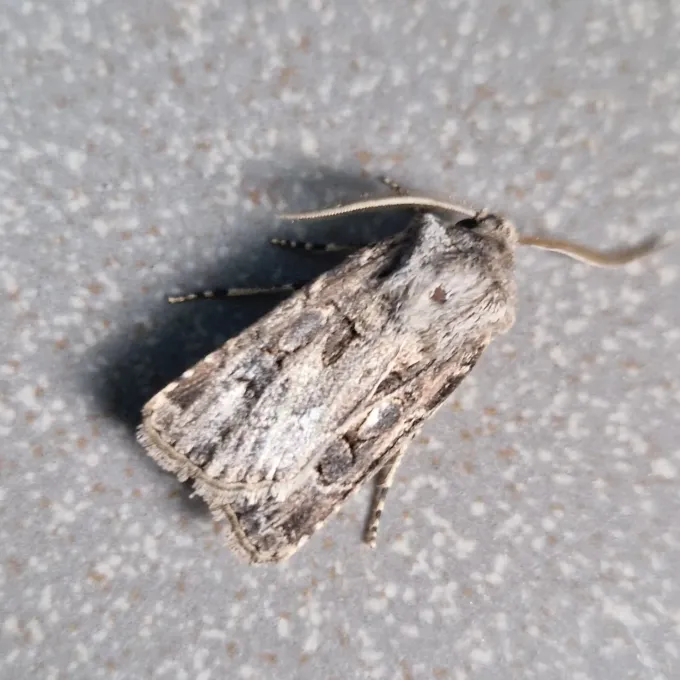
The Turnip moth Agrotis bigramma (closely related to Agrotis segetum) belongs to the Noctuidae family. The adult moth has a wingspan of up to 45 mm, with brownish-grey forewings featuring distinct darker markings.
The larvae, commonly known as cutworms, grow up to 50 mm long. They have a greasy appearance, ranging from earthy grey to dark brown, and possess the characteristic behavior of curling into a tight ring when disturbed.
The pupae are reddish-brown, glossy, and typically reside in the soil at a depth of 10-15 cm. They are protected within an earthen cell, which provides them with insulation and security against predators.
The biology of the Turnip moth is nocturnal; the moths feed on flower nectar and are attracted to light. Their activity patterns are highly influenced by regional climate conditions and soil moisture levels.
The eggs are small, hemispherical, and approximately 0.5 mm in diameter. Females lay them individually or in small clusters on the underside of weed leaves or on the base of host plant stems.
What it damages
This polyphagous pest attacks over 150 plant species, including wheat, barley, sugar beet, maize, sunflower, and potatoes. Its impact can be catastrophic for young crop stands.
Young larvae feed on the foliage, skeletonizing leaves, while older larvae live in the soil. Their subterranean feeding habits make them particularly difficult to detect before severe damage occurs.
The primary form of damage is the cutting of stems at the soil surface or severing of root systems. This leads to plant wilting, sudden death, and noticeable thinning of the crop stand.
In high infestation years, cutworms can destroy large areas of crops, sometimes requiring complete replanting. Damage is most critical during the early growth stages when plants are fragile.
Root crops like sugar beets and potatoes are especially vulnerable. Larvae burrow into the tubers or roots, creating deep tunnels that render the produce unmarketable and susceptible to rot.
When it appears
The Turnip moth typically undergoes two generations per year in most temperate agricultural zones. The late-stage larvae overwinter deep within the soil profile, surviving harsh winter temperatures.
In spring, as soil temperatures rise, larvae move toward the surface to pupate. The subsequent emergence of the first generation of moths usually spans from late May through June.
The second generation is often more damaging to newly sown winter crops. Monitoring the timing of moth flights is essential for predicting the emergence of larvae in the late summer and autumn.
Moderate temperatures and moist soil conditions favor egg development and larval survival. Prolonged droughts during the egg-laying period can significantly reduce the pest's population density.
Agricultural managers must track seasonal phenology using local data. Timing field inspections to match the life cycle of the moth is crucial for timely intervention.
Signs of infestation
Sudden wilting of plants in patches is the most common visual indicator of an infestation. Upon inspection, affected plants often have severed roots or stems eaten through at the base.
Searching the soil around the base of wilting plants during the day will often reveal the curled-up larvae. Digging 5-10 cm into the soil is necessary to confirm their presence.
Evidence of foliage damage, such as small circular holes in the leaves, indicates early-stage larval activity. This is a primary signal to investigate the soil for more advanced larvae.
Using pheromone or light traps helps in identifying the peak flight periods of the moths. High counts in traps indicate that immediate field surveys are required to prevent larval damage.
Fields with high weed density are primary targets for egg-laying females. If the field is overgrown with weeds like bindweed or pigweed, the risk of cutworm damage is substantially higher.
Control measures
Deep autumn plowing is a highly effective control measure. It exposes overwintering larvae to birds, predators, and environmental extremes, significantly reducing their survival rate.
Effective weed management is vital to minimize egg-laying sites. By keeping fields and borders clean of weeds, farmers make the area less hospitable for the Turnip moth population.
Insecticide applications should be targeted at the period when larvae are newly hatched. Systemic or contact treatments are most effective before the larvae reach the late stages and enter the soil.
Integrated pest management (IPM) practices, such as pheromone monitoring, help in timing chemical interventions accurately, ensuring environmental and economic efficiency.
- Use of crop rotation.
- Application of insecticidal seed treatments.
- Regular soil cultivation during the season.
- Introduction of biological control agents and natural predators.
Taxonomy
- Latin name
- Agrotis bigramma
- Order
- Lepidoptera (butterflies)
- Family
- Noctuidae
- EPPO code
- AGROBG
Discussion
No discussions yet — be the first.