
Brown-spot Chestnut
Agrochola litura
Description
How to identify
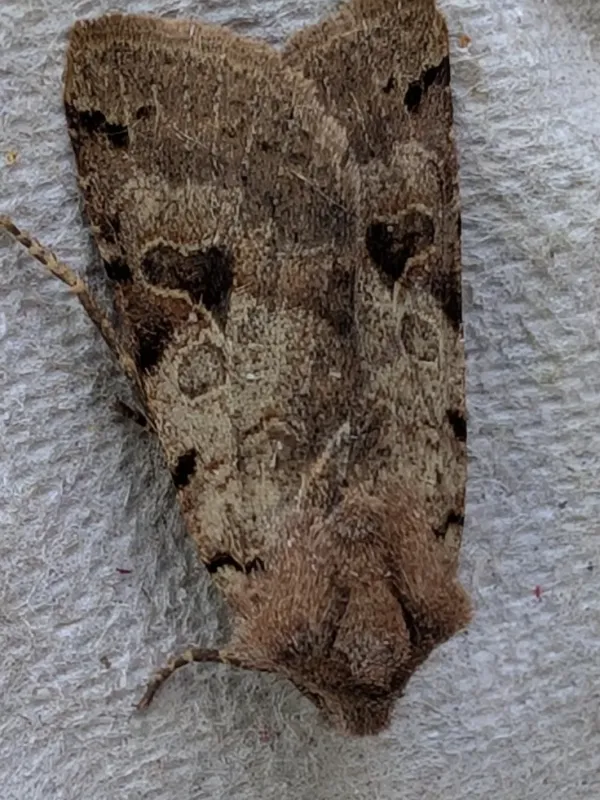
Brown-spot Chestnut (scientific name: Agrochola litura) is a moth belonging to the family Noctuidae. The adult moth typically has a wingspan ranging from 32 to 38 mm.
The forewings exhibit a color palette varying from grayish-brown to reddish-brown. Dark transverse lines and spots serve as camouflage, allowing the moth to blend into tree bark or dead vegetation during the day.
The larvae, or caterpillars, can reach lengths of up to 40 mm. They are generally greenish-gray or brownish, featuring lighter longitudinal stripes that help them hide effectively among foliage.
The species completes one generation per year. The eggs, which are laid by females on host plant branches or in the soil, serve as the overwintering stage, ensuring resilience against cold temperatures.
Adult moths are nocturnal, active primarily at night when they are attracted to light sources and feed on the nectar of flowering plants.
What it damages
This pest is highly polyphagous, meaning it feeds on a wide array of plant species. Agrochola litura is particularly problematic for fruit orchards and various field crops.
Host plants include fruit trees such as apples and pears, berry bushes, various vegetable crops, and several wild-growing grasses.
Young larvae feed primarily on buds and emerging leaves, often skeletonizing them. This feeding pattern stunts plant growth and significantly reduces the photosynthetic capacity of the plant.
As fruits mature, larvae may burrow into the pulp, creating deep tunnels. This behavior destroys the marketability of the produce and creates entry points for secondary infections like fruit rot.
Severe infestations in orchards can result in substantial crop losses and general weakening of trees, making them more susceptible to environmental stressors in subsequent seasons.
When it appears
Caterpillar emergence from overwintered eggs typically coincides with the bud-burst period in spring. This timing makes them especially dangerous to early-season development.
The larval feeding stage lasts until early summer, after which they migrate into the soil for pupation. The pupal stage lasts several weeks before the adult moths emerge.
The flight period for adult moths begins in late summer and continues throughout the autumn months, during which mating and egg-laying occur.
In the autumn, moths are frequently spotted on late-flowering plants, building up energy reserves for reproduction before the onset of winter.
Monitoring efforts should be conducted in two phases: early spring to detect larvae activity and late summer to assess the population density of adult moths.
Signs of infestation
Initial signs of infestation are damaged buds, which may appear hollowed out or be entirely consumed by early spring.
Leaves display irregular feeding holes. In cases of high larval density, only the leaf veins may remain, giving the plant a skeletonized appearance.
- Frass (excrement) accumulation on leaf surfaces beneath feeding sites.
- Circular or deep ulcerous wounds on the skin of maturing fruits.
- Wilting or deformation of young shoots, often indicating high larval presence.
- Visual detection of caterpillars during night inspections using a flashlight.
Sticky residues on fruits and leaves, which often attract ants, can also serve as an indirect indicator of noctuid moth activity.
Control measures
Effective management of Agrochola litura requires an integrated approach that combines cultural, biological, and chemical strategies.
Cultivation practices such as autumn tillage of the soil around tree bases can effectively disrupt the life cycle by destroying pupae and overwintering larvae.
Biological control methods include the utilization of natural enemies and specialized products containing Bacillus thuringiensis, which are particularly effective against early-instar larvae.
In scenarios of high population pressure, the application of systemic or contact insecticides approved for use on the specific crop may be necessary.
The deployment of pheromone traps is recommended to monitor flight patterns, allowing for precise timing of interventions to minimize economic impact.
Taxonomy
- Latin name
- Agrochola litura
- Order
- Lepidoptera (butterflies)
- Family
- Noctuidae
- EPPO code
- AMATLI
Discussion
No discussions yet — be the first.