
Agonum assimile
Agonum assimile
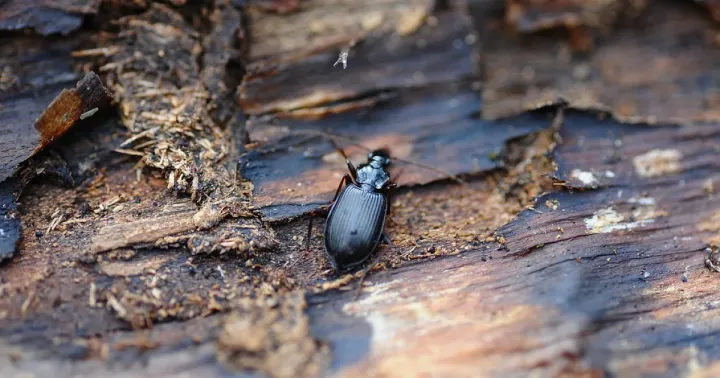
Description
How to identify
Agonum assimile belongs to the ground beetle family (Carabidae) of the order Coleoptera. These are small, dark beetles, typically 7–9 mm in length, known for their metallic luster on the elytra.
The beetle's body is flattened, which allows it to move easily through leaf litter and soil crevices. Their coloration ranges from dark bronze to almost black, with a distinctively shaped pronotum.
The larvae of this species have an elongated form, well-developed thoracic legs, and sclerotized bodies. They live hidden lives, preferring moist, shaded areas of agricultural fields.
Identification of the adults is possible by examining the structure of the pronotum and the shape of the last abdominal segment. In field conditions, they are often caught using pitfall traps.
This species is a typical representative of mesophilic entomofauna, favoring woodland edges and moist fields with dense vegetation cover.
What it damages
While most ground beetles are beneficial predators, some species, including those in the genus Agonum, may exhibit phytophagy when their natural food sources are scarce.
The primary damage is inflicted upon seedling crops, especially during the early stages of development. Adult beetles can damage cotyledons and young leaves of cereals and technical crops.
This pest poses a specific threat during periods of extreme drought or when the population density of their natural insect prey decreases significantly within the agroecosystem.
Damage appears as irregular tissue feeding on leaves, which reduces the photosynthetic capacity of the plants. In severe cases, high beetle density may lead to the total loss of young seedlings.
Beyond direct feeding damage, their presence can facilitate the transmission of fungal pathogens through the wounded plant tissues.
When it appears
Adult activity begins in early spring as soon as soil temperatures reach 8–10 degrees Celsius. Peak beetle population counts are typically observed during May and June.
The life cycle includes a complete metamorphosis: egg, larva, pupa, and adult. Females lay eggs in the soil near host plants, creating optimal conditions for rapid larval feeding after hatching.
Summer generations of adults are primarily nocturnal, seeking shelter during the day. In autumn, the beetles migrate to deeper soil layers or beneath crop debris to hibernate.
Larval development is time-intensive, which is why the most vulnerable phases of crop growth often coincide with the active foraging periods of the new generation.
Temperature and soil moisture are the critical environmental factors determining larval survival rates throughout the vegetation period.
Signs of infestation
Signs of this pest become visible when inspecting field margins and areas with excessive moisture. Characteristic "windowing" on leaves points to adult feeding activity.
Specific types of damage to seedlings that do not match the usual activity of chewing insects may signal the presence of these ground beetles.
In the evening, field surveys may reveal active individuals moving quickly across the soil surface. Using a light source helps to identify them by the characteristic reflection of their armor.
Indirect evidence includes the presence of empty seed shells or damaged underground stems if the pest switches to feeding on the root collar.
During mass occurrences, clusters of insects may be found under soil clods or plant residues in the early morning hours.
Control measures
Effective management begins with agrotechnical measures designed to create unfavorable conditions for the survival of the pest's overwintering stages.
- Deep autumn plowing to destroy overwintering sites.
- Timely removal of weeds along field perimeters.
- Strict crop rotation to interrupt the development cycle.
- Use of high-quality seed treatments with systemic insecticides.
- Targeted insecticide applications during peak adult activity.
Chemical control must be strictly justified by economic threshold data, as ground beetles are frequently beneficial natural enemies of other agricultural pests.
Biological control methods, such as the application of entomopathogenic nematodes, may prove effective in humid climates with adequate soil aeration.
Monitoring population numbers via pheromone or light traps allows for precise timing of control measures while minimizing overall pesticide usage.
Discussion
No discussions yet — be the first.