
Ageniaspis citricola
Ageniaspis citricola
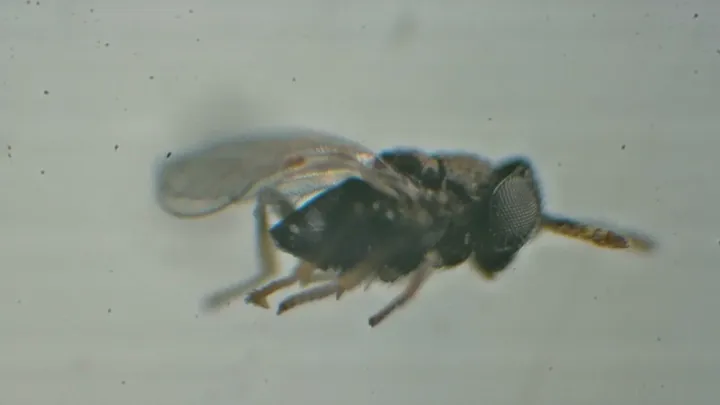
Description
How to identify
Ageniaspis citricola is a beneficial parasitic wasp belonging to the order Hymenoptera and the family Encyrtidae. It is a highly specialized parasitoid of the citrus leafminer.
The adult wasps are minute, dark-colored insects with a metallic sheen, specifically adapted to navigate through citrus canopy to locate their hosts.
This species is well-known for its polyembryonic reproduction, meaning a single egg can produce multiple larvae inside a single citrus leafminer host.
Because of its effectiveness and ease of establishment, Ageniaspis citricola has been introduced into many citrus-growing regions globally.
It remains one of the most reliable biological agents for controlling leafminer populations without the need for intensive chemical applications.
What it damages
Ageniaspis citricola does not damage plants; instead, it provides essential ecosystem services by feeding on citrus leafminer (Phyllocnistis citrella) larvae.
The citrus leafminer is a major pest that creates serpentine mines in young leaves, leading to leaf distortion, stunted growth, and decreased photosynthetic capacity.
By parasitizing the leafminer larvae, the wasp prevents the pest from completing its life cycle and causing extensive damage to the citrus foliage.
In addition to physical damage, unchecked leafminer infestations often leave plants susceptible to citrus canker, making the work of the wasp even more vital.
Managing the pest with this parasitoid ensures healthier tree development, robust shoot growth, and sustained yields across all citrus varieties.
When it appears
The presence and activity of the wasp are synchronized with the growth flush of citrus trees, as this is when the leafminer is most active.
During warm and humid months, the wasp population flourishes, providing effective control throughout the active growing season of the trees.
In cooler periods or during tree dormancy, when leafminer activity decreases, the population of the wasp naturally declines due to the lack of hosts.
Under favorable conditions, the parasitoid can complete its life cycle in less than a month, allowing for multiple generations per year.
This rapid reproductive cycle allows Ageniaspis citricola to respond quickly to sudden outbreaks of the leafminer pest during the main flush cycles.
Signs of infestation
Detection of the wasp's activity can be done by inspecting leaf mines, where signs of parasitic larvae or pupae may be visible under magnification.
Small exit holes on the surface of the mines indicate that an adult wasp has successfully emerged from the leaf tissue after developing within the host.
Parasitized leafminer larvae often exhibit changes in shape or transparency, which are clear indicators of internal infestation by the wasp.
A decline in the number of active, healthy leafminer mines over a few weeks suggests that the wasp is successfully suppressing the population.
Overall, orchards with a healthy population of Ageniaspis citricola show significantly less leaf curling and distortion compared to untreated areas.
Control measures
The most important control measure is the preservation of existing wasp populations by avoiding the use of broad-spectrum, toxic insecticides.
If chemical intervention is absolutely necessary, growers should select selective pesticides that have low toxicity to beneficial Hymenoptera species.
Maintaining good orchard hygiene and balanced pruning helps promote uniform growth flushes, allowing the wasp to search for hosts more efficiently.
In cases of severe infestation, biological augmentation involves releasing lab-reared wasps into the orchard to re-establish the ecological balance.
- Reduce frequency of chemical sprays.
- Adopt Integrated Pest Management (IPM) practices.
- Monitor parasitism rates before taking action against leafminers.
Taxonomy
- Latin name
- Ageniaspis citricola
- Order
- Hymenoptera
- Family
- Encyrtidae
- EPPO code
- AGENCI
Discussion
No discussions yet — be the first.