
Common agama
Agama agama
Description
How to identify
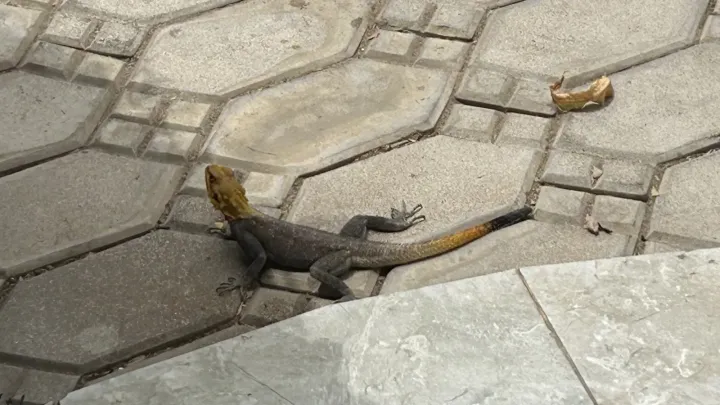
The Common agama (Agama agama) belongs to the Agamidae family. It is a medium-sized lizard, with adult males displaying striking orange-red heads during the breeding season.
The body is covered in keeled scales, and they possess a long, distinct tail. They are known for their ability to thrive in modified habitats near human settlements.
As thermophilic animals, they rely on solar radiation to maintain body temperature and are most active under bright sunlight.
The species exhibits complex social behavior, with males establishing territories that often overlap with cultivated fields and garden areas.
Reproduction involves laying eggs in moist soil, which directly links their biological cycle to the presence of cultivated, irrigated plots.
What it damages
These lizards primarily damage agriculture by feeding on tender sprouts, seedlings, and the leaves of young vegetable crops.
In nurseries, they can cause significant economic losses by grazing on valuable plant material, leading to stunted growth or total plant failure.
Fruits located near the soil surface are often bitten or damaged, providing entry points for secondary fungal and bacterial infections.
Their burrowing behavior can disturb root systems and alter soil structure, causing instability for young seedlings.
In arid or drought-prone areas, they frequently damage irrigation tubing by gnawing on plastic, causing water leaks and system inefficiency.
When it appears
Their activity peaks during the hottest and driest parts of the year when their metabolic needs and search for water are at their highest.
In tropical environments, they are active year-round, while in subtropical areas, their activity fluctuates with seasonal temperature changes.
Daily activity is strictly diurnal, with the highest levels of feeding and territorial defense occurring during the mid-morning and afternoon hours.
Seasonal migrations are minimal, but populations tend to cluster around irrigation sources and human-made structures during dry seasons.
Breeding cycles are tied to the onset of seasonal rains, which creates a spike in local population density and activity levels.
Signs of infestation
Distinctive grazing marks on plant foliage, often showing clean-cut edges or significant loss of leaf area, indicate lizard feeding.
Presence of specific, cylindrical feces found on mulch or bare soil is a primary indicator of an established agama presence.
The discovery of small tunnel entrances or soil disturbance in rows suggests the lizards are using the garden as a nesting site.
Systematic damage to poly-tubing or plastic irrigation lines with noticeable bite marks is a sign of water-seeking behavior.
Regular visual sightings of lizards basking on stones, walls, or fences within the crop area confirm the risk of active damage.
Control measures
Physical exclusion remains the most effective control measure; using fine mesh screens or barriers around nursery beds stops access.
Landscape management, including the removal of rock piles, wood debris, and tall weeds, reduces available shelter and nesting habitat.
Maintaining irrigation integrity and quickly repairing leaks prevents the lizards from focusing their activities near water sources.
Regular soil cultivation helps disrupt potential nesting sites and discourages the females from laying eggs within the planting rows.
In severe cases, non-toxic deterrents can be applied around the perimeter of the crop area to discourage lizard entry into the sensitive zones.
Taxonomy
- Latin name
- Agama agama
- Family
- Agamidae
- EPPO code
- AGAMAG
Discussion
No discussions yet — be the first.