
Apple clearwing
Aegeria pyri
Description
How to identify
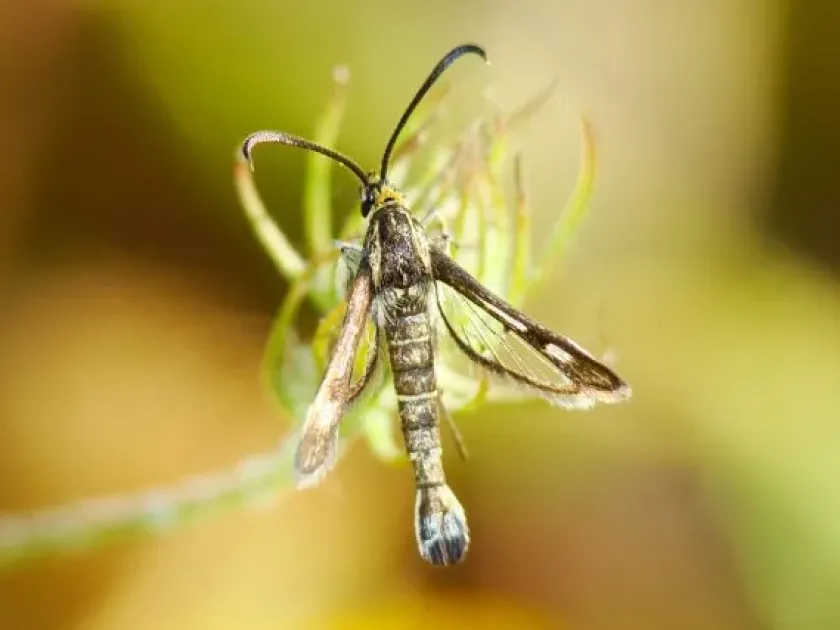
The apple clearwing (Aegeria pyri) is a moth belonging to the family Sesiidae. These insects are famous for their mimicry, as adults closely resemble wasps or hornets to deter potential predators.
Adult moths have a wingspan of approximately 20 mm. Their wings are largely transparent, with dark venation and a distinct dark margin, while their abdomen is marked with yellow bands, enhancing the illusion of a stinging insect.
The larvae, which are the destructive stage, are cream-white with brown heads. They grow up to 25 mm in length and reside entirely within the bark and cambium layers of host trees.
The life cycle typically lasts one to two years. Eggs are laid singly in bark crevices or near existing wounds on the trunks and scaffold branches of trees.
Pupation occurs within the larval galleries, and the emerging adults typically appear during the late spring and early summer period, coinciding with the end of apple blossom.
What it damages
The larvae feed on the bark and cambium of various fruit trees, including apple, pear, quince, cherry, plum, and ornamentals like rowan and hawthorn.
By tunneling through the conductive tissues, the larvae disrupt nutrient transport, which severely weakens the tree, particularly affecting young specimens with thin bark.
The galleries created by the larvae provide easy access for secondary pathogens, such as fungal infections like Nectria canker, leading to larger wounds and tree decline.
Trees heavily infested with clearwing show stunted growth, reduced fruit size, and a general lack of vigor due to the impaired flow of water and nutrients.
In severe cases, if larvae encircle the trunk or a major branch, the affected part of the tree may wilt, turn brown, and eventually die due to complete vascular failure.
Signs of infestation
The most reliable sign of an apple clearwing infestation is the presence of 'frass'—fine, brownish wood shavings or sawdust pushed out of the larval entry holes on the trunk.
Visible holes, approximately 2–3 mm in diameter, can be spotted on the bark, sometimes with sap or gum exuding from the wound site, especially on stone fruits.
Empty pupal casings, which look like dry, brown shells, often remain partially protruding from the exit holes after the adult moth has emerged.
Patches of necrotic or cracking bark, often accompanied by callous tissue formations, suggest that the larvae have been active in that area for some time.
Visible decline in the crown, including premature leaf fall and yellowing foliage during the growing season, indicates significant damage to the tree's internal structure.
Control measures
Effective management requires a combination of monitoring, cultural practices, and, when necessary, targeted insecticide applications during the adult flight period.
Maintaining tree health through proper fertilization and watering is critical, as vigorous trees are better able to heal small wounds and resist initial larval colonization.
Trapping adults with pheromone lures is an excellent way to monitor population levels and precisely time control measures, as chemical sprays are ineffective once larvae have burrowed into the wood.
Mechanical control involves scrubbing off loose bark where eggs might be laid and ensuring that any bark damage is promptly treated with protective wound paint.
- Regular inspection of trunks for early signs of frass.
- Removing and destroying branches that are heavily infested.
- Applying whitewash to the lower trunks to discourage egg-laying.
- Protecting young trees with fine mesh guards during the flight season.
Discussion
No discussions yet — be the first.