
Portland moth
Actebia praecox
Description
How to identify
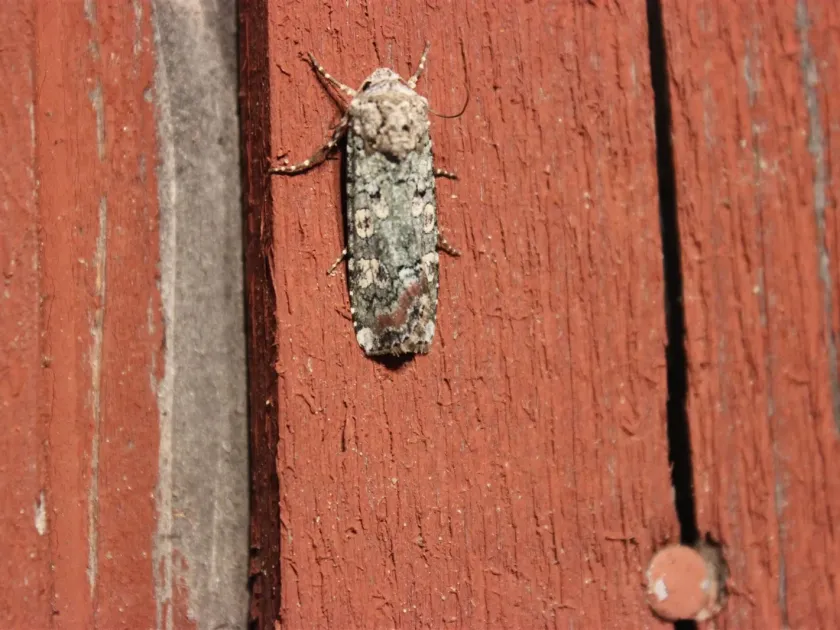
The Portland moth (Actebia praecox) is a moth of the family Noctuidae. It is a nocturnal species with a wingspan typically ranging from 40 to 50 mm.
The forewings have a distinctive greenish color with greyish or brownish undertones, providing excellent camouflage against sandy soil and surrounding vegetation.
The hindwings are paler, usually brownish-grey, which helps the moth remain inconspicuous when resting during the day.
The larvae, known as cutworms, can grow up to 45 mm in length and exhibit a grey-brown or greenish color with darker longitudinal stripes along their body.
The species undergoes complete metamorphosis: egg, larva, pupa, and adult. The lifecycle typically involves overwintering as a larva buried in the soil.
What it damages
This species is a polyphagous pest, though it has a strong preference for habitats with sandy or light loamy soils where it finds ideal conditions.
It damages a wide range of plants, including cereals, root crops, vegetables, and various wild plants that grow in coastal or dune ecosystems.
In agricultural settings, larvae can cause significant damage to young shoots by consuming leaves or severing the roots and stems at the soil surface.
High population densities can lead to thin stands of crops, as the larvae are highly active and capable of consuming large amounts of plant tissue nightly.
The damage caused by these larvae can also make the affected plants more susceptible to pathogens and environmental stress during critical growth stages.
When it appears
The adult moth flight period occurs in late summer, usually extending from July to August or early September, depending on local climate conditions.
Eggs are laid at night, primarily on the soil surface or the underside of the leaves of host plants, where larvae will begin feeding upon hatching.
Larvae develop throughout the autumn and eventually burrow into the soil to undergo diapause, ensuring their survival through the winter months.
In spring, as temperatures rise, the overwintered larvae emerge from the soil to resume feeding on young vegetation, which is the most vulnerable stage for crops.
Pupation takes place within the soil, inside protective earthen cells, before the cycle repeats with the emergence of the next generation of adults.
Signs of infestation
Signs of infestation include irregular holes or "notching" on the edges of leaves, which are typical symptoms of larval feeding activity.
The presence of frass (dark granular excrement) near the base of the plant is a strong indicator of the larval presence in the immediate area.
Wilted or fallen seedlings are often signs of cutworm damage, indicating that the larva has severed the plant stem just below the soil level.
Careful examination of the soil surface around affected plants during the day often reveals the resting larvae, which avoid sunlight.
- Ragged edges on foliage.
- Stem severance near the root collar.
- Presence of dark larval droppings.
Control measures
Effective control begins with proper soil management, including deep plowing in late autumn, which exposes larvae and pupae to predators and frost.
Weed control is essential, as many common weeds serve as secondary food sources that support the population during the early stages of larval development.
Chemical control involving systemic insecticides is applied when monitoring indicates that larval populations have exceeded the economic threshold.
Pheromone monitoring can be used to track adult moth activity, helping to time insecticide applications accurately for maximum efficiency.
Biological control agents, such as formulations of Bacillus thuringiensis, offer a targeted way to reduce larval numbers while preserving beneficial insects.
Taxonomy
- Latin name
- Actebia praecox
- Order
- Lepidoptera (butterflies)
- Family
- Noctuidae
- EPPO code
- RHYIPR
Discussion
No discussions yet — be the first.