
Psi dagger
Acronicta psi
Description
How to identify
The Psi dagger (Acronicta psi) is a moth belonging to the family Noctuidae, characterized by a wingspan of approximately 35–45 mm.
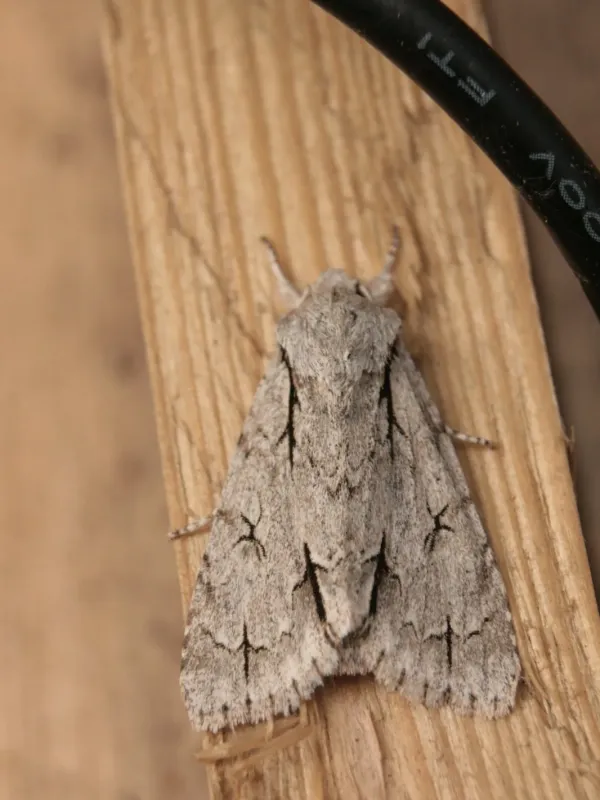
It derives its common name from the distinct black mark on its forewings, which resembles the Greek letter psi (ψ), serving as a primary identification mark.
The larvae, or caterpillars, are visually striking, featuring a yellow dorsal stripe and red spots along their bodies, which are covered in long, sparse hairs.
The adults possess a grey or brownish-grey color that provides excellent camouflage against tree bark, where they typically rest during the daytime.
Pupae overwinter in tough, silken cocoons hidden within crevices of bark or deep in leaf litter, ensuring protection against harsh winter conditions.
What it damages
The Psi dagger is a polyphagous pest, meaning it feeds on a wide range of deciduous trees and shrubbery commonly found in temperate gardens.
Major host plants include various members of the Rosaceae family, such as apple, pear, cherry, plum, and crabapple trees, which are often the most affected.
Caterpillars cause damage by feeding on leaves, often starting from the margins and consuming the tissue between veins, leading to skeletonized foliage.
High infestation levels can lead to significant defoliation, which impairs the tree's photosynthetic capability and affects long-term vitality and fruit yield.
In addition to mature trees, young saplings in nurseries are particularly vulnerable to larvae feeding, which can stunt their growth and overall development.
When it appears
The life cycle of the Psi dagger typically involves one or two generations per year, largely dependent on local climate conditions and heat accumulation.
Adult moths of the first generation emerge in late spring, generally peaking between May and June, with a possible partial second brood later in August.
Larvae are active throughout the summer months, feeding continuously as they progress through several instars before finally preparing for pupation.
Overwintering occurs exclusively in the pupal stage, with the insects remaining dormant until favorable spring temperatures trigger their emergence.
Monitoring the flight period of adults is essential for predicting caterpillar emergence and timing any necessary control interventions during the season.
Signs of infestation
The most obvious sign of infestation is the presence of eaten foliage, where leaves appear tattered or have parts of the blade completely missing.
Frass (larval droppings) visible on leaves beneath the canopy is a clear indicator that caterpillars are feeding high up in the tree branches.
The colorful larvae are often seen directly on the foliage, as they are not exclusively nocturnal and can be spotted during daylight inspections.
Finding sturdy cocoons tucked into bark crevices during winter pruning is a reliable way to assess the presence and potential intensity of the population.
Premature leaf drop in mid-to-late summer, specifically on branches with visible damage, often points toward the feeding activity of this moth species.
Control measures
Effective management of the Psi dagger involves a combination of preventative cultural practices and targeted biological or chemical treatments.
- Scraping and cleaning loose bark from trunks in early spring to destroy hibernating pupae.
- Clearing away leaf litter in the fall to remove potential overwintering sites for the larvae.
- Applying biological insecticides containing Bacillus thuringiensis when caterpillars are in their early stages.
- Using broad-spectrum or selective chemical insecticides during peak infestation if thresholds are exceeded.
- Encouraging bird populations and other natural predators to maintain ecological balance within the orchard.
Taxonomy
- Latin name
- Acronicta psi
- Order
- Lepidoptera (butterflies)
- Family
- Noctuidae
- EPPO code
- ACRNPS
Discussion
No discussions yet — be the first.