
Poplar dagger moth
Acronicta lepusculina
Description
How to identify
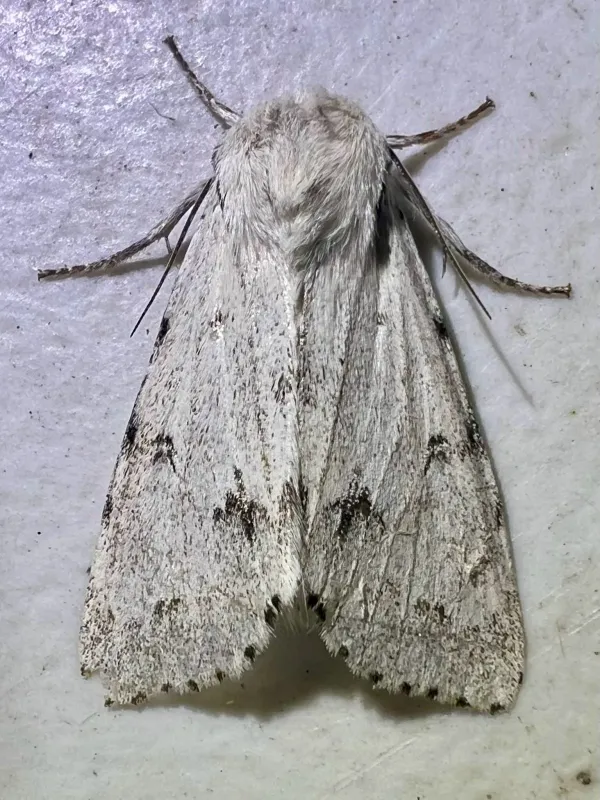
The poplar dagger moth (Acronicta lepusculina) is a member of the Noctuidae family, widely distributed across North America and parts of Eurasia. The adult moth has a wingspan ranging from 40 to 55 mm, characterized by mottled gray and white forewings with dark dagger-like markings.
The larvae are particularly distinct: they are densely covered in long, soft white or yellowish hairs. This "fuzzy" appearance is often punctuated by dorsal tufts of black or dark brown bristles, making them easily recognizable among other tree pests.
The life cycle undergoes complete metamorphosis, including egg, larva, pupa, and adult stages. They typically overwinter as pupae, encased in sturdy cocoons hidden within bark crevices or organic debris at the base of the host tree.
Adults typically emerge in late spring to early summer. After mating, females deposit their eggs on the undersides of leaves, ensuring that hatching larvae have immediate access to food sources.
Populations are often regulated by natural predators, including various species of parasitic wasps and predatory beetles that specifically target the moth's larval stage.
What it damages
The primary hosts for this species are members of the Populus genus, including cottonwoods, quaking aspen, and other poplar varieties. They are also occasionally observed feeding on willow species.
The larvae are leaf defoliators. While isolated damage is rarely fatal to established trees, repeated heavy infestations can significantly impact the overall health and growth rates of young saplings.
In forest nurseries and plantations, extensive feeding can lead to significant loss of photosynthetic surface area, which slows down wood production and weakens the tree's vigor.
Severe infestations might cause premature leaf drop, making the trees more susceptible to secondary stressors such as fungal infections, drought, or harsh winter conditions.
In ornamental landscaping, the physical presence of these large, hairy caterpillars and the resulting damage to foliage can be highly unsightly and undesirable for urban planning.
Signs of infestation
Early signs of infestation include skeletonized leaves, where young caterpillars feed on the soft tissue between veins, leaving behind a delicate, net-like structure.
As the caterpillars grow, their appetite increases, and they begin consuming the entire leaf blade, eventually leaving behind only the petiole and main veins, or stripping branches entirely.
The presence of large amounts of frass (caterpillar excrement) on leaves beneath the feeding area is a classic symptom of an active infestation in the canopy.
Look for the caterpillars themselves on the branches; their distinct white hair and dark tufts make them visible against the green leaves of the host trees.
- Skeletonized leaf patterns.
- Complete defoliation of branch tips.
- Accumulation of dark frass on lower foliage.
- Visible presence of hairy larvae in the canopy.
Control measures
For large-scale management, biological control using Bacillus thuringiensis (Bt) is recommended, as it specifically targets lepidopteran larvae while sparing beneficial insects and predators.
Manual removal of larvae or destruction of overwintering cocoons in small gardens can be an effective way to keep the population density below the damage threshold.
In cases of severe outbreak, professional applications of systemic or contact insecticides may be necessary, timed specifically to coincide with the early larval stage for maximum efficacy.
Good silvicultural practices, such as maintaining proper spacing between trees and ensuring optimal soil health, help trees withstand occasional defoliation events.
Encouraging biodiversity by protecting bird populations that prey on these insects is a sustainable long-term strategy for managing the poplar dagger moth in woodlands.
Taxonomy
- Latin name
- Acronicta lepusculina
- Order
- Lepidoptera (butterflies)
- Family
- Noctuidae
- EPPO code
- ACRNLE
Discussion
No discussions yet — be the first.