
American dagger moth
Acronicta americana
Description
How to identify
The American dagger moth (Acronicta americana) is a nocturnal moth belonging to the family Noctuidae. The adult moth has a wingspan of approximately 50–65 mm and features gray or grayish-brown wings with dark, arrow-like markings.
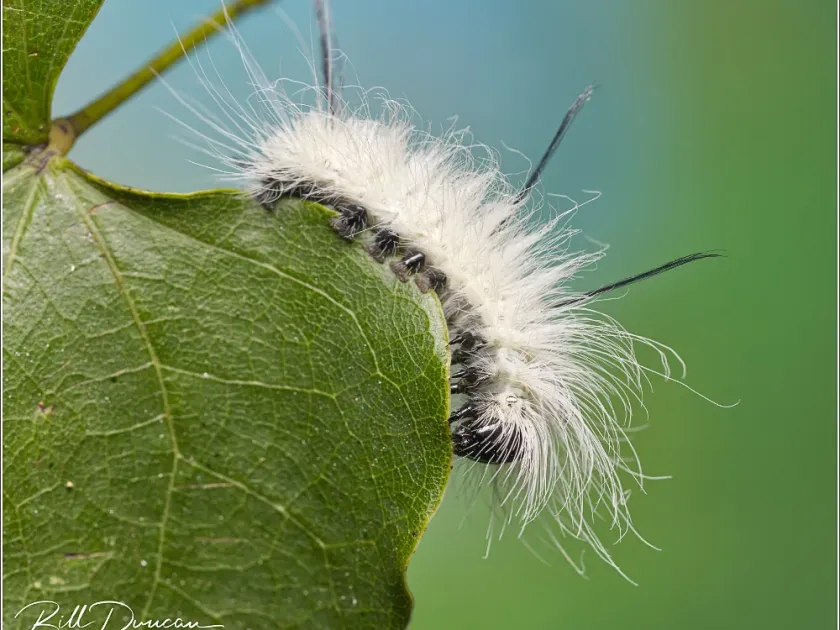
The larvae, commonly known as caterpillars, are distinctive and easily recognized. They are covered in long, yellowish-white hairs that give them a fuzzy appearance.
Mature caterpillars reach lengths of up to 50 mm. They possess striking black hair tufts along their sides and back, which can cause skin irritation upon contact in humans.
The pupa is dark brown and housed within a dense, tough cocoon constructed from silk mixed with bark debris or soil particles.
The life cycle encompasses the egg, five larval stages (instars), pupal stage, and adult. This species is native to North America and typically overwinters in the pupal stage.
What it damages
The caterpillars are foliage feeders that primarily attack a variety of deciduous trees. Their common hosts include maple, alder, birch, ash, oak, and chestnut trees.
Young larvae feed gregariously, skeletonizing the leaves by consuming the tissue between the veins. This early-stage damage often leaves the leaf looking like a fine lace.
As they grow, the larvae begin to consume entire portions of the leaf, including the edges, which leads to significant defoliation of the tree canopy.
Severe infestations can lead to a drastic reduction in the leaf surface area, which stresses the tree, inhibits growth, and reduces its ability to store energy for the winter.
While mature trees can usually withstand moderate defoliation, young saplings in nurseries or new plantings are particularly susceptible to severe vigor loss.
When it appears
Adult moths typically emerge in late spring, with peak activity levels during the summer months. They are nocturnal and are frequently attracted to artificial lights.
Depending on the climatic zone, the moth produces one or two generations per year. The larval activity peaks during the mid-to-late summer period.
Pupation occurs in late summer or early autumn. The cocoons are attached to tree trunks or protected crevices, where they remain throughout the winter.
Monitoring for signs of the pest should begin in early summer when the first batch of eggs is usually laid on the undersides of the host tree leaves.
Environmental conditions, such as temperature and humidity, play a significant role in determining the speed of larval development and the number of generations.
Signs of infestation
The most evident signs of an infestation are skeletonized leaves that eventually turn brown and fall prematurely from the tree.
Frass (caterpillar droppings) accumulating on the leaves or the ground beneath the tree canopy is a clear indicator of active feeding by the larvae.
Tough, brown, silk-covered cocoons attached to the bark of tree trunks or branches are definitive evidence of the species' presence in the vicinity.
Significant thinning of the tree canopy, particularly in the upper branches, often accompanies a large population of feeding larvae.
Visual identification of the distinctive fuzzy yellow caterpillars on leaves or branches is the most direct way to confirm the presence of this specific pest.
Control measures
Mechanical control, such as hand-picking the gregarious larvae while they are still in early stages, is effective for small trees or isolated garden settings.
Biological control using Bacillus thuringiensis (Bt) is highly effective against the caterpillars and is considered environmentally friendly as it spares beneficial insects.
For large infestations or high-value trees, targeted applications of registered insecticides can be used, ensuring compliance with local environmental regulations.
Cleaning up leaf litter and debris in the autumn can help destroy cocoons that are tucked away in fallen leaves, thereby reducing the overwintering population.
Encouraging natural predators such as birds and predatory wasps can help maintain the moth population at levels that do not cause significant economic or aesthetic damage.
Taxonomy
- Latin name
- Acronicta americana
- Order
- Lepidoptera (butterflies)
- Family
- Noctuidae
- EPPO code
- ACRNAM
Discussion
No discussions yet — be the first.