
Sycamore moth
Acronicta aceris
Description
How to identify
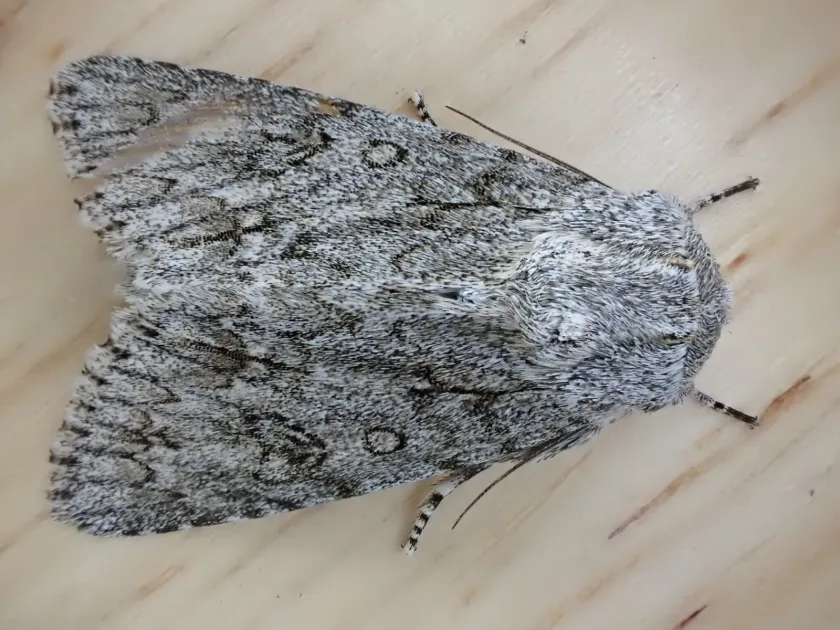
The sycamore moth (Acronicta aceris) is a member of the Noctuidae family, commonly found across Europe and temperate parts of Asia.
Adult moths have a wingspan of 40–50 mm; their forewings are typically light grey with dark markings, providing excellent camouflage against tree bark.
The caterpillar is highly distinctive, characterized by dense tufts of yellow or orange hair and a row of black diamond-shaped spots along its dorsal side.
The species typically undergoes one generation per year, though in warmer southern climates, a partial second generation may emerge.
The insect overwinters as a pupa, protected within a tough silk cocoon hidden in bark crevices or other secluded spots on the host tree.
What it damages
The primary host plants for the larvae include maples (Acer spp.), horse chestnut, and lime trees, though they occasionally feed on fruit trees.
Young larvae feed gregariously, initially skeletonizing the leaves, while older caterpillars feed individually and consume large portions of the leaf tissue.
Severe infestations can lead to significant defoliation, which stresses the tree, reduces photosynthetic capacity, and impairs overall vigor.
In ornamental landscaping, heavy damage results in an unsightly appearance and may affect the long-term health of the affected specimens.
Repeated annual damage can weaken the tree's resistance to secondary pathogens and harsh weather conditions, leading to branch dieback.
When it appears
Adults emerge from late May to June, during which time they mate and deposit eggs on the undersides of host plant leaves.
Larval activity reaches its peak from late June through August as the caterpillars grow rapidly and require high amounts of forage.
Pupation occurs in late summer or early autumn, as the caterpillars seek secure locations to spin their overwintering cocoons.
Environmental factors, such as temperature and humidity, play a critical role in the timing of larval development each season.
Gardeners should focus monitoring efforts during the mid-summer period when the caterpillars are most visible and actively feeding.
Signs of infestation
The presence of the large, hairy caterpillars is the most obvious sign, as they are easily spotted on the branches or feeding on foliage.
Ragged, irregular holes in the leaves, often accompanied by leaf skeletonization, are clear indicators of larval grazing activity.
Frass (caterpillar droppings) accumulating on leaves or lower branches is a common signal that a colony is active in the canopy.
The discovery of grey or brown silk cocoons hidden in tree bark or wall crevices during the winter confirms the presence of the population.
Silk webbing on leaves, though less prominent than in some other species, can sometimes be observed in areas of heavy caterpillar congregation.
Control measures
Manual removal of caterpillars is a practical and effective solution for smaller trees or low-level infestations in private gardens.
Biological control methods, including the use of Bacillus thuringiensis sprays, are highly recommended as they target the larvae without harming beneficial insects.
Proper orchard hygiene, such as removing debris and scraping loose bark, helps reduce the number of suitable sites for overwintering cocoons.
Chemical intervention should be reserved for severe cases and timed precisely with the early larval instars for maximum efficiency.
Encouraging natural predators, such as insectivorous birds and parasitic wasps, provides a sustainable approach to long-term population management.
Taxonomy
- Latin name
- Acronicta aceris
- Order
- Lepidoptera (butterflies)
- Family
- Noctuidae
- EPPO code
- ACRNAC
Discussion
No discussions yet — be the first.