
Millet stem borer
Acigona ignefusalis
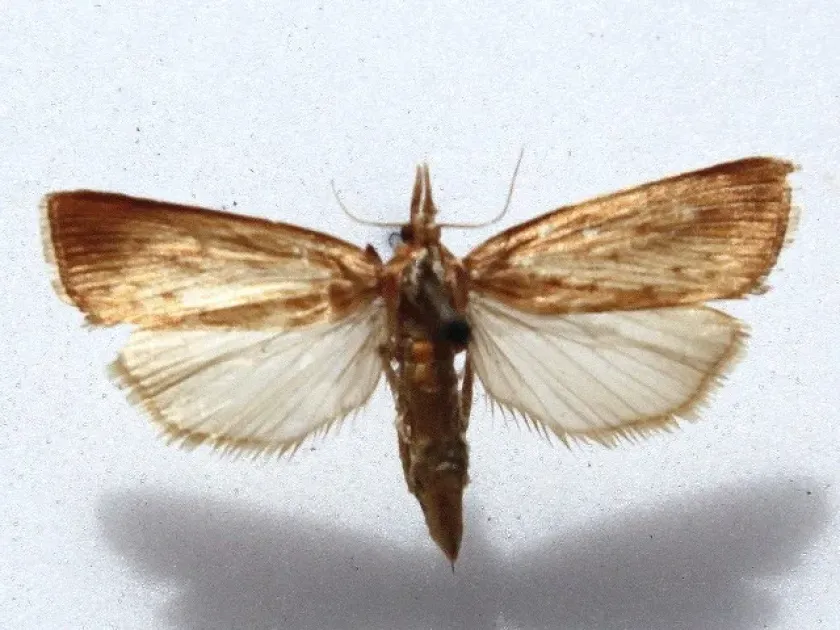
Description
How to identify
The millet stem borer, scientifically identified as Acigona ignefusalis, is a moth species of the family Crambidae. It is considered a major pest of pearl millet and other related cereals in sub-Saharan Africa.
The adult moth is relatively small, with a wingspan of approximately 20 to 25 mm. The forewings are typically straw-colored or light brown, featuring distinct dark markings that provide excellent camouflage on host plants.
The larval stage is the most destructive phase of the insect's life cycle. The larvae are creamy-white to yellowish in color, often marked with dark spots on their segments, making them distinguishable from other stem-boring species.
The life cycle involves several generations per year, depending on the availability of host plants and climatic conditions. Eggs are laid in clusters, usually on the leaf sheaths or near the base of the stems.
Development is highly influenced by temperature and humidity; warm, moist conditions significantly shorten the development time, allowing for rapid population increases during the growing season.
What it damages
The primary host for Acigona ignefusalis is pearl millet, but it is also known to infest sorghum and various wild grasses. The larvae cause severe damage by tunneling into the stems of the plants.
By boring into the stalk, the larvae disrupt the vascular tissues responsible for transporting nutrients and water. This obstruction often leads to stunted growth, reduced tillering, and poor development of the plant's panicle.
Young plants are particularly vulnerable; an attack on the growing point often results in a condition known as "dead heart," where the central shoot dies, effectively halting the plant's reproductive development.
The galleries created by the larvae provide easy access for secondary pathogens, such as fungi and bacteria, which can lead to stem rot and systemic plant failure before the harvest stage.
Yield losses can be massive, with reported cases in severe infestations showing reductions of 30 percent or more of the grain yield, posing a significant threat to regional food security.
Signs of infestation
One of the earliest symptoms is the wilting or "dead heart" of the central leaf in young millet plants, which is a clear indicator that a larva has damaged the growing point.
Small entry holes on the stalks, often surrounded by "frass" (larval excrement resembling sawdust), confirm that a larva has successfully bored into the plant tissue.
Deformed or broken stems are common as the plant matures. Because the internal structural integrity is compromised by the larval tunnels, stalks often snap under moderate wind pressure.
In older plants, the failure of the panicle to emerge properly or the presence of a "chaffy" head indicates that the stem’s nutrient transport system was severed by the borer.
Physical inspection of the stem interior by cutting the stalk open usually reveals the presence of larvae or the evidence of their feeding channels throughout the pith.
Control measures
Cultural control is the most sustainable approach, including the rotation of host crops to non-host species to interrupt the lifecycle and reduce the local pest population density.
Removing and destroying crop residues immediately after harvest is critical, as this removes the shelter where larvae and pupae survive between growing seasons.
Planting resistant or tolerant cultivars is highly recommended as a primary strategy, offering protection without the need for additional chemical inputs in endemic areas.
- Early planting to avoid peak pest emergence windows.
- Using biological control agents, such as egg parasitoids.
- Monitoring pest activity with pheromone-based traps.
- Targeted application of biological insecticides like Bt strains.
Chemical control remains an option for extreme outbreaks, but it must be managed carefully by timing applications to coincide with the larval stage before they penetrate the stalks.
Taxonomy
- Latin name
- Acigona ignefusalis
- Order
- Lepidoptera (butterflies)
- Family
- Noctuidae
- EPPO code
- ACIGIG
Discussion
No discussions yet — be the first.