
Purple deep-sea shrimp
Acanthephyra purpurea
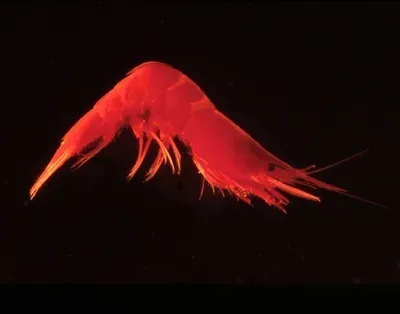
Description
How to identify
Acanthephyra purpurea is a species of deep-sea shrimp belonging to the family Oplophoridae, within the order Decapoda.
This organism resides in deep oceanic waters, typically inhabiting the bathypelagic zone, where light penetration is extremely low.
Physically, the species is recognized by its vivid purple or deep red carapace, which serves as a physiological adaptation for camouflage in the dark ocean.
Its morphology is strictly adapted for swimming and scavenging in an aquatic environment, featuring specialized appendages for movement.
It is fundamentally a marine organism and has no biological link to terrestrial plant ecosystems or agricultural crop pests.
What it damages
Acanthephyra purpurea causes absolutely no damage to agricultural crops, garden plants, or stored agricultural produce.
Since it is an abyssal species, it does not come into contact with land-based plants or the soil environments used for farming.
The diet of this shrimp consists of zooplankton and organic debris, playing a role in the marine food chain rather than the agricultural one.
There is no record of this species interfering with plant development, nutrient uptake, or yield quality in any farming system.
Classifying it as a plant pest is scientifically incorrect as there is no ecological overlap between this species and agricultural land.
When it appears
The life cycle of Acanthephyra purpurea is independent of terrestrial seasonal changes and agricultural growing cycles.
It reproduces and grows throughout the year in the stable conditions of the deep ocean, unaffected by surface weather patterns.
Agricultural timelines, including sowing, cultivation, and harvest periods, have no relevance to the biological activity of this species.
Agronomists do not monitor this shrimp because its population dynamics are entirely tied to oceanographic variables.
There is no specific "season" for this species in the context of plant protection or field management.
Signs of infestation
There are no signs of infection or infestation by Acanthephyra purpurea on terrestrial plants, as the species cannot survive outside the ocean.
Any damage observed on crops should be attributed to local insect pests, pathogens, or environmental stressors common to your specific region.
Attempts to identify this shrimp as a crop pest are misdirected and will not yield any findings related to agricultural damage.
If marine organisms are suspected in irrigation systems, it is a matter of water supply quality control rather than a plant pathology issue.
Consulting standard pest identification manuals will confirm that this species is absent from any list of recognized agricultural pests.
Control measures
No protection measures, chemicals, or integrated pest management (IPM) strategies are required for Acanthephyra purpurea.
Expenditure on control methods for this marine species would be entirely unjustified as it poses zero risk to crops.
Focus should be directed toward managing genuine pests that affect plant health, productivity, and regional economic stability.
Standard agricultural practices for crop maintenance are sufficient to protect against relevant threats without concern for marine fauna.
Professional agronomists must distinguish between oceanic organisms and agricultural threats to ensure efficient resource allocation.
Taxonomy
- Latin name
- Acanthephyra purpurea
- Family
- Oplophoridae
- EPPO code
- AYRAPU
Discussion
No discussions yet — be the first.