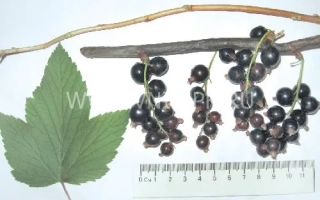
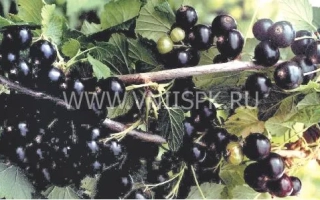
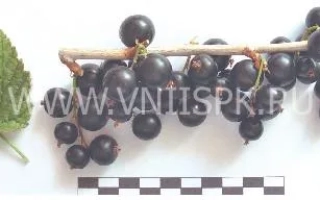
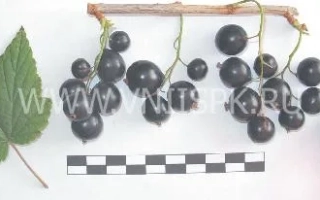
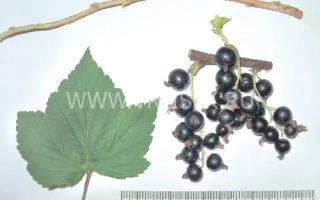
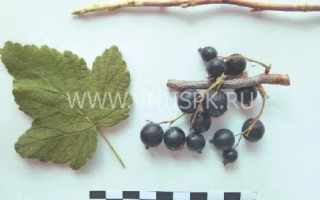
Introduced at the Minusinsk Experimental Garden and Melon Station from crossing of the form [Sinyaya x (Minusinka + Nadezhda + Khasanovets)] and the variety Festival. Authors: V.F. Cherkinsky, L.P. Muravieva, G.A. Muraviev. Under state variety testing since 2005.
Strong-growing, moderately spreading, medium-density bush. Non-hardwood (green) shoots are thick, straight, light green, with moderate anthocyanic coloring in the upper part, hairy, hardened shoots — medium thickness, straight, light gray, hairy, matte. Buds are small, egg-shaped, with pointed apex, light green, with weak anthocyanic coloring, moderately hairy, deviated, solitary, leaf scar shape is rounded-triangular.
Leaf three-lobed, large, green, matte, wrinkled, loose, blade concave. Central lobe is long, exceeds lateral lobes. Lateral lobes are long, wide, apexes sharp, directed sideways, angle between their veins acute. Base of leaf has medium, open notch.
Teeth are small, apexes of teeth have a 'claw', veins are not colored. Leaf petiole is long, thin, bare, light green, anthocyanic coloring in upper part of shoot.
Flowers are medium-sized, calyx lobes are light pink, arranged loosely. Inflorescences are medium length and density, thick. Axis is thick, petiole short, bare.
Berries are large (1.4–3.2 g), oval, uneven, nearly black, medium skin, dry detachment, with many small seeds, tart-sweet flavor (4.8 points), universal use. Calyx is closed, medium, non-falling, pedicel is short, brown-green, bare. Chemical composition: dry solids — 13.0%, total sugars — 5.4%, titratable acidity — 2.8%, ascorbic acid — 192.0 mg/100 g.
Variety is highly winter-hardy, self-fertile (up to 52%), highly resistant to powdery mildew, anthracnose, septoria, and bud mite, moderately drought-tolerant, heat-resistant, yield 7.7 t/ha (1.6 kg/plant).
Advantages of the variety: winter hardiness, early fruiting, high annual yield, comprehensive resistance to major pests and diseases.
Disadvantages of the variety: spreading bush, uneven berry size.