
Appalachian farmers rebuild topsoil after Hurricane Helene ravaged fields
More than a year after Hurricane Helene, farms in Tennessee and North Carolina are still rebuilding the topsoil that floodwater stripped away or buried under sand and silt.
Farmers in the southern Appalachians are still rebuilding not only fences, barns, and machinery after Hurricane Helene, but the soil itself. Grist reports that on Will Runion's 736-acre cattle and hay farm in northeast Tennessee, the Nolichucky River rewrote the landscape on September 27, 2024. When the flood receded, Runion found debris, dead fish, and tomatoes washed down from upstream vegetable farms, along with severe damage across his hay ground.
According to the report, two holes the size of football fields were carved into his pastures to a depth of 12 feet, while other sections were buried under as much as 8 feet of sand or silt. Helene dumped up to 30 inches of rain across the southern Appalachians and caused historic flooding and landslides in North Carolina, South Carolina, Tennessee, Georgia, Kentucky, and Virginia. In North Carolina alone, agriculture losses were estimated at $4.9 billion, while Tennessee agriculture losses were estimated at $1.3 billion.
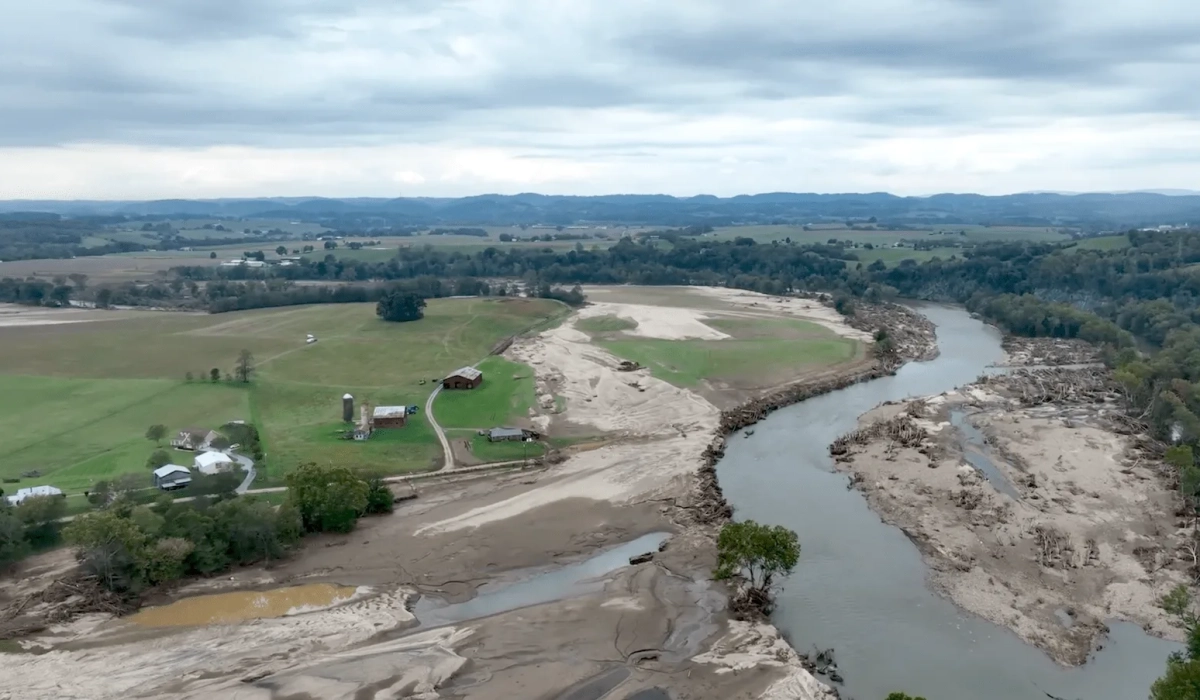
The lasting agronomic problem is the loss of topsoil. Scientists note that the richest upper layer of soil usually makes up less than a foot of the full soil profile, but it holds the nutrients and structure crops depend on. When that layer is washed away, or buried under sterile sand, farmland can lose productivity for years. Stephanie Kulesza of North Carolina State University said some of the deposits left behind by Helene are not really soils yet, meaning the recovery clock has effectively been reset.
Runion spent the months from October through April removing debris, pushing sand off fields with bulldozers, filling holes, and grading uneven land. He received close to $1 million in state and federal aid, but said that money could easily have been consumed by cleanup labor, replacement equipment, fuel, and fertilizer alone. By June he had produced enough hay to feed his herd of 125 cattle, but not enough to sell. In a normal year, hay sales account for about one-third of the farm's income.
Researchers from the University of Tennessee are now using the farm as a large field laboratory. Soil specialist Forbes Walker and his team established about 300 test plots to compare amendments such as hay, wood chips, poultry litter, biochar, and Triple 19 fertilizer with equal parts nitrogen, phosphorus, and potassium. They are measuring crop growth, biomass, protein quality, water-holding capacity, and soil structure. Preliminary results suggest mulch from woody debris is helping grasses establish better than several other treatments, which could give flood-hit farms a practical recovery option as extreme rain events become more common.