
Xerocomus armeniacus
Xerocomus armeniacus
Description
Symptoms
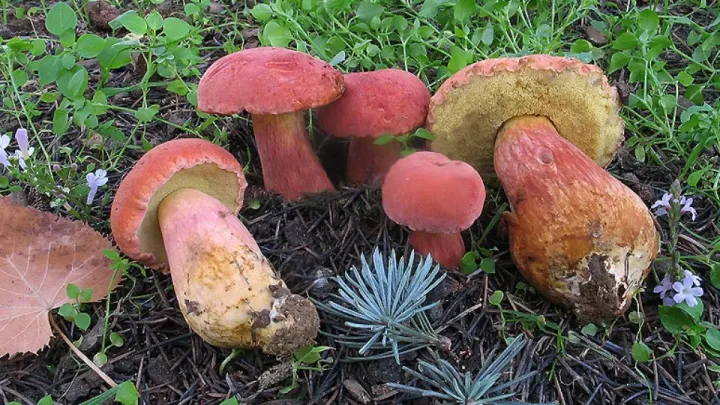
Xerocomus armeniacus is a cap fungus belonging to the Boletaceae family. A key visual characteristic is its dry cap, which can crack with age, revealing a yellowish flesh underneath the cuticle.
The cap color ranges from ocher-yellow to reddish-brown or brick-red. The cap diameter typically measures between 4 and 10 centimeters, with a shape that starts convex and becomes flatter over time.
The tube layer (hymenophore) is bright yellow, turning blue-green when pressed. This is an important diagnostic feature for identifying the species and distinguishing it from non-edible look-alikes.
The stem is cylindrical, often tapering towards the base, and colored in yellowish tones with a reddish bloom. The surface is usually smooth or slightly fibrous, lacking the reticulated pattern found in other boletes.
The flesh is firm and turns slightly blue upon bruising or cutting. The taste and odor are mild and pleasant, typical for edible members of the family.
Pathogen
It is crucial to clarify that Xerocomus armeniacus is not a plant pathogen or a disease. It is a mycorrhizal fungus that exists in symbiosis with trees, such as oaks, beeches, and conifers.
Biologically, the species belongs to the Basidiomycota division. It plays a vital role in forest ecosystems by participating in the decomposition of organic matter and nutrient exchange with higher plants.
The mycelium penetrates tree roots, facilitating the exchange of nutrients and water, which supports the growth of forest stands. It is a typical forest inhabitant rather than an agricultural pest.
In an agronomic context, confusing it with plant diseases is inaccurate. This fungus does not attack vegetables, grains, or fruit crops, and therefore requires no control measures or agricultural management.
Researching this species is important for mycology and forestry, as it serves as an indicator of forest ecosystem health and soil quality within wooded areas.
Conditions for development
Xerocomus armeniacus prefers warm, well-lit areas of the forest. It is most frequently found in deciduous forests dominated by oaks and beeches between July and October.
For active fruiting, the fungus requires sufficient air and soil humidity, along with stable average daily temperatures. During drought periods, the development of fruit bodies is significantly slowed.
The species thrives in moderately acidic or neutral soils rich in humus. It is commonly spotted at forest edges, along trails, and in clearings where sunlight encourages fungal growth.
Mycelial development occurs in the leaf litter and topsoil layers, where significant organic matter accumulates. These optimal conditions promote the formation of the mycorrhizal network.
Human activities, such as soil compaction or the excessive use of fungicides in nearby agricultural areas, can negatively impact the population density of this species.
Discussion
No discussions yet — be the first.