
Verrucaria muralis
Verrucaria muralis
Description
Symptoms
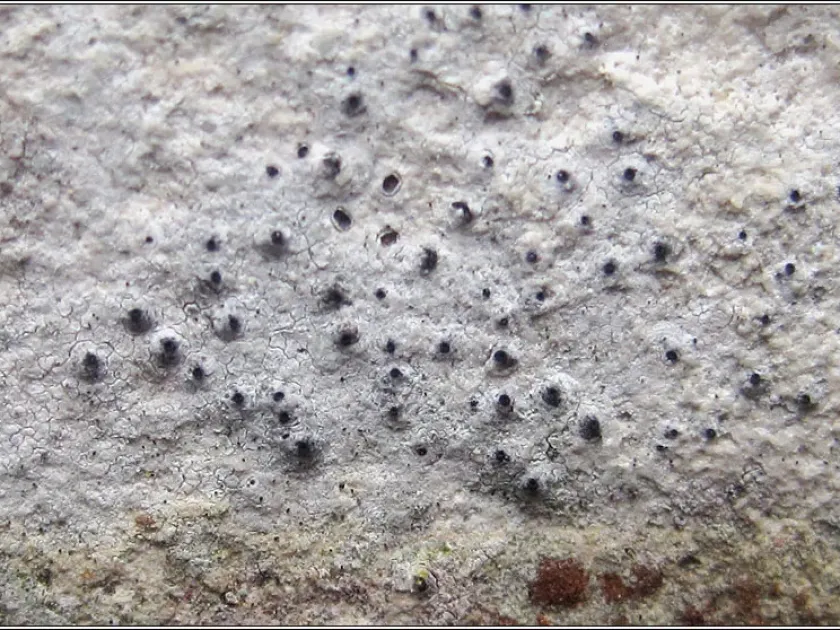
Verrucaria muralis appears as a thin, crust-like growth firmly attached to various stone or concrete substrates.
The visual signs include irregular grey or brownish patches with a finely granular or pitted texture covering the surface.
Tiny black dots, known as perithecia, are embedded within the crust, representing the fruiting bodies of the lichen.
When wet, these patches change color, becoming darker and more prominent, which makes them easier to spot during damp conditions.
The lichen is most commonly found on limestone walls, old bricks, and concrete foundations of farm buildings and storage structures.
Pathogen
This organism is not a plant pathogen or a disease-causing agent for agricultural crops, but rather a species of lichen.
It belongs to the family Verrucariaceae and functions through a symbiotic relationship between a fungus and an alga.
It does not infect or damage living plant tissues, meaning it poses no biological threat to field crops, vegetables, or fruit trees.
The life cycle is exclusively linked to the weathering of minerals and the acquisition of moisture from the atmosphere.
The fungal component provides the structure, while the algal partner performs photosynthesis to provide energy for survival.
Conditions for development
Verrucaria muralis thrives primarily on calcareous substrates, making limestone and concrete ideal environments for its colonization.
High humidity levels and sufficient moisture are crucial for its metabolic activity and subsequent spread across surfaces.
It is remarkably resilient to extreme temperatures and high solar radiation, allowing it to dominate exposed outdoor surfaces.
The spores of the lichen are easily dispersed by wind and splashing rainwater, leading to colonization of new porous areas.
Growth is generally slow, but it can quickly cover large areas if the environmental conditions remain consistently damp.
Why it matters
The damage caused by Verrucaria muralis is primarily limited to the biogenic weathering of construction materials.
By secreting lichen acids, it slowly breaks down the mineral components of the substrate, increasing the porosity of the stone or concrete.
Over time, this process leads to surface erosion, which can exacerbate physical degradation caused by freeze-thaw cycles.
While the lichen is harmless to plants, its growth on greenhouse frames or glass may reduce light penetration, affecting productivity.
The main impact is aesthetic and structural, requiring maintenance efforts to preserve the longevity of farm building infrastructure.
Protection
Mechanical removal is the most direct control method, using stiff brushes or pressure washers to strip the lichen from affected surfaces.
Chemical control involves the application of fungicides or specific stone biocide solutions that kill the lichen and inhibit spore germination.
Preventive maintenance includes painting surfaces with moisture-resistant or biocidal paints to prevent the lichen from gaining a foothold.
Improving local drainage and ensuring adequate ventilation can reduce surface dampness, making the area less attractive to lichen growth.
- Pressure washing with water.
- Application of stone-safe biocides.
- Painting surfaces with anti-fouling coatings.
- Regular structural inspections.
Discussion
No discussions yet — be the first.