
Typhula blight
Typhula ishikariensis
Description
Symptoms
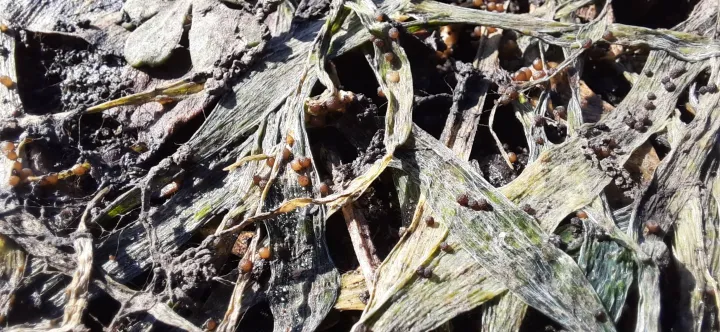
The most prominent symptom of Typhula blight appears immediately after snowmelt. A dense, white to grayish mat of fungal mycelium covers the affected leaves, often described as a felt-like appearance.
As the disease progresses, the plant tissues soften, lose their structural integrity, and eventually decay. Within the mycelial mat, small, dark brown to black sclerotia can be clearly observed.
The crown region is frequently destroyed, leading to the total death of the winter wheat or rye plant. When the disease is severe, it causes large, irregular patches of dead vegetation across the field.
Unlike other fungal infections, Typhula blight leaves the area looking bleached or grayish. The damaged crowns lose the ability to regenerate, meaning that even in mild springs, the plants cannot recover.
In addition to the mycelial growth, the presence of sclerotia scattered on the soil surface or embedded in the rotting leaf tissues serves as a definitive diagnostic sign of this particular pathogen.
Pathogen
The causal agent of Typhula blight is the basidiomycete fungus Typhula ishikariensis. This pathogen is one of the primary organisms responsible for the complex of diseases commonly referred to as snow mold.
The fungus is psychrophilic, meaning it thrives in cold environments, particularly under snow cover where temperatures remain slightly above freezing. It survives in the soil and on plant debris in the form of sclerotia.
Sclerotia are small, hard, dark structures of fungal tissue that can remain dormant in the soil for several years. They serve as the primary source of infection, germinating when conditions become favorable for fungal growth.
Once active, the fungus produces mycelium that colonizes the plant surface. It prefers moisture-rich environments and uses its enzymatic activity to degrade the plant's tissues, specifically targeting the crown and leaves.
The life cycle of the pathogen is intricately linked to winter conditions. The fungus utilizes the protective insulation of the snow layer to expand its mycelial network without being inhibited by extreme frost.
Conditions for development
The primary environmental driver for Typhula blight is persistent snow cover on unfrozen or lightly frozen soil. This creates a stable microenvironment with high humidity and temperatures near 0°C.
Autumn weather conditions are crucial; high rainfall leading into winter favors the initial infection. Plants that have entered the winter in an overly lush or overgrown state are significantly more susceptible.
Excessive nitrogen fertilization in the late autumn induces a growth spurt, leaving the plants with thin cell walls and high sugar content, which makes them an ideal food source for the encroaching fungus.
Agricultural practices such as minimal tillage or heavy crop residue left on the surface provide the necessary inoculum reservoir for the pathogen to survive from one season to the next.
Frequent winter thaws that are followed by new snow accumulation create a repeating cycle of growth for the fungus, exacerbating the spread and severity of the disease in the field.
Why it matters
The economic impact of Typhula blight is primarily driven by the loss of stand density. In severe cases, the damage is so extensive that the entire field must be replanted in the spring.
Sub-lethal infections still result in significantly reduced yields. Plants that survive are often stunted and fail to produce enough tillers, which prevents the crop from reaching its full yield potential.
The disease weakens the overall vigor of the crop, making the stand highly vulnerable to secondary stressors like spring drought, nutrient deficiencies, or other opportunistic soil-borne pathogens.
In regions with heavy snowfall, this disease acts as a major limitation for winter cereal production. The need for constant vigilance and protective treatments adds to the operational costs for farmers.
Furthermore, the patches left by the disease create an uneven field canopy, which complicates harvest operations and may encourage weed growth in the gaps left by the dead crops.
Protection
Effective management begins with proper agronomic practices. Avoid late-season nitrogen applications to ensure the crop does not enter the winter in an overly succulent and vulnerable state.
Crop rotation is essential to break the infection cycle. By rotating away from susceptible cereals for at least two to three years, the population of sclerotia in the soil can be reduced.
Seed treatments with systemic fungicides are critical for protecting the seedlings during the early establishment phase, which provides some level of insurance against early fungal colonization.
In high-risk areas, a preventative fungicide application in late autumn can significantly reduce the initial mycelial load before the snow cover becomes permanent.
- Deep incorporation of crop residues into the soil.
- Selection of winter-hardy and resistant cereal varieties.
- Optimal seeding timing to prevent excessive biomass before winter.
- Balanced fertilization, particularly with phosphorus and potassium.
Discussion
No discussions yet — be the first.