
Tuber oligospermum
Tuber oligospermum
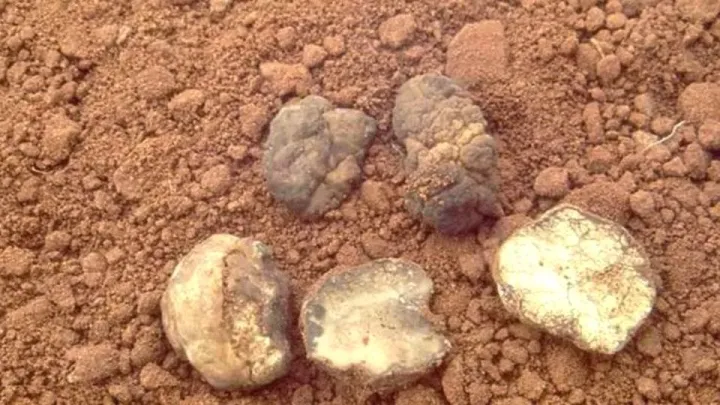
Description
Symptoms
Visual symptoms of Tuber oligospermum infection often manifest as stunted growth of the plant's above-ground parts. Leaves acquire a chlorotic hue and gradually turn yellow, starting from the lower levels.
The root system of the infected plant shows signs of necrosis. Dark spots or characteristic soft tissue areas may appear on the roots, which indicates the proteolytic activity of the fungus.
Upon examination of the root collar, one can notice a thin mycelial coating, which is often mistaken for mold. However, in the case of this pathogen, the coating has a specific structure associated with the microscopic fruiting bodies of the fungus.
Plants infected at an early age lag significantly in development and often die before the tillering phase. Adult specimens form weak, underdeveloped ears with low grain quality.
In the field, the disease manifests in patches, forming characteristic "bare spots" where plants appear suppressed or completely dead against the background of a healthy crop.
Pathogen
The causative agent of the disease is the fungus Tuber oligospermum, which belongs to a group of specific soil-borne pathogens. Although the genus Tuber is more commonly associated with mycorrhizal fungi (truffles), some of its representatives exhibit parasitic properties, infecting the root systems of agricultural crops.
The type of disease is classified as a soil-borne infection affecting the root zone. The pathogen can persist in the soil substrate for a long time as spores, waiting for favorable conditions to germinate and attack weakened plants.
The biology of the fungus involves the development of mycelium, which actively colonizes the rhizosphere of crops, gradually penetrating the root epidermis. This leads to a disruption in the normal uptake of water and nutrients from the soil.
The reproduction process of the pathogen is closely linked to soil moisture and the presence of plant debris, where the fungus can exist as a saprotroph before switching to active parasitism.
The fungus is resistant to temperature fluctuations, making it an extremely difficult object to eradicate using standard soil tillage methods.
Conditions for development
The development of the disease is most active in conditions of high soil moisture at moderate temperatures. Waterlogging in fields is the main triggering factor for the mass spread of the infection.
Soil pH plays an important role in the life cycle of Tuber oligospermum. Most species in this group prefer slightly alkaline or neutral soils, which is important to consider when planning agronomic measures.
The absence of crop rotation and monoculture promote the accumulation of the infectious agent in the soil horizon. Fungal spores can remain viable for several years even in the absence of a host plant.
Damage to the root system by pests or agricultural machinery opens the "gates" for fungal infection. This is why rhizosphere pests often act as vectors for the spread of the disease.
Unbalanced application of nitrogen fertilizers, which reduces plant immunity, also creates a favorable environment for the rapid development of the pathogen during critical growth phases.
Why it matters
The main danger lies in the total loss of the harvest during epiphytotic outbreaks of the disease. The pathogen not only destroys the root system but also releases toxins that poison the plant's vascular system.
A reduction in grain weight is an inevitable consequence of root damage. Even with mild infection, the commercial quality of the produce drops, making it unsuitable for food use due to the risk of mycotoxin accumulation.
The economic damage consists not only of crop loss but also of the need for expensive land reclamation and soil fungicide treatments to restore soil fertility.
The spread of the fungus across the field complicates the planning of subsequent planting seasons, as it requires mandatory use of cover crops or a long break in cultivating susceptible species.
The disturbance of the soil microbiome during mass reproduction of Tuber oligospermum suppresses beneficial microflora, which in the long term leads to soil depletion.
Protection
Effective protection starts with following crop rotation. It is recommended to alternate susceptible cereal crops with crops that are not hosts for this fungus (e.g., legumes or mustard).
The use of fungicides for seed treatment is a basic method of preventive protection. Preparations based on systemic active ingredients are capable of preventing early seedling infection.
Agronomic measures include deep plowing with soil inversion, which helps incorporate plant debris and reduce the spore population in the topsoil.
- Optimization of soil pH balance (liming if necessary).
- Monitoring of drainage systems to prevent waterlogging.
- Timely application of phosphorus-potassium fertilizers to strengthen the root system.
In case of detection of infection centers, their localization and treatment with biofungicides, which suppress pathogen development through antagonistic microflora, are recommended.
Discussion
No discussions yet — be the first.