
Northern corn leaf blight
Trichometasphaeria
Description
Symptoms
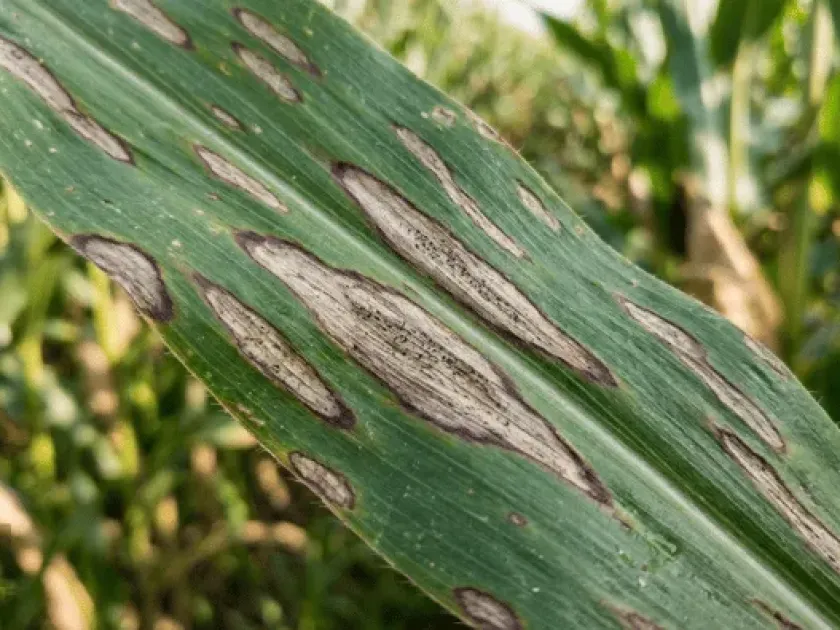
Initial symptoms of Northern corn leaf blight appear as small, elliptical, pale green or yellow-tan spots on the lower leaves. As the disease progresses, these spots expand into elongated, spindle-shaped lesions.
The center of the lesions typically becomes necrotic, turning gray-brown or olive-colored, often surrounded by a chlorotic halo. In high humidity, a velvety dark olive-colored mat of spores covers the lesion surface.
The infection progresses from the bottom leaves upward to the upper canopy and eventually the husks. Severe infestations give the field a burnt appearance, as the leaf tissues die and dry out prematurely.
Infected leaves lose their ability to photosynthesize, which significantly impairs the plant's metabolic processes. The lesions can weaken the leaf tissue, leading to structural instability and potential lodging of the plants during windy weather.
Symptoms are diagnostic and clearly visible during the mid-to-late vegetative stages. Early detection on the lower leaves is a critical indicator of the potential for a severe disease outbreak later in the season.
Pathogen
The disease is caused by the fungus Trichometasphaeria turcica (synonym Setosphaeria turcica), which belongs to the class Ascomycetes. It is widely known in agriculture as the pathogen responsible for Northern Corn Leaf Blight.
The fungus survives in soil and crop residues as mycelium and conidia, which remain viable for several seasons. Primary infection occurs when spores are dispersed by wind or rain splashes onto young corn leaves during the early growing stages.
The pathogen thrives in conditions of moderate temperature and high humidity. Throughout the growing season, multiple generations of conidia are produced, allowing the disease to spread rapidly across corn fields under favorable weather conditions.
The biological plasticity of the fungus allows it to adapt to various agro-climatic zones. The spores possess resilient cell walls that protect them against environmental stress, including UV radiation and dehydration.
The lifecycle includes both asexual (conidial) and sexual (ascospore) stages, which contributes to the genetic diversity of the pathogen and makes it challenging to breed corn varieties with permanent, broad-spectrum resistance.
Conditions for development
Optimal conditions for the development of Northern corn leaf blight include warm temperatures between 20°C and 28°C. The presence of free moisture on leaves (dew, fog, or rain) is essential for spore germination.
Extended periods of high relative humidity (above 90%) during the night are major drivers of infection. Frequent rainfall and cloud cover during the silking and grain-fill stages provide the ideal environment for the disease to flourish.
Dense crop stands create a microclimate that traps moisture and facilitates pathogen spread. Poor air circulation within the canopy allows the fungus to colonize the leaves more efficiently.
Crop residue management is a key factor, as infected stalks and leaves serve as a primary reservoir for the fungus. Reduced or no-till practices may increase the pathogen load if residues are left on the soil surface.
Balanced plant nutrition, particularly potassium, plays a role in plant defense. Conversely, excessive nitrogen can encourage succulent growth that is more susceptible to fungal penetration.
Why it matters
Northern corn leaf blight is considered a highly destructive disease, capable of reducing grain yields by 30% to 50% or more when environmental conditions favor epidemic development.
The primary economic impact stems from the drastic reduction in photosynthetic leaf area, which limits the plant's ability to fill the kernels. This results in small, underdeveloped ears and reduced test weight.
As the plant becomes physiologically stressed and weakened, it becomes more vulnerable to secondary pathogens, including ear rots and stalk rot fungi, which further degrade grain quality.
The disease reduces the quality of both grain and silage, impacting overall agricultural profitability. In severe cases, the entire plant may die before reaching physiological maturity, leading to total harvest losses.
Monitoring for the disease is essential, as the rapid spread of the fungus during peak vegetative phases can overwhelm large fields in a very short amount of time if left unchecked.
Protection
The most effective strategy for managing the disease is the use of genetically resistant corn hybrids. Seed companies offer various levels of resistance that should be considered based on local field history.
Agronomic practices, such as deep plowing to bury crop residues, help speed up decomposition and reduce the inoculum level in the soil. A well-planned crop rotation is also recommended to break the life cycle of the pathogen.
Fungicide applications, particularly using triazoles and strobilurins, can be effective if applied early. Treatments should be timed based on scouting results to prevent the infection from spreading to the upper canopy.
Optimizing plant density ensures better air circulation, which helps keep the leaf canopy dry. Maintaining balanced soil fertility helps the corn plants maintain robust health and natural immunity.
Integrated pest management (IPM) is crucial. Consistent field monitoring during critical growth stages allows farmers to make informed decisions about intervention, ensuring the protection of the crop throughout the season.
Discussion
No discussions yet — be the first.