
Tricholoma stans
Tricholoma stans
Description
Symptoms
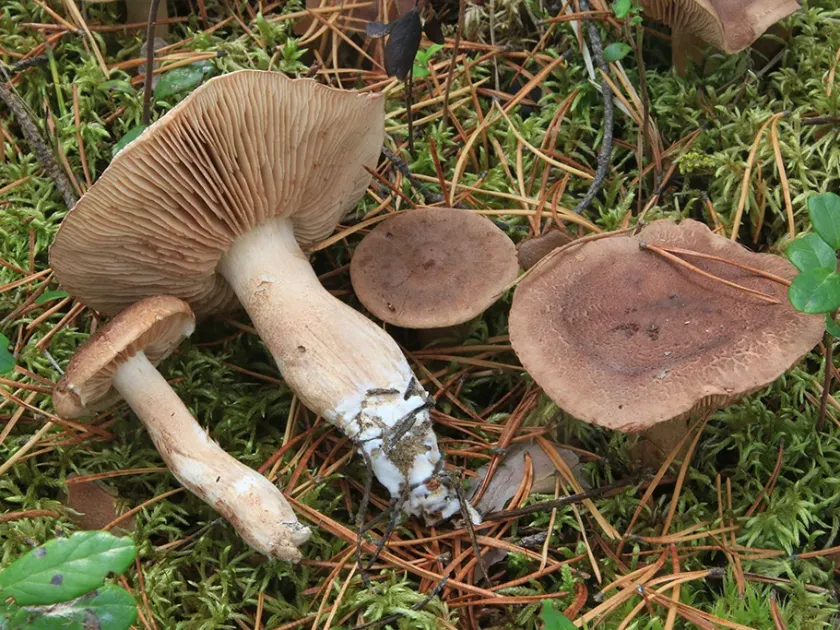
The fruit bodies of Tricholoma stans have a typical shape for the genus. The cap is initially convex and becomes expanded with age, showing a distinct reddish-brown or chestnut color.
The gills are crowded and attached to the stem, sometimes with a small notch. They appear white in young specimens and may develop darker spots as the fungus matures.
The stem is robust and firm, often featuring a distinct ring-like zone or transition area under the cap. The internal flesh has a characteristic mealy or mild odor.
When identifying the fungus, one must look for the reddish-brown cap color and the dense, "standing" appearance of the stem. These features help distinguish it from other mushroom species.
- Cap diameter: 4–10 cm.
- Color: reddish-brown.
- Spore print: white.
Pathogen
Tricholoma stans is not a phytopathogenic agent affecting agricultural crops. It is a basidiomycetous fungus belonging to the Tricholomataceae family, which typically lives as a saprotroph or mycorrhizal partner in forests.
Biologically, the fungus forms symbiotic relationships mainly with coniferous tree species. It does not induce plant diseases; therefore, the term "disease" is not scientifically applicable to this species in agricultural practice.
The fungus acts as a decomposer of organic litter in its habitat. In agricultural production, this species poses no threat to field crops, vegetables, or ornamental plants.
Morphologically, the fungus features a dense fruit body and specific cap pigmentation. It is ecologically restricted to woodland areas, which prevents any interaction with cultivated agricultural environments.
Scientific consensus classifies this species as inedible or potentially toxic, which necessitates caution for those foraging in areas adjacent to agricultural lands.
Conditions for development
Tricholoma stans prefers sandy or loamy soils typical of pine forests. Its growth and fruit body development are triggered by cool and humid conditions during the autumn season.
The mycelium requires the presence of coniferous needle litter for optimal growth. As it is not a pathogen, it does not depend on a host plant for its life cycle.
The mycelium is highly resilient and can persist in soil for many years. Spore dispersal is facilitated primarily by wind and rainfall patterns within the forest canopy.
The species is rarely found outside forested areas, as it relies on specific mycorrhizal associations with coniferous trees that are absent in typical agricultural fields.
High soil and air moisture during late September and October promote the emergence of fruiting bodies, making them more apparent during these periods.
Why it matters
The species does not cause any harm to the agricultural sector. It does not infect roots, stems, or leaves, nor does it impact the quality or yield of commercial agricultural produce.
The main issue with Tricholoma stans is the risk of accidental harvest by foragers due to its similarity to edible species. Consumption can lead to gastrointestinal discomfort and toxicity.
In forestry, the fungus plays a beneficial role in nutrient cycling by decomposing organic debris. It does not cause damage to healthy trees or contribute to tree diseases.
The application of fungicides against this species is entirely unnecessary, as it does not constitute an economic threat to farming or forestry operations.
In summary, Tricholoma stans is an integral part of the natural forest ecosystem and carries no negative significance for agricultural or horticultural practices.
Protection
No specific protection or control measures are required, as the species is not a pest or a crop disease. Agricultural pest management programs do not target this fungus.
Prevention relies on public education regarding mushroom identification. It is vital to learn how to distinguish non-edible species from edible varieties to prevent accidental poisoning.
If the fungus is sighted near fields or forest edges, no chemical or physical control is warranted. Natural ecological competition effectively limits its population size.
Agricultural techniques such as plowing or fertilizer application are not intended to manage this species, as it does not interfere with the health or yield of crop plants.
The best "control" measure is simple awareness and adhering to safety protocols when foraging in pine-dominated forest areas to avoid confusion with edible mushrooms.
Discussion
No discussions yet — be the first.